

The Best 2V0-17.25 Exam Study Material Premium Files and Preparation Tool (Jul-2026)
Get Instant Access to 2V0-17.25 Practice Exam Questions
NEW QUESTION # 81
An administrator is tasked to monitor business-critical Virtual Machines (VMs) within a VMware Cloud Foundation (VCF) fleet.
The following requirements must be met:
- The existing policy named "Organization Policy" must be used for the
entire environment.
- Only business-critical VMs must be assigned additional metrics.
- Business-critical VMs will be organized based on a naming schema.
Which three steps must an administrator complete to satisfy the requirements? (Choose three.)
- A. Assign the Custom Group to the new policy.
- B. Create a Custom Datacenter and add the business-critical VMs.
- C. Assign the Custom Datacenter to the new policy.
- D. Create a new policy under "Base Settings" and enable the additional metrics.
- E. Create a Custom Group and add the business-critical VMs.
- F. Create a new policy under "Organization Policy" and enable the additional metrics.
Answer: A,E,F
Explanation:
Create a child policy under the existing Organization Policy (C): Policies can inherit settings from parent policies. By creating a child policy under Organization Policy, administrators can apply additional metrics without overriding global policies.
Create a Custom Group (F): Custom Groups allow dynamic membership based on naming conventions or criteria. In this case, business-critical VMs can be grouped automatically by naming schema.
Assign the Custom Group to the new child policy (B): This ensures that the additional metrics only apply to the business-critical VMs in the Custom Group.
NEW QUESTION # 82
DRAG DROP
Match each troubleshooting task with its relevant procedure or tool.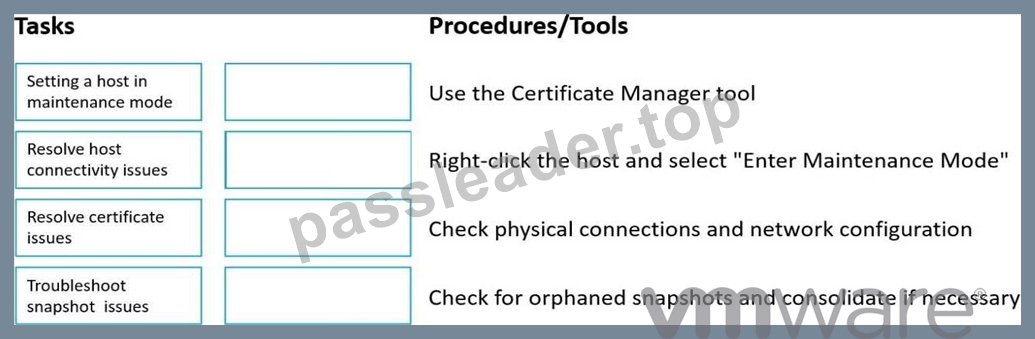
Answer:
Explanation: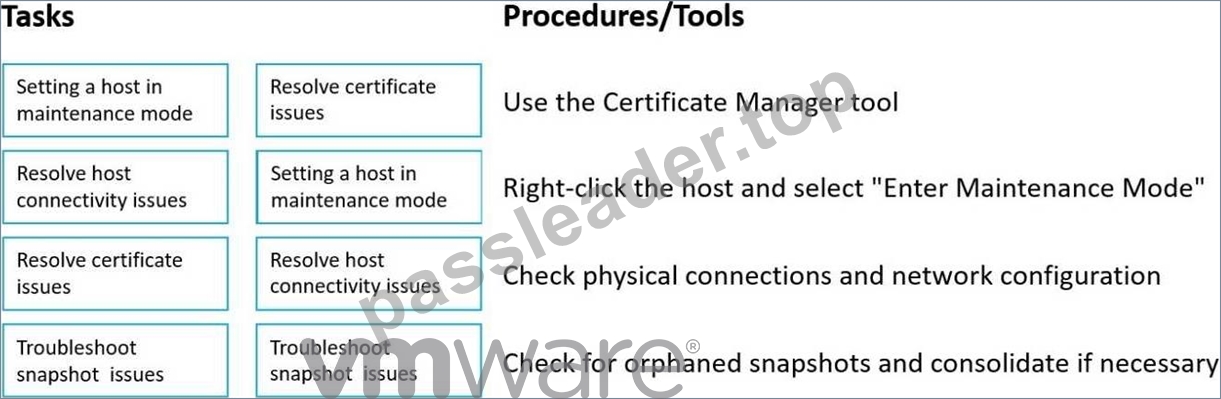
NEW QUESTION # 83
Which of the following methods can help secure and simplify the management of root or administrative credentials for multiple ESXi hosts?
- A. Leveraging vCenter Single Sign-On to authenticate users
- B. Using the same root password across all hosts for easy recall
- C. Joining ESXi hosts to an Active Directory domain
- D. Configuring Lockdown Mode to enforce centralized management
Answer: A,C,D
Explanation:
Integrating ESXi with Active Directory (A) and vCenter SSO (C) centralizes credentials, while Lockdown Mode (D) enforces that management occurs via vCenter. Using the same root password everywhere (B) is a security risk.
NEW QUESTION # 84
Which three tasks must an administrator complete to enable Audit Events in VCF Operations?
(Choose three.)
- A. Enable Audit Events in VCF Operations.
- B. Enable Audit Events in VCF Operations for Logs.
- C. Install VCF Operations for Logs.
- D. Configure vCenter server instances in VCF Operations for Logs.
- E. Configure VCF Operations Content Pack in VCF Operations for Logs.
- F. Configure VCF Operations for Logs Integration in VCF Operations.
Answer: A,C,F
Explanation:
Enable Audit Events in VCF Operations so the feature is active in the platform.
Install VCF Operations for Logs, since audit events are captured and processed through the logging component.
Configure VCF Operations for Logs Integration in VCF Operations, ensuring that the audit event data flows into the operations console for visibility and compliance.
NEW QUESTION # 85
When considering standardization in VMware environments, which of the following are aligned with industry or regulatory best practices?
- A. Regular audits and patching guided by ITIL processes
- B. CO2 emission compliance
- C. Role-based access control following ISO 27001 principles
- D. Hardening guides that align with NIST standards
Answer: A,C,D
Explanation:
NIST-based hardening guides, ISO 27001-aligned RBAC, and ITIL-driven audits and patching all intersect with VMware security and operational best practices. CO2 emissions (C) are environmental considerations, not typically covered under VMware's security/operational standards.
NEW QUESTION # 86
An administrator is tasked with resetting the identity management of a VMware Cloud Foundation (VCF) instance after initial configuration. Which two steps should the administrator perform? (Choose two.)
- A. Disable Single Sign-On.
- B. Revert the VCF Single Sign-On configuration.
- C. Delete all of the Single Sign-On configurations, including the identity broker configuration.
- D. Reconfigure the VCF Single Sign-On.
- E. Delete all of the Single Sign-On configurations, excluding the provisioned user and groups.
Answer: C,D
Explanation:
Resetting identity management in VCF requires removal of existing identity configurations, including external identity providers and the Identity Broker configuration. The VCF documentation states that to reset identity services, administrators must remove the SSO configuration, including broker settings, and then reconfigure SSO.
Option B ensures complete cleanup of identity integrations.
Option C re-establishes identity management with the correct configuration.
Disabling (D) or reverting (E) is not a supported reset method. Leaving provisioned users/groups (A) would not fully reset identity management.
NEW QUESTION # 87
An administrator has been tasked to create a new cluster in an existing VMware Cloud Foundation (VCF) instance. The hosts within the cluster have different generation Intel processors. What feature must be configured on the cluster to ensure VMware Distributed Resource Scheduler (DRS) is able to automatically move Virtual Machines within the cluster?
- A. Host Affinity Rules
- B. Enhanced vMotion Compatibility
- C. vSphere Fault Tolerance
- D. vSphere Availability
Answer: B
Explanation:
EVC ensures vMotion compatibility across hosts with different CPU generations by exposing a uniform set of CPU features to all virtual machines in the cluster.
NEW QUESTION # 88
Which IT standards or best practices often intersect with VMware security and operations?
- A. COBIT for governance and management
- B. NIST guidelines for secure configurations
- C. SNMP for live VM migration
- D. ISO 27001 for information security management
Answer: A,B,D
Explanation:
NIST, COBIT, and ISO 27001 are commonly applied standards in virtualized environments. SNMP (Simple Network Management Protocol) is a protocol used for network management/monitoring, not specifically for live VM migration.
NEW QUESTION # 89
When implementing a hybrid approach that combines vSAN with external NAS or SAN datastores, which storage design principle should generally be followed?
- A. Do not place the same VM's disks on both vSAN and external storage
- B. Configure ephemeral bridging between vSAN objects and LUNs
- C. Use a single datastore cluster containing vSAN and SAN for SIOC
- D. Deploy multiple active cluster master nodes for vSAN
Answer: A
Explanation:
Typically, a given VM's disks should reside entirely on a single storage type (vSAN or SAN/NAS), rather than split across different storage solutions to avoid complexity. SIOC is for block-based LUNs, ephemeral bridging (C) isn't supported, and vSAN doesn't have multiple "active cluster master nodes" (D) in that sense.
NEW QUESTION # 90
Which statement describes a Container Storage Interface (CSI) in vSphere Supervisor?
- A. It is a plug-in that allows providers to expose storage as persistent storage.
- B. It is a plug-in that is required for ephemeral storage.
- C. It is a plug-in that is only used for clusters which require cloud native storage.
- D. It is a plug-in that only works with vSphere object storage.
Answer: A
Explanation:
The vSphere CSI driver allows vSphere storage to be exposed as persistent storage to containerized applications running on Kubernetes clusters. The driver implements the Kubernetes CSI specification and enables dynamic provisioning, attach/detach, and snapshot operations for persistent volumes.
NEW QUESTION # 91
Which statement describes Harbor?
- A. Harbor requires all images be pulled from GitHub for validation.
- B. Harbor is an image scanner used to verify that images are free from vulnerabilities and patches.
- C. Harbor, formerly known as Bitnami, is an image catalog for downloading verified open-source packages.
- D. Harbor is an open source registry that secures artifacts with policies and RBAC, scans images for vulnerabilities, and signs images as trusted.
Answer: D
Explanation:
According to the VCF 9.0 Container Registry Documentation, Harbor is defined as:
"Harbor is an open source registry that secures artifacts with policies and role-based access control, ensures images are scanned and free from vulnerabilities, and signs images as trusted." This description aligns exactly with option A. Harbor is not Bitnami (B), though it integrates with open-source images. It includes vulnerability scanning but is not only an image scanner (C). It does not require GitHub as a source (D); Harbor can integrate with multiple registries.
Therefore, Harbor's primary role within VCF is to act as a secure image registry with RBAC, scanning, and signing capabilities.
NEW QUESTION # 92
What is the function of Velero?
- A. Monitor cluster services.
- B. Publish DNS records for applications to DNS servers.
- C. Backup and restore Kubernetes clusters.
- D. Collect data and logs from different sources, unify them, and send them to multiple destinations.
Answer: C
Explanation:
Velero is an open-source Kubernetes backup and restore solution integrated into VMware Cloud Foundation for Kubernetes management. The VCF 9.0 Kubernetes Services Documentation describes it as:
"Velero provides backup, recovery, and migration of Kubernetes cluster resources and persistent volumes." Key functionality includes:
* Backup and restore of Kubernetes objects such as deployments, services, and namespaces.
* Data protection for persistent volumes via storage snapshots.
* Migration capabilities across clusters.
Analysis of incorrect options:
* Publishing DNS records (A) is handled by CoreDNS or external DNS integrations, not Velero.
* Monitoring cluster services (B) is the role of Kubernetes health checks and observability tools like Prometheus, not Velero.
* Collecting logs and data (C) is done by logging stacks such as Fluent Bit or VCF Operations for Logs.
Therefore, Velero's primary role is backup and restore of Kubernetes clusters.
References: VMware Cloud Foundation 9.0 - Kubernetes Services and Data Protection (Velero integration).
NEW QUESTION # 93
An administrator is preparing to deploy a new VMware Cloud Foundation (VCF) fleet to an environment that does not have Internet access. Which two binaries must be uploaded to the VCF Installer appliance before initiating the deployment? (Choose two.)
- A. NSX
- B. Lifecycle Manager
- C. VCF Operations
- D. ESX
- E. Identity Broker
Answer: A,C
Explanation:
In VCF 9.x, air-gapped bring-up requires staging the required binaries in the VCF Installer. The documented list explicitly includes NSX and VCF Operations among the components to upload. The product guide states:
" VMware Cloud Foundation required binaries include... NSX ... VMware Cloud Foundation Operations ... vCenter ... SDDC Manager..." (exact list excerpt). This list does not call for ESX images or the legacy "Lifecycle Manager." Therefore, from the given options the two binaries that must be uploaded are NSX and VCF Operations .
ESX is pre-imaged on hosts per preparation guidance and is not a required VCF Installer binary; "Lifecycle Manager" is not used in VCF 9.0 bring-up.
NEW QUESTION # 94
An administrator is tasked with deploying a new VMware vSAN backed vSphere cluster.
- The existing VMware Cloud Foundation (VCF) instance has two workload
domains.
- Each workload domains has one VMware vSphere cluster.
- The administrator is required to lifecycle and scale the components
related to the new vSphere cluster separate from the existing clusters.
Which action must the administrator take when deploying the new cluster?
- A. Deploy the new vSphere cluster as a new workload domain with shared NSX within the existing VCF instance.
- B. Deploy the new vSphere cluster as a new workload domain with a new NSX instance within the existing VCF instance.
- C. Deploy the new vSphere cluster on one of the non-management workload domains within the existing VCF instance.
- D. Deploy the new vSphere cluster on one of the existing workload domains within the existing VCF instance.
Answer: B
Explanation:
Deploying the new vSphere cluster as a separate workload domain with its own NSX instance ensures that lifecycle management and scaling of the cluster and its associated components are fully isolated from the existing workload domains, which meets the requirement for independent management.
NEW QUESTION # 95
What is the primary use case for Aria Operations within the VMware Aria Suite?
- A. To manage and analyze log data from various sources
- B. To enable network virtualization and security.
- C. To automate workload deployments across multiple cloud environments.
- D. To provide comprehensive monitoring, analytics, and performance management of the cloud infrastructure.
Answer: D
Explanation:
Aria Operations (formerly known as vRealize Operations) is used to monitor, analyze, and manage the performance of cloud infrastructures, providing insights into capacity, utilization, and overall health. It helps in optimizing resources, preventing downtime, and ensuring the smooth running of applications and services in a VMware environment.
NEW QUESTION # 96
Which technology is primarily used to separate traffic and provide Layer 2 isolation in a vSphere virtual network environment?
- A. Jumbo frames
- B. VMware Tools
- C. VLAN tagging
- D. NIC teaming
Answer: C
Explanation:
VLAN tagging is used to isolate traffic at Layer 2 within virtual switches, ensuring network segmentation and security.
NEW QUESTION # 97
An administrator needs to scale an NSX Edge cluster by adding additional Edge nodes.
Which three steps must be taken before scaling an Edge cluster from SDDC Manager? (Choose three.)
- A. Assign two Tunnel Endpoint (TEP) addresses for each Edge node.
- B. Assign a unique management IP for each Edge node.
- C. Place the Edge cluster in maintenance mode prior to expanding.
- D. Verify DNS records have been added for each new Edge node.
- E. Add an additional NSX VDS uplink for each Edge node being added.
Answer: A,B,D
Explanation:
Comprehensive and Detailed Explanation From Exact Extract:
When scaling an NSX Edge cluster in VMware Cloud Foundation using SDDC Manager, the following preparatory steps are explicitly required as per the official documentation:
Assign a unique management IP for each Edge node (A): Each new Edge node must have its own unique management IP address for proper identification and network communication.
Assign two Tunnel Endpoint (TEP) addresses for each Edge node (B): Two TEP addresses are needed for overlay network connectivity to ensure redundancy and optimal traffic flow.
Verify DNS records have been added for each new Edge node (D): Proper DNS records must exist for management and operational connectivity, as DNS resolution is critical for Edge node communication and cluster integration.
Adding uplinks or placing the Edge cluster in maintenance mode are not prerequisites for adding new Edge nodes, according to the preparation requirements detailed in VMware documentation.
NEW QUESTION # 98
......
Validate your Skills with Updated 2V0-17.25 Exam Questions & Answers and Test Engine: https://www.passleader.top/VMware/2V0-17.25-exam-braindumps.html
Reliable Study Materials & Testing Engine for 2V0-17.25 Exam Success!: https://drive.google.com/open?id=1JpHVIVaiOgRrN7a7_Q7bJlaiTsjQNBg4