

Verified C1000-130 dumps Q&As 100% Pass in First Attempt Guaranteed Updated Dump from PassLeader
Pass IBM Certified Administrator C1000-130 Exam With 115 Questions
IBM Cloud Pak for Integration V2021.2 is a comprehensive integration platform that allows users to connect applications, data, and devices across multiple environments. This platform is designed to help organizations streamline their integration processes and accelerate their digital transformation initiatives. The IBM C1000-130 certification exam is designed to ensure that IT professionals have the necessary skills and knowledge to effectively manage and administer this integration platform.
NEW QUESTION # 12
What ate the two possible options to upgrade Common Services from the Extended Update Support (EUS) version (3.6.x) to the continuous delivery versions (3.7.x or later)?
- A. Click the Update button on the Details page of the common-services operand.
- B. Click the Update button on the Details page of the IBM Cloud Pak Founda-tional Services operator.
- C. Use the OpenShift web console to change the operator channel from stable-v1 to v3.
- D. Select the Update Common Services option from the Cloud Pak Administration Hub console.
- E. Run the script provided by IBM using links available in the documentation.
Answer: D,E
NEW QUESTION # 13
Before upgrading the Foundational Services installer version, the installer catalog source image must have the correct tag. To always use the latest catalog click on where the text 'latest' should be inserted into the image below?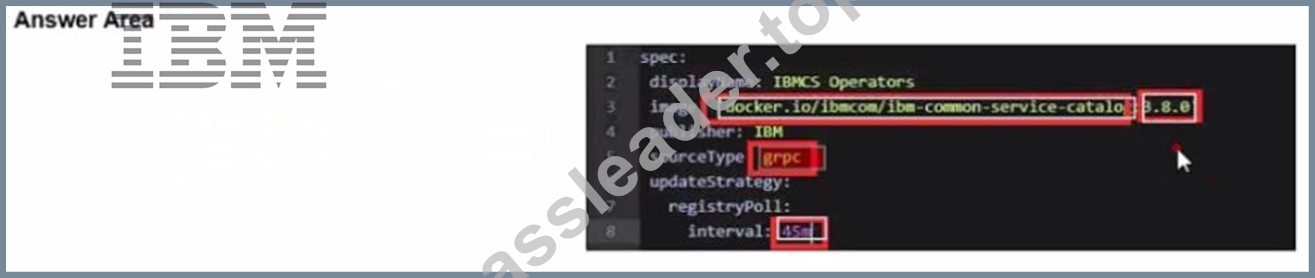
Answer:
Explanation: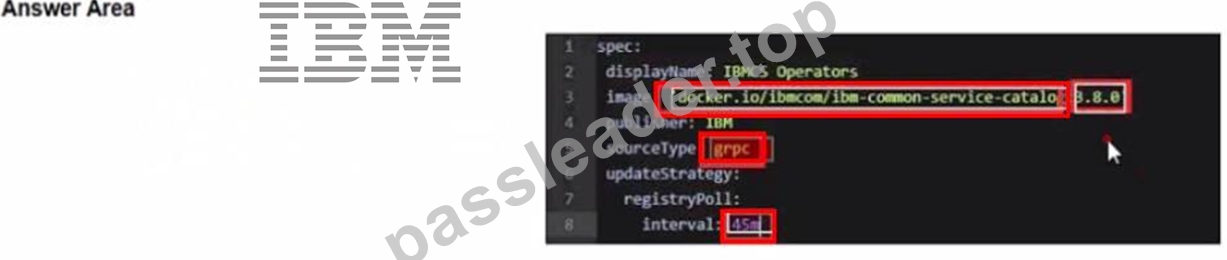
NEW QUESTION # 14
Which queue manager includes a pair of pods, one of which is the active queue manager and the other of which is a standby?
- A. Multi-instance
- B. Single Resilient
- C. Replicated Data
- D. Native HA
Answer: A
Explanation:
In IBM Cloud Pak for Integration (CP4I) v2021.2, IBM MQ provides multiple high-availability (HA) deployment options. A multi-instance queue manager consists of a pair of pods:
One active queue manager (handling message processing).
One standby queue manager (ready to take over if the active instance fails).
The standby instance continuously monitors the active queue manager, and if it detects a failure, it automatically takes over, ensuring minimal downtime and high availability.
Why the other options are incorrect:
A . Native HA - Incorrect
Native HA (Highly Available) queue managers use persistent storage and multiple replicas for redundancy but do not rely on an active-standby pod setup. Instead, they use Raft consensus for leader election and failover.
They are different from multi-instance queue managers, which explicitly have one active and one standby pod.
C . Single Resilient - Incorrect
A Single Resilient queue manager has only one instance running and recovers using persistent storage, but it does not have a standby pod for immediate failover.
D . Replicated Data - Incorrect
"Replicated Data" is not a specific IBM MQ HA mode. Instead, Native HA queue managers use replicated data across multiple pods to ensure resilience.
IBM Cloud Pak for Integration (CP4I) v2021.2 Administration Reference:
IBM MQ Multi-Instance Queue Manager Documentation
IBM Cloud Pak for Integration - High Availability Configurations
OpenShift Deployment of IBM MQ
NEW QUESTION # 15
When using the Operations Dashboard, which of the following is supported for encryption of data at rest?
- A. base64
- B. NFS
- C. AES128
- D. Portworx
Answer: D
Explanation:
https://www.ibm.com/docs/en/cloud-paks/cp-integration/2020.3?topic=configuration-installation
NEW QUESTION # 16
How can OLM be triggered to start upgrading the IBM Cloud Pak for Integration Platform Navigator operator?
- A. Navigate to the Installed Operators, select the Platform Navigator operator and select the latest channel version on the Subscription tab.
- B. Open the Platform Navigator web interface and select Update from the main menu. In IBM Cloud Pak for Integration (CP4I) v2021.2, the Operator Lifecycle Manager (OLM) manages operator upgrades in OpenShift. The IBM Cloud Pak Platform Navigator operator is updated through the OLM subscription mechanism, which controls how updates are applied.
- C. Navigate to the Installed Operators, select the Platform Navigator operator and click the Upgrade button on the Details page.
- D. Navigate to the Installed Operators, select the Platform Navigator operator, select the operand instance, and select Upgrade from the Actions list.
Answer: A
Explanation:
Correct
Explanation:
To trigger OLM to start upgrading the Platform Navigator operator, follow these steps:
Go to the OpenShift Web Console.
Navigate to Operators > Installed Operators.
Select the Platform Navigator operator from the list.
Click on the Subscription tab.
Change the channel version to the latest available version.
OLM will detect this change and automatically trigger the upgrade process.
✅ Why this is correct?
OLM follows the subscription model, where the selected channel dictates the upgrade path.
By selecting a newer channel, OLM automatically pulls and installs the latest available version.
Explanation of Incorrect Options:
❌ A. Navigate to the Installed Operators, select the Platform Navigator operator and click the Upgrade button on the Details page.
There is no direct Upgrade button on the Details page for OLM-managed operators.
Instead, upgrades are controlled via subscriptions and channels.
❌ B. Navigate to the Installed Operators, select the Platform Navigator operator, select the operand instance, and select Upgrade from the Actions list.
Operand instances (e.g., Platform Navigator deployment) do not control operator upgrades.
The operator itself must be upgraded through OLM at the subscription level.
❌ D. Open the Platform Navigator web interface and select Update from the main menu.
The Platform Navigator web UI does not have an option to trigger operator upgrades.
Operator management is handled within OpenShift OLM, not inside the application interface.
IBM Cloud Pak for Integration (CP4I) v2021.2 Administration Reference:
IBM Cloud Pak for Integration Operator Management: IBM Docs - Managing Operators Red Hat OpenShift OLM Documentation: Upgrading Operators via Subscription IBM Platform Navigator Installation & Upgrade Guide: IBM Docs - Platform Navigator Final answer:
✅ C. Navigate to the Installed Operators, select the Platform Navigator operator and select the latest channel version on the Subscription tab.
NEW QUESTION # 17
Which CLI command will retrieve the logs from a pod?
- A. oc retrieve logs ...
- B. oc logs ...
- C. oc describe ...
- D. oc get logs ...
Answer: B
Explanation:
In IBM Cloud Pak for Integration (CP4I) v2021.2, which runs on Red Hat OpenShift, administrators often need to retrieve logs from pods to diagnose issues or monitor application behavior. The correct OpenShift CLI (oc) command to retrieve logs from a specific pod is:
sh
CopyEdit
oc logs <pod_name>
This command fetches the logs of a running container within the specified pod. If a pod has multiple containers, the -c flag is used to specify the container name:
sh
CopyEdit
oc logs <pod_name> -c <container_name>
Explanation of Other Options:
A . oc get logs → Incorrect. The oc get command is used to list resources (such as pods, deployments, etc.), but it does not retrieve logs.
C . oc describe → Incorrect. This command provides detailed information about a pod, including events and status, but not logs.
D . oc retrieve logs → Incorrect. There is no such command in OpenShift CLI.
IBM Cloud Pak for Integration (CP4I) v2021.2 Administration Reference:
IBM Cloud Pak for Integration Logging and Monitoring
Red Hat OpenShift CLI (oc) Reference
IBM Cloud Pak for Integration Troubleshooting
NEW QUESTION # 18
Which storage type is supported with the App Connect Enterprise (ACE) Dash-board instance?
- A. Ephemeral storage
- B. File storage
- C. Raw block storage
- D. Flash storage
Answer: B
Explanation:
In IBM Cloud Pak for Integration (CP4I) v2021.2, App Connect Enterprise (ACE) Dashboard requires persistent storage to maintain configurations, logs, and runtime data. The supported storage type for the ACE Dashboard instance is file storage because:
It supports ReadWriteMany (RWX) access mode, allowing multiple pods to access shared data.
It ensures data persistence across restarts and upgrades, which is essential for managing ACE integrations.
It is compatible with NFS, IBM Spectrum Scale, and OpenShift Container Storage (OCS), all of which provide file system-based storage.
Why the other options are incorrect:
A . Ephemeral storage - Incorrect
Ephemeral storage is temporary and data is lost when the pod restarts or gets rescheduled.
ACE Dashboard needs persistent storage to retain configuration and logs.
B . Flash storage - Incorrect
Flash storage refers to SSD-based storage and is not specifically required for the ACE Dashboard.
While flash storage can be used for better performance, ACE requires file-based persistence, which is different from flash storage.
D . Raw block storage - Incorrect
Block storage is low-level storage that is used for databases and applications requiring high-performance IOPS.
ACE Dashboard needs a shared file system, which block storage does not provide.
IBM Cloud Pak for Integration (CP4I) v2021.2 Administration Reference:
IBM App Connect Enterprise (ACE) Storage Requirements
IBM Cloud Pak for Integration Persistent Storage Guide
OpenShift Persistent Volume Types
NEW QUESTION # 19
Before upgrading the Foundational Services installer version, the installer catalog source image must have the correct tag. To always use the latest catalog click on where the text 'latest' should be inserted into the image below?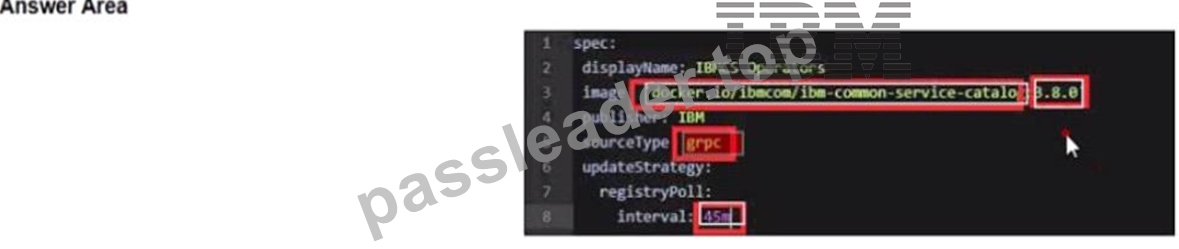
Answer:
Explanation: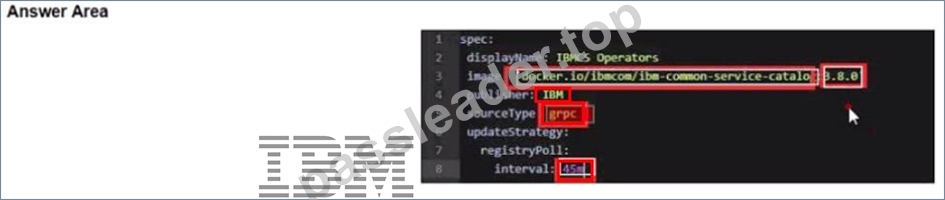
NEW QUESTION # 20
An administrator has just installed the OpenShift cluster as the first step of installing Cloud Pak for Integration.
What is an indication of successful completion of the OpenShift Cluster installation, prior to any other cluster operation?
- A. The OpenShift Admin console can be opened with the default user and will display the cluster statistics.
- B. The command "which oc" shows that the OpenShift Command Line Interface(oc) is successfully installed.
- C. The duster credentials are included at the end of the /.openshifl_install.log file.
- D. The command "oc get nodes" returns the list of nodes in the cluster.
Answer: D
Explanation:
After successfully installing an OpenShift cluster, the most reliable way to confirm that the cluster is up and running is by checking the status of its nodes. This is done using the oc get nodes command.
The command oc get nodes lists all the nodes in the cluster and their current status.
If the installation is successful, the nodes should be in a "Ready" state, indicating that the cluster is functional and prepared for further configuration, including the installation of IBM Cloud Pak for Integration (CP4I).
Analysis of the Options:
Option A (Incorrect - which oc): This only verifies that the OpenShift CLI (oc) is installed on the local system, but it does not confirm the cluster installation.
Option B (Incorrect - Checking /.openshift_install.log): While the installation log may indicate a successful install, it does not confirm the operational status of the cluster.
Option C (Correct - oc get nodes): This command confirms that the cluster is running and provides a status check on all nodes. If the nodes are listed and marked as "Ready", it indicates that the OpenShift cluster is successfully installed.
Option D (Incorrect - OpenShift Admin Console Access): While the OpenShift Web Console can be accessed if the cluster is installed, this does not guarantee that the cluster is fully operational. The most definitive check is through the oc get nodes command.
IBM Cloud Pak for Integration (CP4I) v2021.2 Administration Reference:
IBM Cloud Pak for Integration Installation Guide
Red Hat OpenShift Documentation - Cluster Installation
Verifying OpenShift Cluster Readiness (oc get nodes)
NEW QUESTION # 21
An account lockout policy can be created when setting up an LDAP server for the Cloud Pak for Integration platform. What is this policy used for?
- A. It restricts access to the account if multiple login attempts fail.
- B. It prompts the user to change the password.
- C. It warns the administrator if multiple login attempts fail.
- D. It deletes the user account.
Answer: B
NEW QUESTION # 22
Which statement is true about App Connect Designer?
- A. Only one instance of App Connect Designer can be created in a namespace.
- B. Multiple instances of App Connect Designer can be created in a namespace.
- C. App Connect Designer must be linked to a toolkit for validation.
- D. For each App Connect Designer instance, a corresponding toolkit instance must be created.
Answer: B
NEW QUESTION # 23
OpenShift supports forwarding cluster logs to which external third-party system?
- A. Apache Lucene.
- B. Apache Solr.
- C. Kafka Broker.
- D. Splunk.
Answer: C
NEW QUESTION # 24
Which diagnostic information must be gathered and provided to IBM Support for troubleshooting the Cloud Pak for Integration instance?
- A. Platform Navigator event logs.
- B. Cloud Pak For Integration activity logs.
- C. Integration tracing activity reports.
- D. Standard OpenShift Container Platform logs.
Answer: B
NEW QUESTION # 25
An administrator is looking to install Cloud Pak for Integration on an OpenShift cluster. What is the result of executing the following?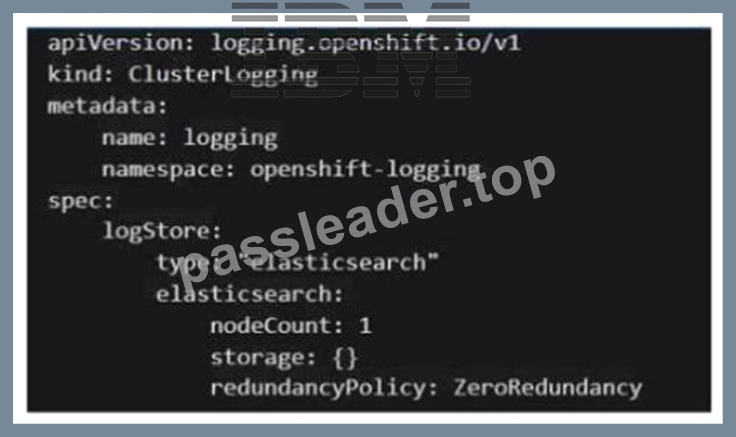
- A. A single infrastructure node with persisted ElasticSearch.
- B. A single node ElasticSearch cluster with no persistent storage.
- C. A single node ElasticSearch cluster with default persistent storage.
- D. A single node ElasticSearch cluster which auto scales when redundancyPolicy is set to MultiRedundancy.
Answer: B
NEW QUESTION # 26
Which statement describes the Aspera High Speed Transfer Server (HSTS) within IBM Cloud Pak for Integration?
- A. HSTS allows an unlimited number of concurrent users to transfer files of up to 100GB at high speed using an Aspera client.
- B. HSTS allows an unlimited number of concurrent users to transfer files of up to 1TB at highs peed using an Aspera client.
- C. HSTS allows an unlimited number of concurrent users to transfer files of any size at high speed using an Aspera client.
- D. HSTS allows an unlimited number of concurrent users to transfer files of up to 500GB at high speed using an Aspera client.
Answer: C
Explanation:
IBM Aspera High-Speed Transfer Server (HSTS) is a core component of IBM Cloud Pak for Integration (CP4I) that enables secure, high-speed file transfers over networks, regardless of file size, distance, or network conditions.
HSTS does not impose a file size limit, meaning users can transfer files of any size efficiently.
It uses IBM Aspera's FASP (Fast and Secure Protocol) to achieve transfer speeds significantly faster than traditional TCP-based transfers, even over long distances or unreliable networks.
HSTS allows an unlimited number of concurrent users to transfer files using an Aspera client.
It ensures secure, encrypted, and efficient file transfers with features like bandwidth control and automatic retry in case of network failures.
Analysis of the Options:
A . HSTS allows an unlimited number of concurrent users to transfer files of up to 500GB at high speed using an Aspera client. (Incorrect) Incorrect file size limit - HSTS supports files of any size without restrictions.
B . HSTS allows an unlimited number of concurrent users to transfer files of up to 100GB at high speed using an Aspera client. (Incorrect) Incorrect file size limit - There is no 100GB limit in HSTS.
C . HSTS allows an unlimited number of concurrent users to transfer files of up to 1TB at high speed using an Aspera client. (Incorrect) Incorrect file size limit - There is no 1TB limit in HSTS.
D . HSTS allows an unlimited number of concurrent users to transfer files of any size at high speed using an Aspera client. (Correct) Correct answer - HSTS does not impose a file size limit, making it the best choice.
IBM Cloud Pak for Integration (CP4I) v2021.2 Administration Reference:
IBM Aspera High-Speed Transfer Server Documentation
IBM Cloud Pak for Integration - Aspera Overview
IBM Aspera FASP Technology
NEW QUESTION # 27
What is the default time period for the data retrieved by the License Service?
- A. The full period from the deployment.
- B. 90 days.
- C. 30 days.
- D. 60 days.
Answer: C
Explanation:
Explanation
https://www.ibm.com/docs/SSHKN6/license-service/1.x.x/APIs.html
NEW QUESTION # 28
What is the License Service's frequency of refreshing data?
- A. 5 minutes.
- B. 1 hour.
- C. 30 minutes.
- D. 30 seconds.
Answer: A
Explanation:
In IBM Cloud Pak Foundational Services, the License Service is responsible for collecting, tracking, and reporting license usage data. It ensures compliance by monitoring the consumption of IBM Cloud Pak licenses across the environment.
The License Service refreshes its data every 5 minutes to keep the license usage information up to date.
This frequent update cycle helps organizations maintain accurate tracking of their entitlements and avoid non-compliance issues.
Analysis of the Options:
A . 1 hour (Incorrect)
The License Service updates its records more frequently than every hour to provide timely insights.
B . 30 seconds (Incorrect)
A refresh interval of 30 seconds would be too frequent for license tracking, leading to unnecessary overhead.
C . 5 minutes (Correct)
The IBM License Service refreshes its data every 5 minutes, ensuring real-time tracking without excessive system load.
D . 30 minutes (Incorrect)
A 30-minute refresh would delay the reporting of license usage, which is not the actual behavior of the License Service.
IBM Cloud Pak for Integration (CP4I) v2021.2 Administration Reference:
IBM License Service Overview
IBM Cloud Pak License Service Data Collection Interval
IBM Cloud Pak Compliance and License Reporting
NEW QUESTION # 29
Starling with Common Services 3.6, which two monitoring service modes are available?
- A. Grafana Monitoring
- B. OpenShift Common Monitoring
C CP4I Monitoring - C. OCP Monitoring
- D. CS Monitoring
Answer: C,D
Explanation:
Starting with IBM Cloud Pak for Integration (CP4I) v2021.2, which uses IBM Common Services 3.6, there are two monitoring service modes available for tracking system health and performance:
OCP Monitoring (OpenShift Container Platform Monitoring) - This is the native OpenShift monitoring system that provides observability for the entire cluster, including nodes, pods, and application workloads. It uses Prometheus for metrics collection and Grafana for visualization.
CS Monitoring (Common Services Monitoring) - This is the IBM Cloud Pak for Integration-specific monitoring service, which provides additional observability features specifically for IBM Cloud Pak components. It integrates with OpenShift but focuses on Cloud Pak services and applications.
Why the other options are incorrect:
Option B (OpenShift Common Monitoring) is incorrect: While OpenShift has a Common Monitoring Stack, it is not a specific mode for IBM CP4I monitoring services. Instead, it is a subset of OCP Monitoring used for monitoring the OpenShift control plane.
Option C (CP4I Monitoring) is incorrect: There is no separate "CP4I Monitoring" service mode. CP4I relies on OpenShift's monitoring framework and IBM Common Services monitoring.
Option E (Grafana Monitoring) is incorrect: Grafana is a visualization tool, not a standalone monitoring service mode. It is used in conjunction with Prometheus in both OCP Monitoring and CS Monitoring.
IBM Cloud Pak for Integration (CP4I) v2021.2 Administration Reference:
IBM Cloud Pak for Integration Monitoring Documentation
IBM Common Services Monitoring Overview
OpenShift Monitoring Stack - Red Hat Documentation
NEW QUESTION # 30
Which two storage types are required before installing Automation Assets?
- A. Asset ephemeral storage - a Block RWX volume
- B. Automation metadata storage - a File RWX volume
- C. Automation data storage - a Block RWO volume
- D. Asset data storage - a File RWX volume
- E. Asset metadata storage - a Block RWO volume
Answer: D,E
Explanation:
Explanation
Prerequisites
You must meet the following dependencies before creating an instance of Automation assets. A Integration Specialist should carry out the following tasks.
* A project must exist for the instance.
* If you are using the IBM Entitled Registry, a pull secret must exist in the namespace containing an entitlement key.
* You must provide two different types of storage class for use by the Automation assets instance:
* Asset data storage - This requires a File RWX volume. For IBM Cloud File the ibmc-file-gold-gid storage class must be used (specifically the gid variant).
* Asset metadata storage - This requires a Block RWO volume that meets POSIX requirements and has other characteristics as required by CouchDB persistence storage. For IBM Cloud Block, the ibmc-block-gold storage class must be used.
https://www.ibm.com/docs/en/cloud-paks/1.0?topic=assets-installing-automation
NEW QUESTION # 31
What is the default time period for the data retrieved by the License Service?
- A. The full period from the deployment.
- B. 90 days.
- C. 30 days.
- D. 60 days.
Answer: B
Explanation:
In IBM Cloud Pak for Integration (CP4I) v2021.2, the IBM License Service collects and retains license usage data for a default period of 90 days. This data is crucial for auditing and compliance, ensuring that software usage aligns with licensing agreements.
Key Details About the IBM License Service Data Retention:
The IBM License Service continuously collects and stores licensing data.
By default, it retains data for 90 days before older data is automatically removed.
Users can query and retrieve usage reports from this 90-day period.
The License Service supports regulatory compliance by ensuring transparent tracking of software usage.
Why Not the Other Options?
B . The full period from the deployment - Incorrect. The License Service does not retain data indefinitely; it follows a rolling 90-day retention policy.
C . 30 days - Incorrect. The default retention period is longer than 30 days.
D . 60 days - Incorrect. The default is 90 days, not 60.
IBM Cloud Pak for Integration (CP4I) v2021.2 Administration Reference
IBM License Service Documentation
IBM Cloud Pak for Integration v2021.2 - Licensing Guide
IBM Support - License Service Data Retention Policy
NEW QUESTION # 32
Which two OpenShift project names can be used for installing the Cloud Pak for Integration operator?
- A. default
- B. cp4i
- C. openshift-cp4i
- D. openshift-infra
- E. openshift
Answer: D,E
Explanation:
https://www.ibm.com/docs/en/cloud-paks/cp-integration/2021.2?topic=installing-operators
NEW QUESTION # 33
What is a prerequisite when configuring foundational services IAM for single-sign-on?
- A. Access to IAM service as administrator.
- B. Access to IBM Cloud Pak for Integration as kubeadmin.
- C. Access to the OpenShift Container Platform console as kubeadmin.
- D. Access to OpenShift cluster as root.
Answer: A
Explanation:
In IBM Cloud Pak for Integration (CP4I) v2021.2, Identity and Access Management (IAM) is part of Foundational Services, which provides authentication and authorization across different modules within CP4I.
When configuring IAM for single sign-on (SSO), the administrator must have administrator access to the IAM service. This is essential for:
Integrating external identity providers (IdPs) such as LDAP, SAML, or OIDC.
Managing user roles and access control policies across the Cloud Pak environment.
Configuring SSO settings for seamless authentication across all IBM Cloud Pak services.
Why Answer D (Access to IAM service as administrator) is Correct?
IAM service administrators have full control over authentication and SSO settings.
They can configure and integrate identity providers for authentication.
This level of access is required to modify IAM settings in Cloud Pak for Integration.
Explanation of Incorrect Answers:
A . Access to the OpenShift Container Platform console as kubeadmin. → Incorrect While kubeadmin is a cluster-wide OpenShift administrator, this role does not grant IAM administrative privileges in Cloud Pak Foundational Services.
IAM settings are managed within IBM Cloud Pak, not solely through OpenShift.
B . Access to IBM Cloud Pak for Integration as kubeadmin. → Incorrect
kubeadmin can manage OpenShift resources, but IAM requires specific access to the IAM service within Cloud Pak.
IAM administrators are responsible for configuring authentication, SSO, and identity providers.
C . Access to OpenShift cluster as root. → Incorrect
Root access is not relevant here because OpenShift does not use root users for administration.
IAM configurations are done within Cloud Pak, not at the OpenShift OS level.
IBM Cloud Pak for Integration (CP4I) v2021.2 Administration Reference:
IBM Cloud Pak Foundational Services - IAM Configuration
Configuring Single Sign-On (SSO) in IBM Cloud Pak
IBM Cloud Pak for Integration Security Overview
OpenShift Authentication and Identity Management
NEW QUESTION # 34
Which capability describes and catalogs the APIs of Kafka event sources and socializes those APIs with application developers?
- A. Event Endpoint Management
- B. REST Endpoint Management
- C. Gateway Endpoint Management
- D. API Endpoint Management
Answer: A
Explanation:
https://www.ibm.com/docs/en/cloud-paks/cp-integration/2021.3?topic=socializing-your-kafka-event-sources
NEW QUESTION # 35
......
IBM C1000-130: IBM Cloud Pak for Integration V2021.2 Administration is a professional certification exam offered by IBM. IBM Cloud Pak for Integration V2021.2 Administration certification exam is designed for IT professionals who are responsible for the administration of IBM Cloud Pak for Integration V2021.2. It is a highly recognized certification that validates the skills and knowledge required to configure, administer, and troubleshoot IBM Cloud Pak for Integration V2021.2.
IBM C1000-130 exam is designed for IT professionals who are responsible for administering the IBM Cloud Pak for Integration V2021.2. C1000-130 exam measures the candidate's knowledge and skills in installing, configuring, and managing the IBM Cloud Pak for Integration. C1000-130 exam also covers topics such as troubleshooting, security, and monitoring of the IBM Cloud Pak for Integration.
Ultimate Guide to Prepare Free C1000-130 Exam Questions and Answer: https://drive.google.com/open?id=1jckv5PD35-XZA2QXFrQt0Qjp6V0-o6zN
Pass C1000-130 Tests Engine pdf - All Free Dumps: https://www.passleader.top/IBM/C1000-130-exam-braindumps.html