

[Sep 24, 2025] Fully Updated Dumps PDF - Latest AZ-700 Exam Questions and Answers
100% Free AZ-700 Exam Dumps to Pass Exam Easily from PassLeader
NEW QUESTION # 56
Your on-premises network uses an IP address space of 10.0.0.0/20.
You have an Azure subscription that contains the resources shown in the following table.
The on-premises network is connected to HubVnet by using a Site-to-Site (S2S) VPN.
You deploy an Azure firewall named AZFW1 to HubVNet.
You need to ensure that AZFW1 can inspect all the traffic between the on-premises network and SpokeVNet.
What should you do in RT1? To answer, drag the appropriate destination to the correct route. Each resource may be used once, more than once, or not at all. You may need to drag the split bar between panes or scroll to view content.
NOTE: Each correct selection is worth one point.
Answer:
Explanation:
NEW QUESTION # 57
You need to provide connectivity to storage1. The solution must meet the PaaS networking requirements and the business requirements.
What should you include in the solution?
- A. Azure Front Door
- B. Azure Traffic Manager
- C. a service endpoint
- D. a private endpoint
Answer: C
Explanation:
Reference:
https://docs.microsoft.com/en-us/azure/virtual-network/virtual-network-service-endpoints-overview
Topic 3, Proseware. Inc
Overview
Existing Environment
Proseware. Inc. is a financial services company that has a main office in New York City and a branch office in San Francisco.
Hybrid Environment
Proseware has an on-premises Active Directory Domain Services (AD DS) forest named corp.proseware.com that syncs with a Microsoft Entra tenant named proseware.com.
Proseware has an Azure subscription that is linked to proseware.com.
Proseware has an internal certification authority (CA).
Network infrashtructure
The offices contain the resources shown in the following table.
NYCNet connects to Azure by using an ExptessRoute circuit.
SFONet connects to Azure by using a Site to-Site (S2S) VPN.
The Azure subscriotion contains the virtual networks and subnets shown in the followina table.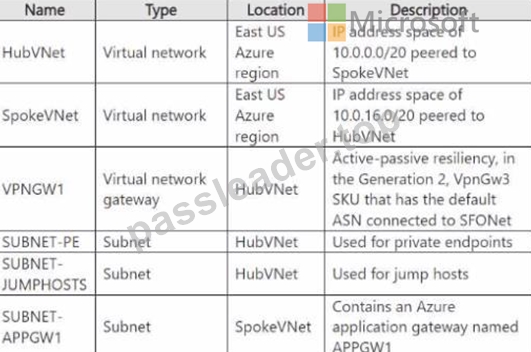
The subscription contains four virtual machines named VM1, VM2, VM3, and VM4. VM1 and VM2 host an app named App1.
VM3 and VM4 host a web app named App2 that is accessed by using a FQDN of app2.proseware.com. Users access app2.proseware.com by using HTTP or HTTPS.
VM1, VM2, and VM4 are connected to SpokeVNet
The subscription contains Application Gateway resources shown in the following table.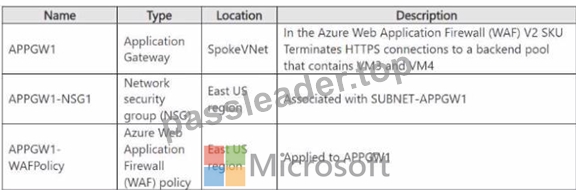
The subscription contains an Azure Front Door Standard profile named FD1. FD1 contains a single origin group that targets APPGW1 by using the default endpoint name.
HubVNet connects to NYCNet by using an ExpressRoute gateway named ERGW1.
The subscription contains an Azure Private DNS zone named DNSZonel in the East US region. DNSZonel hosts a namespace of azure.piosewaie.com and is linked to HubVNet The subscription contains a Standard Azure load balancer named LBS1 in the East US region. LBS1 contains a backend pool that hosts VM1 and VM2.
Planned Changes
Proseware plans to implement the following changes:
* Deploy an Azure Private DNS Resolver named PRDNSl to HubVNet and link PRDNS1 to SpokeVNet.
* Create a DNS forwarding ruleset named DNSRS1 and associate DNSRS1 with PRDNSl
* Deploy Azure Virtual Network Manager and implement the following rules:
o Allow inbound connections on TCP port 3389 from the on-premises networks to SU8NET-JUMPHOSTS. o Block inbound connections on TCP poit 80 from the internet to SpokeVNet.
* Ensure that Azure Virtual Network Manager rules take precedence over conflicting NSG rules.
* Deploy two network virtual appliances (NVAs) named NVA1 and NVA2 to HubVNet.
* Deploy a gateway load balancer named L8GW1 to HubVNet.
* Configure LBGW1 to inspect traffic on TCP ports 443, 1433, and 1434 from LBS1 by using NVA1 and NVA2.
* Ensure that all the traffic to App2 is processed by using FD1.
Connectivity Requirements
Proseware identifies the following connectivity requirements:
* Minimize the complexity of the Azure Virtual Network Manager deployment.
* Route traffic between NYCNet and SFONet via the ExpressRoute circuit and the S2S VPN
* Ensure that remote users on Windows 11 devices can connect to HubVNet by using a Point-to-Site (P2S) VP and their proseware.com credentials.
Security Requirements
Proseware identifies the following general requirements:
* Minimize the IP address space required to deploy platform-managed resources to the virtual networks.
* From SpokeVNet, resolve name resolution requests for the azure.proseware.com namespace and the corp.
proseware.com namespace by using PRDNS1.
* Whenever possible, minimize administrative effort.
NEW QUESTION # 58
You have an Azure subscription that contains the resources shown in the following table.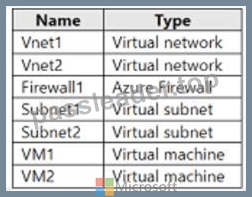
The virtual network topology is shown in the following exhibit.
Firewall1 is configured as shown in following exhibit.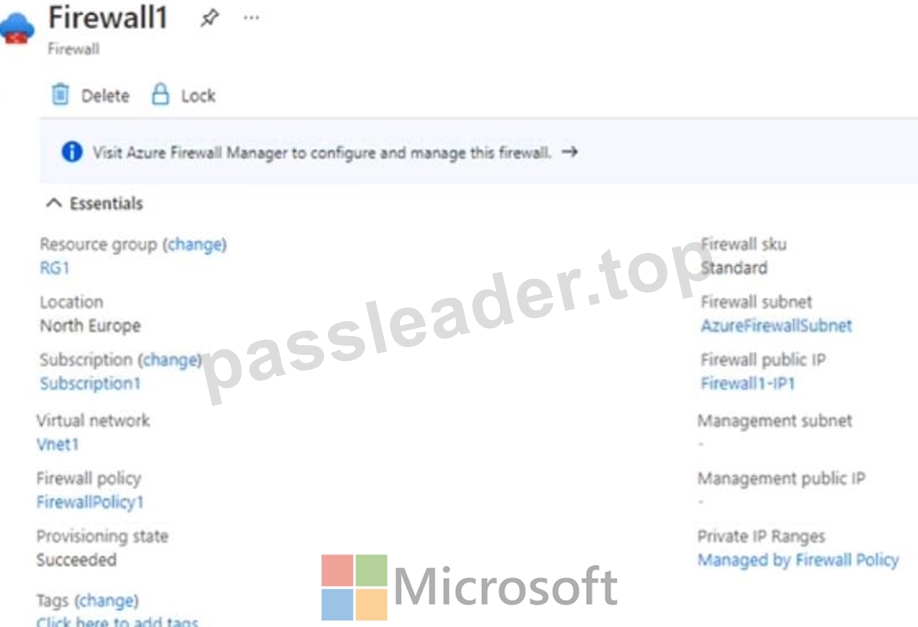
FirewallPolicy1 contains the following rules:
* Allow outbound traffic from Vnet1 and Vnet2 to the internet.
* Allow any traffic between Vnet1 and Vnet2.
No custom private endpoints. service endpoints. routing tables, or network security groups (NSGs) were created. For each of the following statements, select Yes if the statement is true. Otherwise, select No. NOTE:
Each correct selection is worth one point.
Answer:
Explanation:
NEW QUESTION # 59
You have an Azure subscription.
You have the on-premises sites shown the following table.
You plan to deploy Azure Virtual WAN.
You are evaluating Virtual WAN Basic and Virtual WAN Standard.
Which type of Virtual WAN can you use for each site? To answer, select the appropriate options in the answer area.
NOTE: Each correct selection is worth one point.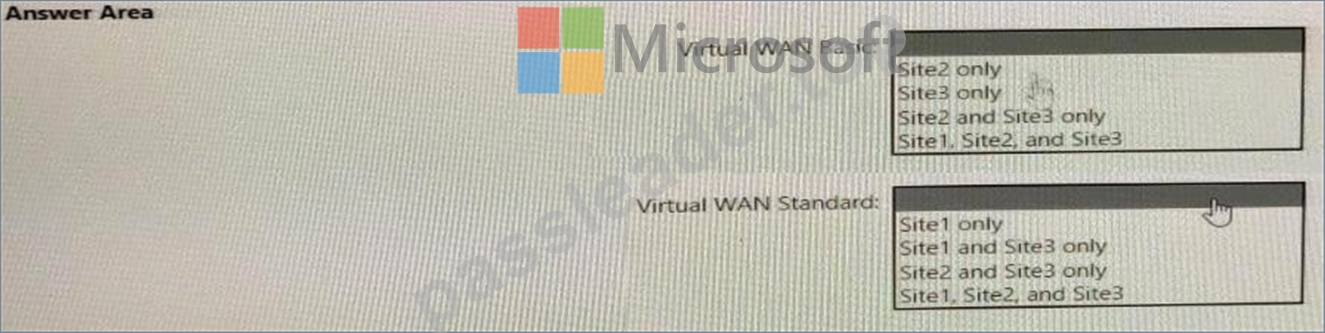
Answer:
Explanation: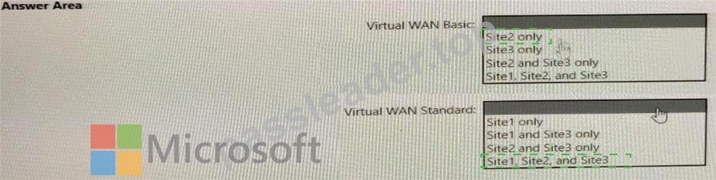
Explanation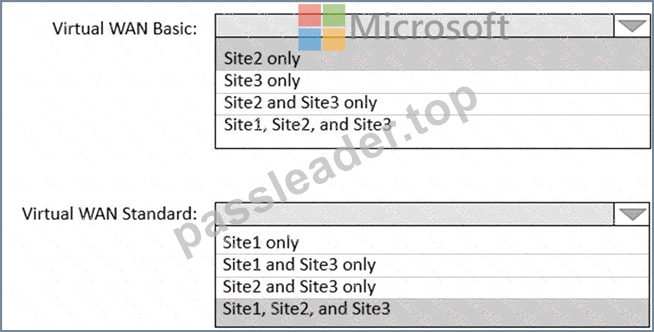
Reference:
https://docs.microsoft.com/en-us/azure/virtual-wan/virtual-wan-about
NEW QUESTION # 60
You have an Azure subscription that contains the resources shown in the following table.
You purchase a certificate for app1.contoso.com from a public certification authority (CA) and install the certificate on appservice1.
You need to ensure that App1 can be accessed by using a URL of https://app1.contoso.com. The solution must ensure that all the traffic for App1 is routed via FD1.
Which type of DNS record should you create, and where should you store the certificate? To answer, select the appropriate options in the answer area.
NOTE: Each correct selection is worth one point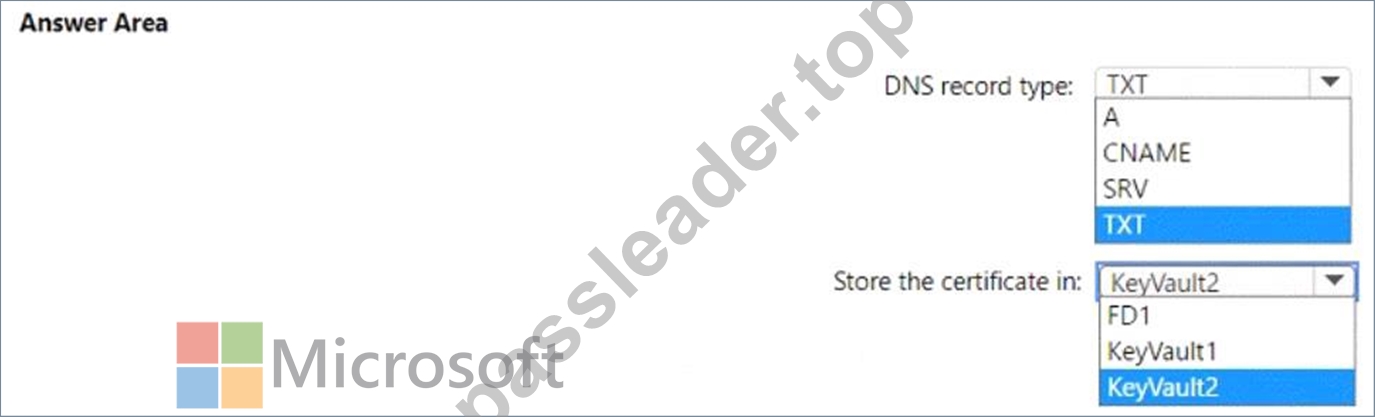
Answer:
Explanation: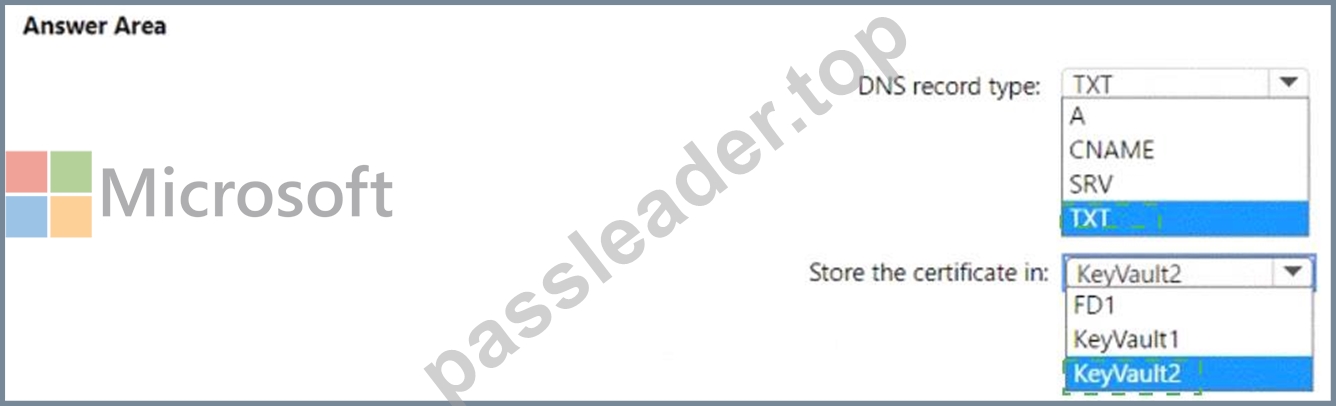
Explanation:
NEW QUESTION # 61
Case Study 1 - Litware. Inc
Overview
Litware. Inc. is a financial company that has a main datacenter in Boston and 20 branch offices across the United States. Users have Android, iOS, and Windows 10 devices.
Existing Environment:
Hybrid Environment
The on-prernises network contains an Active Directory forest named litwareinc.com that syncs to an Azure Active Directory (Azure AD) tenant named litwareinc.com by usinq Azure AD Connect.
All the offices connect to a virtual network named Vnetl by using a Site-to-Site VPN connection.
Azure Environment
Litware has an Azure subscription named Sub1 that is linked to the litwareinc.com Azure AD tenant. Sub1 contains resources in the East US Azure region as shown in the following table.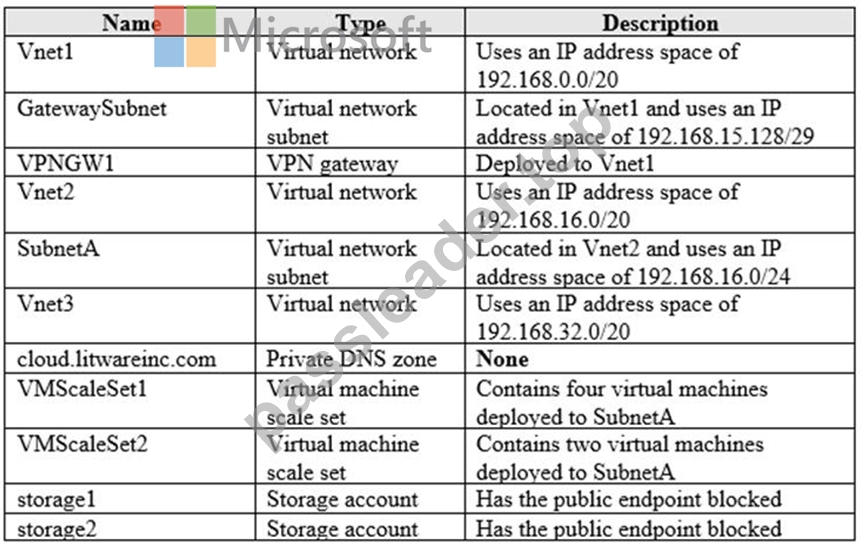
A diagram of the resource in the East US Azure region is shown in the Network Diagram exhibit.
There is bidirectional peering between Vnet1 and Vnet2. There is bidirectional peering between Vnet1 and Vnet3. Currently, Vnet2 and Vnet3 cannot communicate directly.
Azure Environment Diagram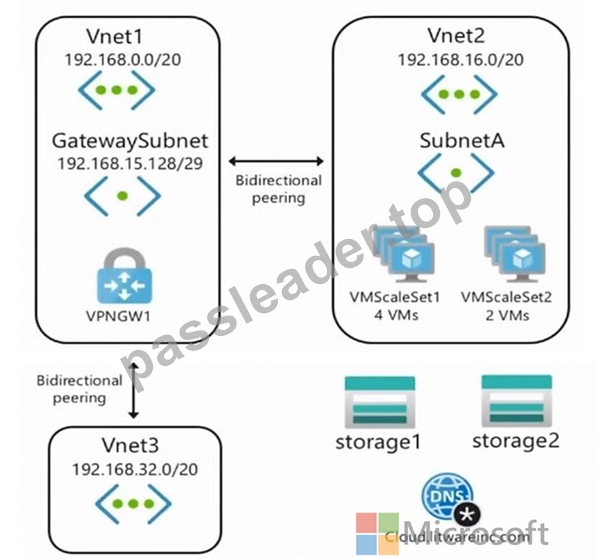
Requirements:
Business Requirements
Litware wants to minimize costs whenever possible, as long as all other requirements are met.
Virtual Networking Requirements
Litware identifies the following virtual networking requirements:
- Direct the default route of 0.0.0.0/0 on Vnet2 and Vnet3 to the
Boston datacenter over an ExpressRoute circuit.
- Ensure that the records in the cloud.litwareinc.com zone can be
resolved from the on-premises locations.
- Automatically register the DNS names of Azure virtual machines to the cloud.litwareinc.com zone.
- Minimize the size of the subnets allocated to platform-managed
services.
- Allow traffic from VMScaleSet1 to VMScaleSet2 on the TCP port 443
only.
Hybrid Networking Requirements
Litware identifies the following hybrid networking requirements:
- Users must be able to connect to Vnet1 by using a Point-to-Site (P2S) VPN when working remotely. Connections must be authenticated by Azure AD.
- Latency of the traffic between the Boston datacenter and all the
virtual networks must be minimized.
- The Boston datacenter must connect to the Azure virtual networks by
using an ExpressRoute FastPath connection.
- Traffic between Vnet2 and Vnet3 must be routed through Vnet1.
PaaS Networking Requirements
Litware identifies the following networking requirements for platform as a service (PaaS):
- The storage1 account must be accessible from all on-premises
locations without exposing the public endpoint of storage1.
- The storage2 account must be accessible from Vnet2 and Vnet3 without
exposing the public endpoint of storage2.
You need to provide connectivity to storage1.
The solution must meet the PaaS networking requirements and the business requirements.
What should you include in the solution?
- A. Azure Front Door
- B. Azure Traffic Manager
- C. a service endpoint
- D. a private endpoint
Answer: D
Explanation:
The storage1 account must be accessible from all on-premises locations without exposing the public endpoint of storage1.
NEW QUESTION # 62
You have three on-premises sites. Each site has a third-party VPN device.
You have an Azure virtual WAN named VWAN1 that has a hub named Hub1. Hub1 connects two of the three on-premises sites by using a Site-to-Site VPN connection.
You need to connect the third site to the other two sites by using Hub1.
Which four actions should you perform in sequence? To answer, move the appropriate actions from the list of actions to the answer area and arrange them in the correct order.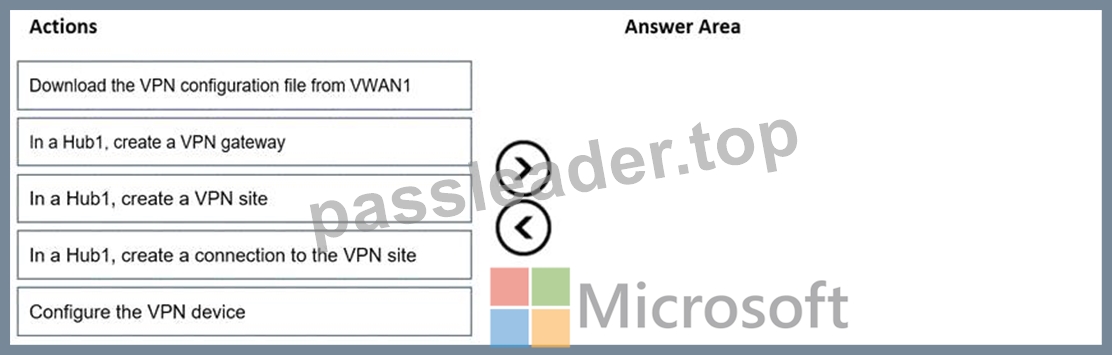
Answer:
Explanation: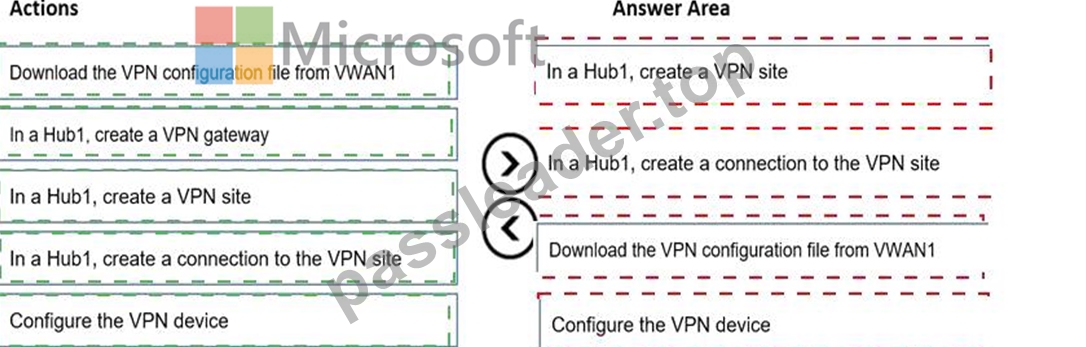
Explanation: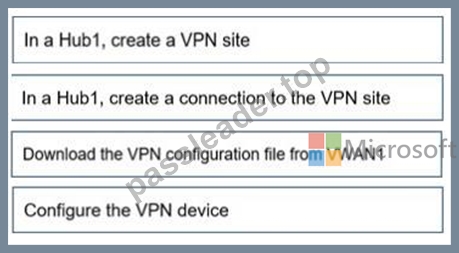
Reference:
https://docs.microsoft.com/en-us/azure/virtual-wan/virtual-wan-site-to-site-portal
NEW QUESTION # 63
You have two Azure subscriptions named Sub1 and Sub2. Sub1 contains a virtual machine named VM1.
You plan to make VM1 available to the resources in Sub2 by using Azure Private Link.
You need to ensure that the private link service can be configured to provide access to VM1.
What should you configure in Sub1 first?
- A. an Azure load balancer
- B. an Azure Private DNS zone
- C. a private endpoint
- D. a service endpoint
Answer: A
NEW QUESTION # 64
You need to recommend a configuration for the ExpressRoute connection from the Boston datacenter. The solution must meet the hybrid networking requirements and business requirements.
What should you recommend? To answer, select the appropriate options in the answer area.
NOTE: Each correct selection is worth one point.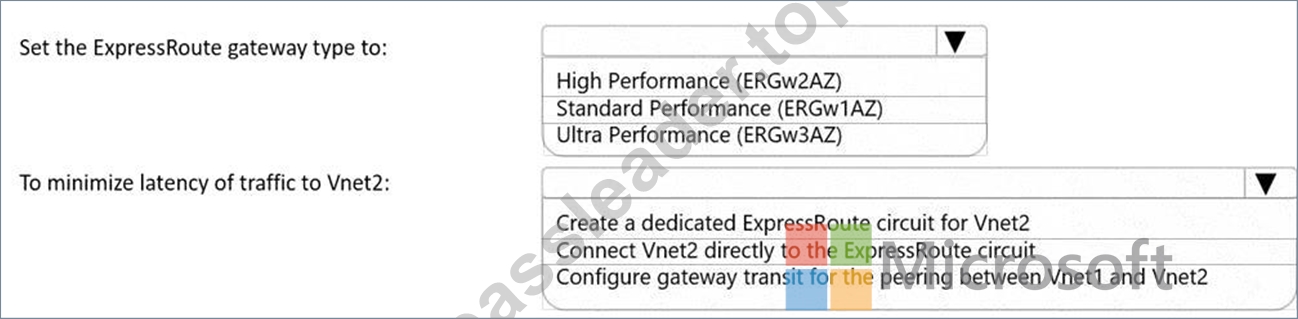
Answer:
Explanation: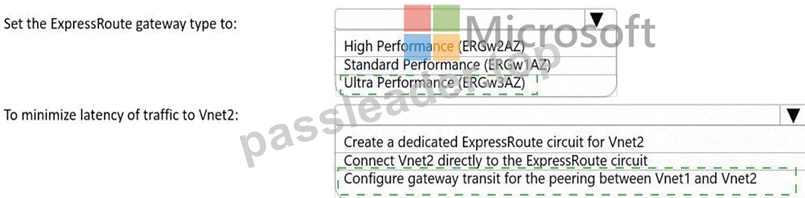
Explanation: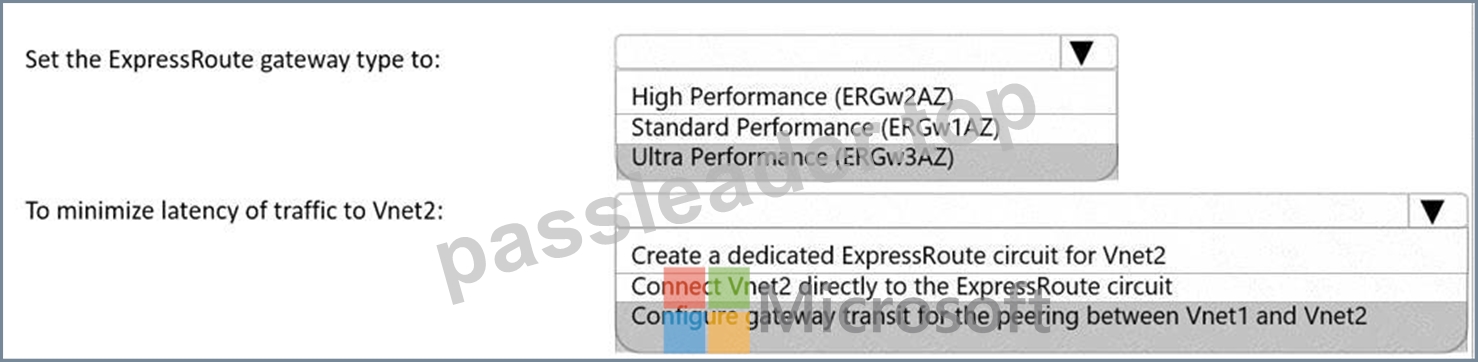
For the first question, only ExpressRoute GW SKU Ultra Performance support FastPath feature.
For the second question, vnet1 will connect to ExpressRoute gw, once Vnet1 peers with Vnet2, the traffic from on-premise network will bypass GW and Vnet1, directly goes to Vnet2, while this feature is under public preview.
====Reference
ExpressRoute virtual network gateway is designed to exchange network routes and route network traffic.
FastPath is designed to improve the data path performance between your on-premises network and your virtual network. When enabled, FastPath sends network traffic directly to virtual machines in the virtual network, bypassing the gateway.
To configure FastPath, the virtual network gateway must be either:
Ultra Performance
ErGw3AZ
VNet Peering - FastPath will send traffic directly to any VM deployed in a virtual network peered to the one connected to ExpressRoute, bypassing the ExpressRoute virtual network gateway.
https://docs.microsoft.com/en-us/azure/expressroute/about-fastpath
Gateway SKU
https://docs.microsoft.com/en-us/azure/expressroute/expressroute-about-virtual-network-gateways
NEW QUESTION # 65
You have an Azure subscription. The subscription contains two virtual machine scale sets that host two apps named App1 and App2, an Azure Private Link service named PLS1. and an Azure load balancer named LB1.
PLS1 uses LB1 and has TCP Proxy V2 disabled PLS1 provides access to App1 only.
You need to perform the following actions:
* Provide access to App1 and App2.
* Increase the number of supported private endpoint connections.
What should you modify to provide access to App2, and what should you modify to increase the number of supported connections? To answer, select the appropriate options in the answer area.
NOTE: Each correct selection is worth one point.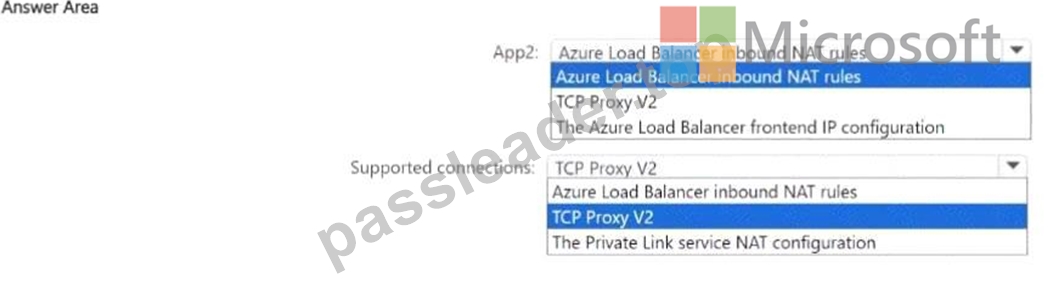
Answer:
Explanation: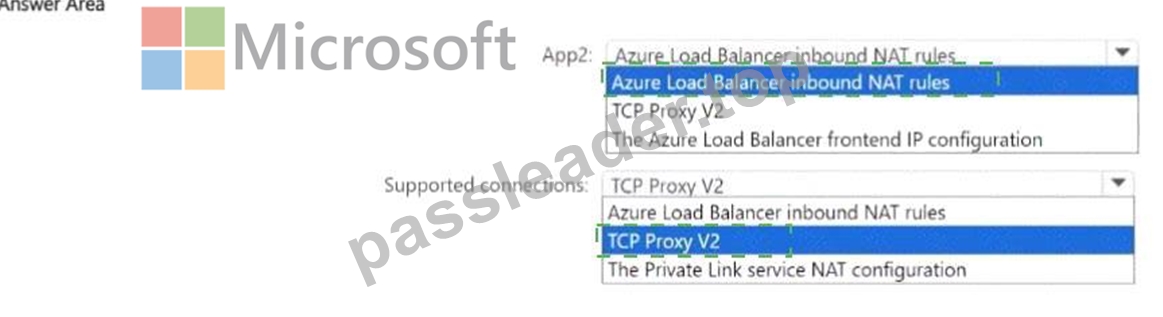
Explanation:
NEW QUESTION # 66
Your company has an Azure virtual network named Vnet1 that uses an IP address space of 192.168.0.0/20. Vnet1 contains a subnet named Subnet1 that uses an IP address space of 192.168.0.0/24.
You create an IPv6 address range to Vnet1 by using a CIDR suffix of /48.
You need to enable the virtual machines on Subnet1 to communicate with each other by using IPv6 addresses assigned by the company. The solution must minimize the number of additional IPv4 addresses.
What should you do? To answer, select the appropriate options in the answer area.
NOTE: Each correct selection is worth one point.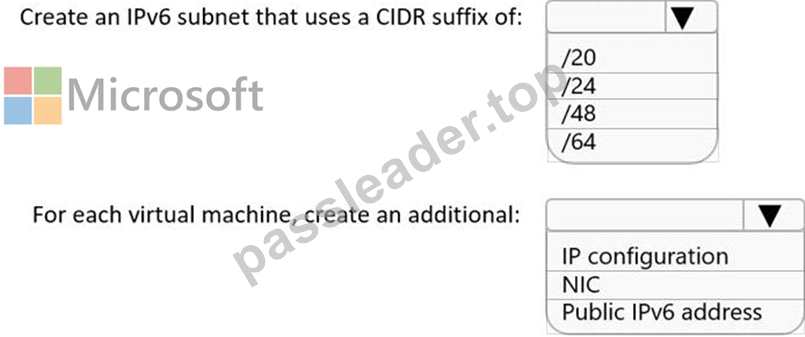
Answer:
Explanation: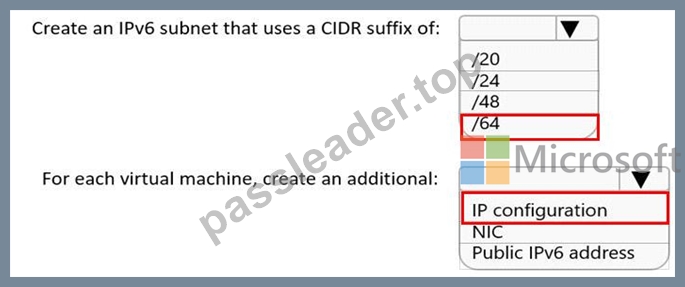
Reference:
https://docs.microsoft.com/en-us/azure/virtual-network/ipv6-overview
https://docs.microsoft.com/en-us/azure/virtual-network/ipv6-add-to-existing-vnet-powershell
NEW QUESTION # 67
You have an Azure subscription that contains a virtual network gateway named VNetGwy1. VNetGwy1 has a public IP address of 20.25.32.214.
You need to query the health probe of VNetGwy1,
How should you complete the URI? To answer, select the appropriate options in the answer area.
NOTE: Each correct selection is worth one point.
Answer:
Explanation:
Explanation:
NEW QUESTION # 68
You have an Azure subscription that contains the resources shown in the following table.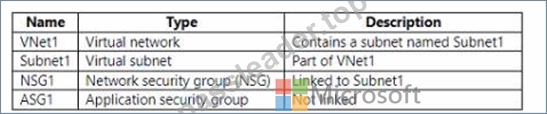
Subshell contains Three virtual machines that host an app named App1. App1 is accessed by using the SFTP protocol.
From NSG1. you configure an inbound security rule named Rule2 that allows inbound SFTP connections to ASG1.
You need to ensure that the inbound SFTP connections are managed by using ASG1. The solution must minimize administrative effort.
What should you do?
- A. From NSG1. modify the priority of Rule2.
- B. From Subnet1 create a subnet delegation.
- C. From ASG1, modify the role assignments.
- D. From each virtual machine, associate the network interface to ASG1
Answer: D
NEW QUESTION # 69
You have the Azure environment shown In the Azure Environment exhibit. (Click the Azure Environment tab.) The settings for each subnet are shown in the following table.
The Firewalls and virtual networks settings for storage1 are configured as shown in the Storage1 exhibit.
(Click the Storage1 tab.) For each of the following statements, select Yes if the statement is true. Otherwise, select No. NOTE: Each correct selection is worth one point.
Answer:
Explanation:
Explanation: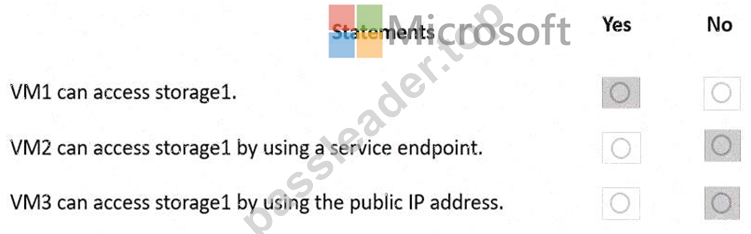
NEW QUESTION # 70
You have an Azure Front Door instance that provides access to a web app. The web app uses a hostname of www.contoso.com.
You have the routing rules shown in the following table.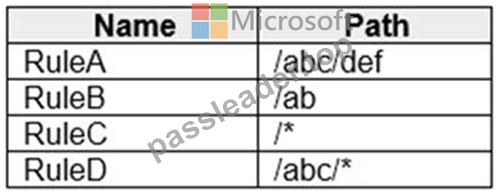
Which rule will apply to each incoming request? To answer, select the appropriate options in the answer area.
NOTE: Each correct selection is worth one point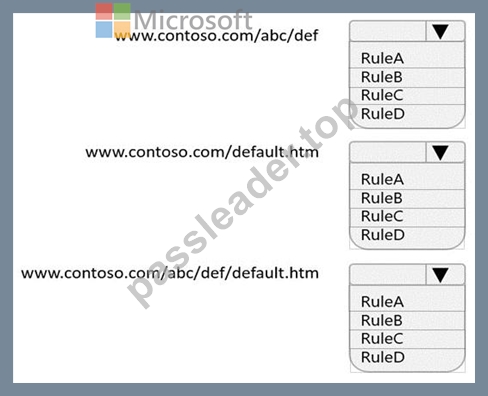
Answer:
Explanation: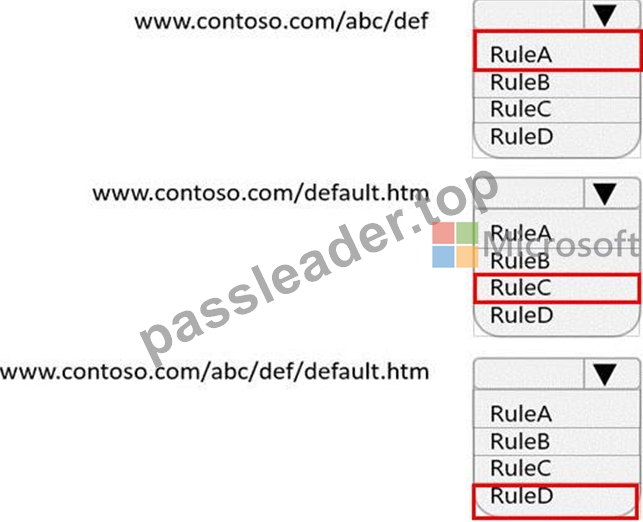
Reference:
https://docs.microsoft.com/en-us/azure/frontdoor/front-door-route-matching
NEW QUESTION # 71
You have an Azure subscription that contains a virtual network gateway named VNetGwy1. VNetGwy1 has a public IP address of 20.25.32.214.
You need to query the health probe of VNetGwy1,
How should you complete the URI? To answer, select the appropriate options in the answer area.
NOTE: Each correct selection is worth one point.
Answer:
Explanation:
NEW QUESTION # 72
You have two on-premises datacenters.
You have an Azure subscription that contains four virtual networks named VNet1 VNet2, VNet3, and VNet4 You create an Azure virtual WAN named VWAN1. VWAN1 contains a single virtual hub that is connected to both on-premises datacenters and all the virtual networks in a full mesh topology.
You create a route table named RT1.
You need to configure VWAN1 to meet the following requirements:
* Connectivity between VNet1 and VNet2 and both on-premises datacenters must be allowed.
* Connectivity between VNet3 and VNet4 and both on-premises datacenters must be allowed.
* VNet1 and VNet2 must be isolated from VNet3 and VNet4.
How should you configure routing for VNet1 and VNet2 and for both on-premises datacenters? To answer, drag the appropriate route tables and route table propagation to the correct requirements. Each route table and route table propagation may be used once, more than once, or not at all. You may need to drag the split bar between panes or scroll to view content.
NOTE: Each correct selection is worth one point.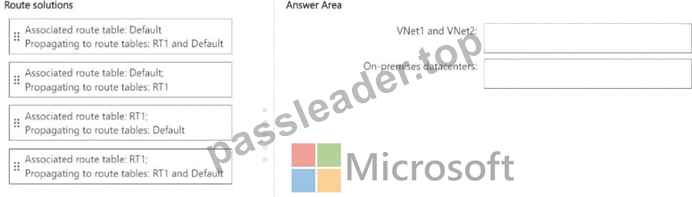
Answer:
Explanation: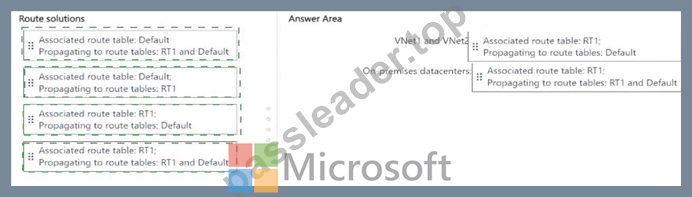
Explanation: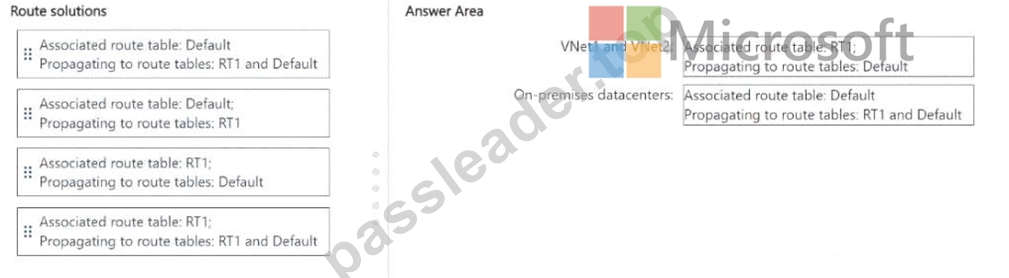
NEW QUESTION # 73
You have two Azure virtual networks named Hub1 and Spoke1. Hub1 connects to an on-premises network by using a Site-to-Site VPN connection.
You are implementing peering between Hub1 and Spoke1.
You need to ensure that a virtual machine connected to Spoke1 can connect to the on-premises network through Hub1.
How should you complete the PowerShell script? To answer, drag the appropriate values to the correct targets. Each value may be used once, more than once, or not at all. You may need to drag the split bar between panes or scroll to view content.
NOTE: Each correct selection is worth one point.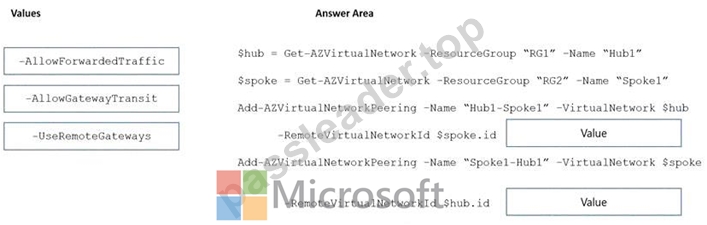
Answer:
Explanation: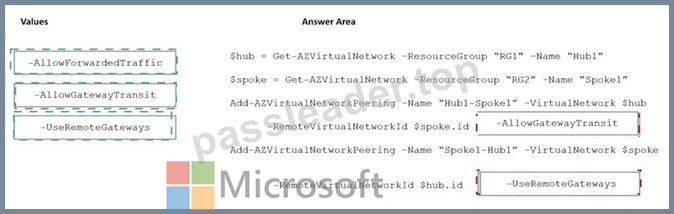
Explanation: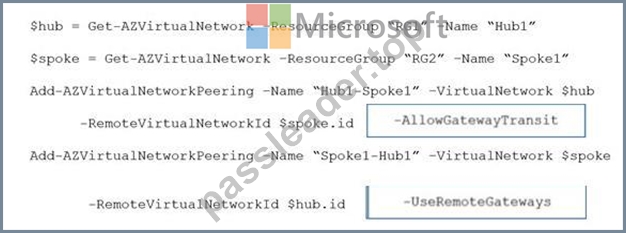
Reference:
https://docs.microsoft.com/en-us/azure/architecture/reference-architectures/hybrid-networking/hub-spoke?
tabs=cli#virtual-network-peering
NEW QUESTION # 74
You have an Azure subscription that contains a dual-stack virtual network named VNet1. VNet1 has the following IP address spaces:
* IPv4:192.168.0.0/24
* IPv6: fd0adbftdeca: deed: y48
You plan to deploy an Azure VPN gateway and multiple virtual machines to VNet1.
You need to configure the subnet masks for VNet1. The solution must meet the following requirements:
* Maximize the number of usable IP addresses.
* Support the deployment of the VPN gateway and the virtual machines.
Which subnet mask should you use for each address space? To answer, select the appropriate options in the answer area.
NOTE: Each correct selection is worth one point.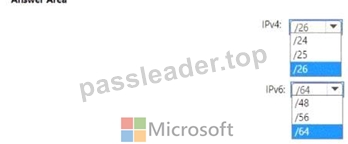
Answer:
Explanation: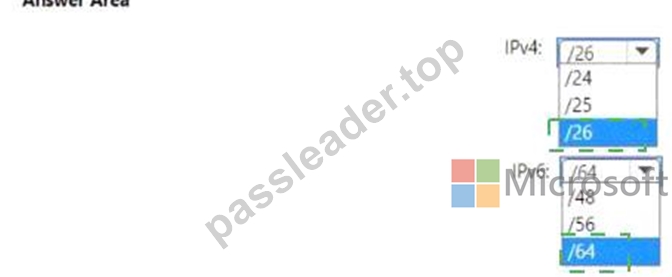
Explanation: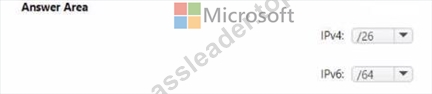
NEW QUESTION # 75
You have an Azure subscription that contains six Azure App Service apps. The apps have an identical configuration and are deployed across multiple Azure regions.
You plan to deploy Azure Front Door to load balance traffic across the apps.
You need to ensure that the round robin load-balancing algorithm will send traffic only to a limited number App Service apps based on their proximity to a user. The solution must minimize administrative effort.
What should you modify, and what should you configure? To answer, select the appropriate options in the answer area.
NOTE: Each correct selection is worth one point.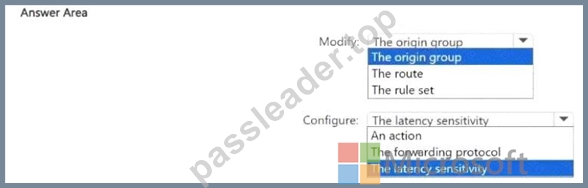
Answer:
Explanation: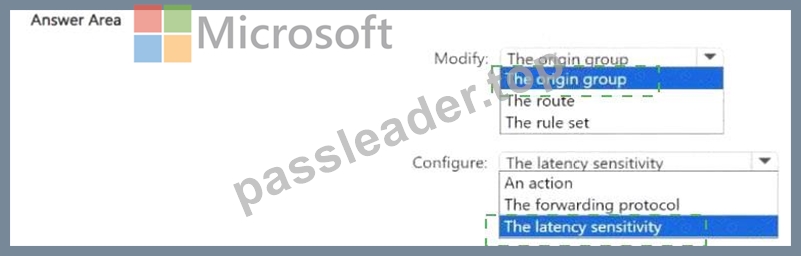
Explanation:
NEW QUESTION # 76
Hotspot Question
You have an Azure subscription that contains multiple virtual machines in two Azure regions.
You need to load balance network traffic across the virtual machines by using a cross-region load balancer solution.
Which type of load balancer should you deploy to each region, and which type of rule should you configure for the cross-region load balancer? To answer, select the appropriate options in the answer area.
NOTE: Each correct answer is worth one point.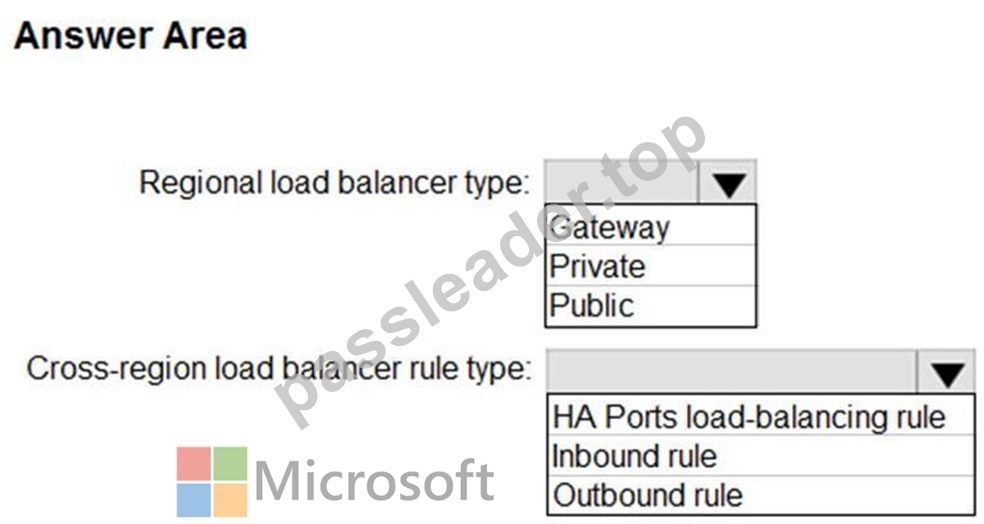
Answer:
Explanation: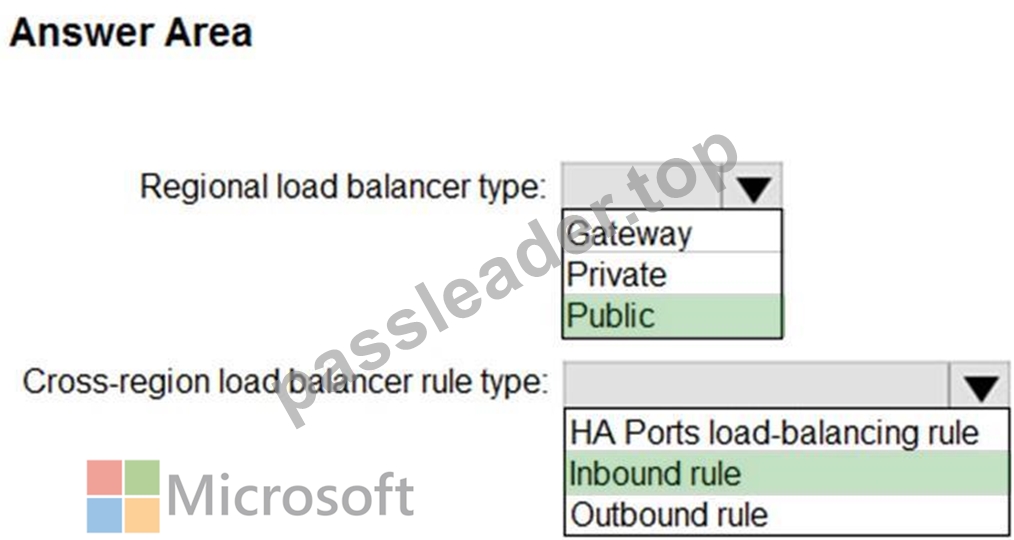
NEW QUESTION # 77
You have an Azure subscription that contains the virtual machines shown in the following table.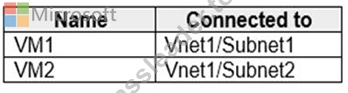
Subnet1 and Subnet2 are associated to a network security group (NSG) named NSG1 that has the following outbound rule:
Priority: 100
Port: Any
Protocol: Any
Source: Any
Destination: Storage
Action: Deny
You create a private endpoint that has the following settings:
Name: Private1
Resource type: Microsoft.Storage/storageAccounts
Resource: storage1
Target sub-resource: blob
Virtual network: Vnet1
Subnet: Subnet1
For each of the following statements, select Yes of the statement is true. Otherwise, select No.
NOTE: Each correct selection is worth one point.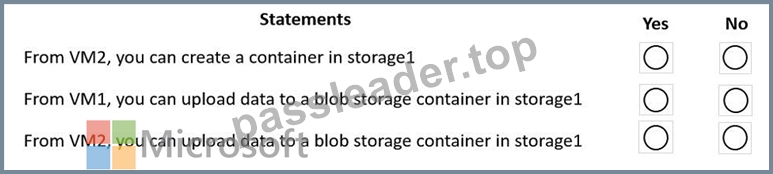
Answer:
Explanation: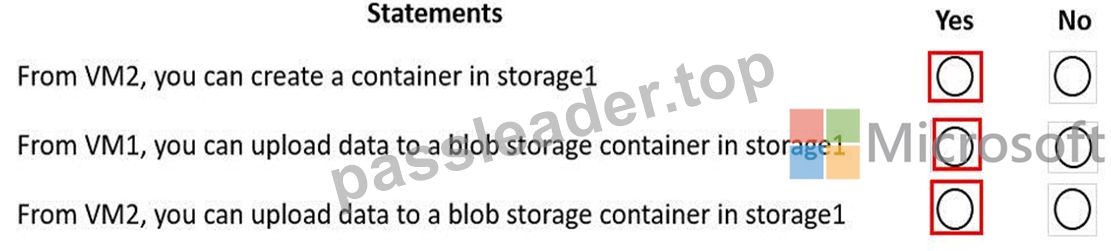
NEW QUESTION # 78
You have Azure App Service apps in the West US Azure region as shown in the following table.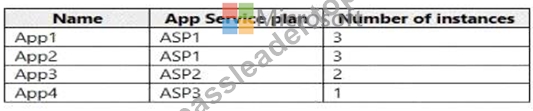
You need to ensure that all the apps can access the resources in a virtual network named Vnet1 without forwarding traffic through the internet-How many integration subnets should you create?
- A. 0
- B. 1
- C. 2
- D. 3
- E. 4
Answer: C
Explanation:
One integration subnet is required per App Service Plan regardless of how many apps are running in the App Service Plan.
Reference:
https://docs.microsoft.com/en-us/azure/app-service/overview-vnet-integration
NEW QUESTION # 79
......
Free AZ-700 Exam Questions AZ-700 Actual Free Exam Questions: https://www.passleader.top/Microsoft/AZ-700-exam-braindumps.html
Verified AZ-700 dumps and 398 unique questions: https://drive.google.com/open?id=1pjKV8GRuy_V_s8Ft2006g4s6aJQW2kNk