

May 26, 2026 PASS Juniper JN0-683 EXAM WITH UPDATED DUMPS
JN0-683 Questions PDF [2026] Use Valid New dump to Clear Exam
NEW QUESTION # 30
You are designing an IP fabricfora large data center, and you are concerned about growth and scalability.
Which two actions would you take to address these concerns? (Choose two.)
- A. Design a three-stage Clos IP fabric.
- B. Use OFX5700 Series devices as the super spines.
- C. Design a five-stage Clos IP fabric.
- D. Use EX4300 Series devices as the spine devices.
Answer: B,C
NEW QUESTION # 31
Click the Exhibit button. Connections between hosts connected to Leaf-1 and Leaf-2 are not working correctly.
Referring to the exhibit, which two configuration changes are required to solve the problem?
(Choose two.)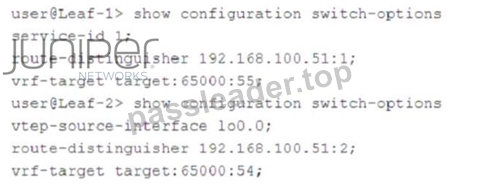
- A. Configure the set switch-options vrf-target target: 65000:55 parameter on Leaf-2.
- B. Configure the set switch-options route-distinguisher 192.168.100.51:2 parameter on Leaf-1.
- C. Configure the set switch-options vtep-source-interface 100. 0 parameter on Leaf-1.
- D. Configure the set switch-options service-id 1 parameter on Leaf-2.
Answer: A,D
Explanation:
Configure the set switch-options service-id 1 parameter on Leaf-2: The service ID parameter should be consistent between the two leaf switches in order to ensure proper EVPN operation.
The service ID helps to associate the EVPN instance with the correct context. Configuring the same service-id 1on both Leaf-1 and Leaf-2 will allow them to properly intercommunicate.
Configure the set switch-options vrf-target target:65000:55 parameter on Leaf-2: The vrf- targetdefines the routing target for VRF routes in the EVPN context. Since Leaf-1 has vrf- target target:65000:55, Leaf-2 must also have the same VRF target to ensure consistent route propagation between the two switches.
NEW QUESTION # 32
Which parameter is used to associate a received route with a local VPN route table?
- A. VLAN ID
- B. VNI
- C. route-distinguisher
- D. route-target community
Answer: D
Explanation:
* Understanding VPN Route Table Association:
* In MPLS/VPN and EVPN networks, theroute-target communityis a BGP extended community attribute used to control the import and export of VPN routes. It associates received routes with the appropriate VPN route tables on the PE (Provider Edge) routers.
* Function of Route-Target Community:
* The route-target community tag ensures that routes are imported into the correct VRF (Virtual Routing and Forwarding) instance, allowing them to be correctly routed within the VPN.
Conclusion:
* Option A:Correct-The route-target community is used to associate received routes with a local VPN route table.
NEW QUESTION # 33
Exhibit.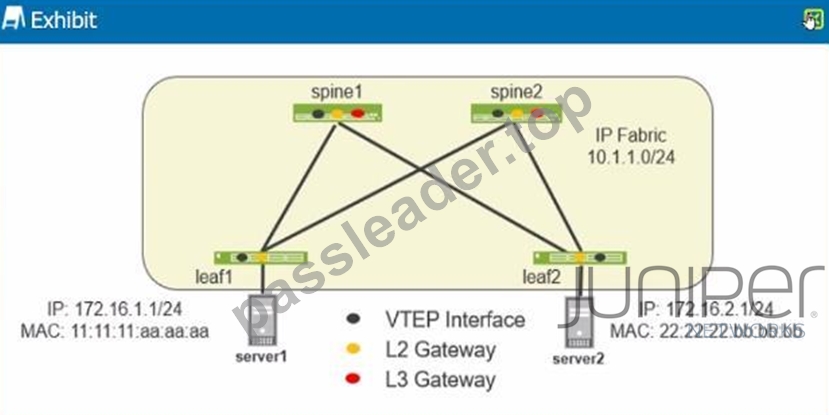
You have implemented an EVPN-VXLAN data center. Device served must be able to communicate with device server2.
Referring to the exhibit, which two statements are correct? (Choose two.)
- A. Traffic from server1 to server2 will transit a VXLAN tunnel to spinel or spine2. then a VXLAN tunnel from spinel or spine2 to Ieaf2.
- B. An IRB Interface must be configured on leaf1 and Ieaf2.
- C. Traffic from server! to server2 will transit the VXLAN tunnel between leaf1 and Ieaf2.
- D. An IRB interface must be configured on spinel and spine2.
Answer: B,C
Explanation:
* Understanding the Exhibit Setup:
* The network diagram shows an EVPN-VXLAN setup, a common design for modern data centers enabling Layer 2 and Layer 3 services over an IP fabric.
* Leaf1 and Leaf2 are the leaf switches connected to Server1 and Server2, respectively, with each server in a different subnet (172.16.1.0/24 and 172.16.2.0/24).
* Spine1 and Spine2 are part of the IP fabric, interconnecting the leaf switches.
* EVPN-VXLAN Basics:
* EVPN (Ethernet VPN) provides Layer 2 and Layer 3 VPN services using MP-BGP.
* VXLAN (Virtual Extensible LAN) encapsulates Layer 2 frames into Layer 3 packets for transmission across an IP network.
* VTEP (VXLAN Tunnel Endpoint) interfaces on leaf devices handle VXLAN encapsulation and decapsulation.
* Integrated Routing and Bridging (IRB):
* IRB interfaces are required on leaf1 and leaf2 (where the endpoints are directly connected) to route between different subnets (in this case, between 172.16.1.0/24 and 172.16.2.0/24).
* The IRB interfaces provide the necessary L3 gateway functions for inter-subnet communication.
* Traffic Flow Analysis:
* Traffic from Server1 (172.16.1.1) destined for Server2 (172.16.2.1) must traverse from leaf1 to leaf2.
* The traffic will be VXLAN encapsulated on leaf1, sent over the IP fabric, and decapsulated on leaf2.
* Since the communication is between different subnets, the IRB interfaces on leaf1 and leaf2 are crucial for routing the traffic correctly.
* Correct Statements:
* C. An IRB Interface must be configured on leaf1 and leaf2:This is necessary to perform the inter-subnet routing for traffic between Server1 and Server2.
* D. Traffic from server1 to server2 will transit the VXLAN tunnel between leaf1 and leaf2:
This describes the correct VXLAN operation where the traffic is encapsulated by leaf1 and decapsulated by leaf2.
Data Center References:
* In EVPN-VXLAN architectures, the leaf switches often handle both Layer 2 switching and Layer 3 routing via IRB interfaces. This allows for efficient routing within the data center fabric without the need to involve the spine switches for every routing decision.
* The described traffic flow aligns with standard EVPN-VXLAN designs, where direct VXLAN tunnels between leaf switches enable seamless and scalable communication across a data center network.
NEW QUESTION # 34
You want to convert an MX Series router from a VXLAN Layer 2 gateway to a VXLAN Layer 3 gateway for VNI 100. You have already configured an IRB interface.
In this scenario, which command would you use to accomplish this task?
- A. set bridge-domains VLAN-100 routing-interface irb.100
- B. set protocols isis interface irb.100 passive
- C. set protocols ospf area 0.0.0.0 interface irb.100 passive
- D. set vlans VLAN-100 13-interface irb.100
Answer: A
Explanation:
To convert the VXLAN Layer 2 gateway to a VXLAN Layer 3 gateway for VNI 100, you need to assign the IRB interface (which is configured for Layer 3 routing) to the relevant bridge domain.
This is accomplished with the command set bridge-domains VLAN-100 routing-interface irb.100.
This command links the IRB interface (irb.100) to the bridge domain (VLAN-100) and enables Layer 3 routing for that VNI.
NEW QUESTION # 35
Whatare two ways in which an EVPN-signaled VXLAN is different from a multicast-signaled VXLAN?
(Choose two.)
- A. An EVPN-signaled VXLAN can perform autodiscovery of VTEPs using IS-IS.
- B. An EVPN-signaled VXLAN can perform autodiscovery of VTEPs using BGP.
- C. An EVPN-signaled VXLAN features slower and more complete convergence.
- D. An EVPN-signaled VXLAN is less resource intensive.
Answer: B,D
Explanation:
* Multicast-Signaled VXLAN:
* In traditional multicast-signaled VXLAN, VTEPs (VXLAN Tunnel Endpoints) use multicast to flood and learn about remote VTEPs. This method relies on multicast in the underlay network to distribute BUM (Broadcast, Unknown unicast, and Multicast) traffic.
* This approach can be resource-intensive due to the need for multicast group management and increased network traffic, especially in large deployments.
* EVPN-Signaled VXLAN:
* EVPN-signaled VXLAN uses BGP (Border Gateway Protocol) to signal the presence of VTEPs and distribute MAC address information. BGP is used for VTEP autodiscovery and the distribution of endpoint information.
* This method is more efficient because it reduces the reliance on multicast, instead using BGP control-plane signaling to handle VTEP discovery and MAC learning, which reduces the overhead on the network and improves scalability.
* Correct Statements:
* B. An EVPN-signaled VXLAN can perform autodiscovery of VTEPs using BGP:This is correct because EVPN uses BGP for VTEP autodiscovery, making it more efficient and scalable compared to multicast-based methods.
* C. An EVPN-signaled VXLAN is less resource-intensive:This is correct because it eliminates the need for multicast flooding in the underlay, instead using BGP for signaling, which is less demanding on network resources.
* Incorrect Statements:
* A. An EVPN-signaled VXLAN can perform autodiscovery of VTEPs using IS-IS:This is incorrect because EVPN relies on BGP, not IS-IS, for VTEP discovery and signaling.
* D. An EVPN-signaled VXLAN features slower and more complete convergence:This is incorrect; EVPN with BGP typically provides faster convergence due to its use of a control plane rather than relying on data plane learning.
Data Center References:
* EVPN-VXLAN is widely adopted in modern data center designs due to its scalability, efficiency, and reduced resource consumption compared to multicast-based VXLAN solutions. It leverages the strengths of BGP for control-plane-driven operations, resulting in more efficient and scalable networks.
NEW QUESTION # 36
You are deploying multiple Juniper switches al the same location. Your switches are currently using the factory-default configuration.
In this scenario, which two statements are correct? (Choose two.)
- A. The DHCP server configuration can provide Junos version requirements to DHCP clients.
- B. The switch will try to request an IP address from a DHCP server using only the management interface.
- C. The DHCP server configuration cannot provide Junos version requirements to DHCP clients.
- D. The switch will try to request an IP address from a DHCP server using all interfaces that are connected and are operational.
Answer: A,D
Explanation:
* DHCP Behavior in Factory-Default Configuration:
* Option B:In the factory-default configuration, Juniper switches are designed to send DHCP requests on all operational interfaces. This behavior ensures that the switch can obtain an IP address for management and further configuration from any available DHCP server.
* Option D:The DHCP server can provide additional configuration parameters, including the required Junos version. This allows for automated provisioning and ensures that the switch is running the correct software version.
Conclusion:
* Option B:Correct-The switch will use any operational interface to request an IP address via DHCP.
* Option D:Correct-The DHCP server can specify Junos version requirements, enabling automated software management.
NEW QUESTION # 37
You are asked to implement VXLAN group-based policies (GBPs) in your data center. Which two statements are correct in (his scenario? (Choose two.)
- A. VXLAN GBP uses scalable group tags that may be configured on a RADIUS server and pushed to the switch through 802.1X.
- B. VXLAN GBP uses scalable group tags thatmust be configured statically on each switch and activated through 802.1X.
- C. VXLAN GBP ensures consistent application of BGP groups throughout the network.
- D. VXLAN GBP ensures consistent application of security group policies throughout the network.
Answer: A,D
Explanation:
* VXLAN Group-Based Policies (GBP):
* VXLAN Group-Based Policies are used to apply security policies consistently across the network. These policies are often tied to user or device identities rather than static IP addresses, which allows for more dynamic and scalable security management.
* Scalable Group Tags via RADIUS and 802.1X:
* Option B:VXLAN GBP can use scalable group tags configured on a RADIUS server, which are then pushed to network devices through 802.1X. This allows for centralized and automated policy application based on user or device identity.
* Consistent Security Policy Application:
* Option C:GBP ensures that security policies are consistently applied across the network, regardless of where a user or device connects. This consistency is crucial in environments where security policies must follow the user or device.
Conclusion:
* Option B:Correct-Group tags can be configured on a RADIUS server and pushed via 802.1X, enabling centralized policy management.
* Option C:Correct-GBP ensures consistent application of security policies, which is essential for maintaining security across a dynamic network environment.
NEW QUESTION # 38
What are two ways in which an EVPN-signaled VXLAN is different from a multicast-signaled VXLAN? (Choose two.)
- A. An EVPN-signaled VXLAN can perform autodiscovery of VTEPs using IS-IS.
- B. An EVPN-signaled VXLAN can perform autodiscovery of VTEPs using BGP.
- C. An EVPN-signaled VXLAN features slower and more complete convergence.
- D. An EVPN-signaled VXLAN is less resource intensive.
Answer: B,D
NEW QUESTION # 39
Exhibit.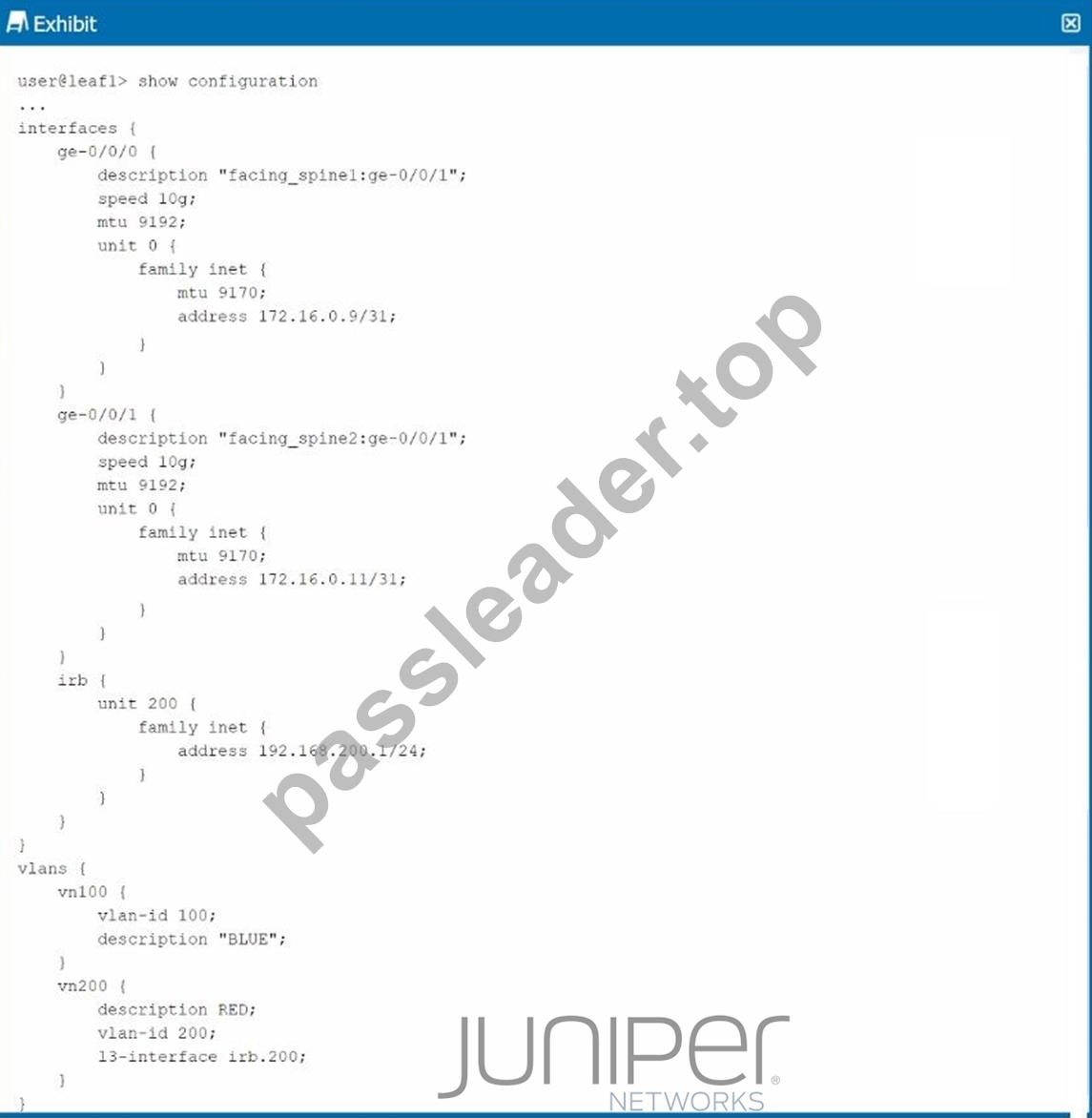
Host A is connected to vlan 100 on lead. Host B is connected to vlan 200 on leaf1. Host A and Host B ate unable to communicate. You have reviewed the touting and your hosts have the correct default route (.1) Referring to the exhibit, which two commands will solve the problem? (Choose two.)
- A. set interfaces irb unit 100 family inet address 192-168.100.1
- B. delete vlans vn200 13-interface irb.200
- C. set routing-options static route 0.0.0.0/0 next-hop 192.168.200.10
- D. set vlans vn10013-interface irb.100
Answer: C,D
Explanation:
In the provided network configuration, Host A is in VLAN 100 and Host B is in VLAN 200. The issue arises because these two hosts are unable to communicate, which indicates that either the interfaces are not properly linked to their respective VLANs, or there is a missing static route required for inter-VLAN routing.
Step-by-Step Analysis:
* VLAN Assignment:
* The exhibit shows that irb.200 is correctly associated with VLAN 200 in the configuration.
However, there is no corresponding irb.100 for VLAN 100. Without irb.100, the network lacks the logical interface to handle routing for VLAN 100. Thus, adding irb.100 to VLAN 100 is necessary.
Command to solve this:
set vlans vn100 13-interface irb.100
* Static Route Configuration:
* For inter-VLAN routing to occur, a static route needs to be configured that allows traffic to pass between different subnets (in this case, between VLAN 100 and VLAN 200). The command set routing-options static route 0.0.0.0/0 next-hop 192.168.200.10 would add a static route that directs all traffic from VLAN 100 to the correct gateway (192.168.200.10), which is necessary to route traffic between the two VLANs.
Command to solve this:
set routing-options static route 0.0.0.0/0 next-hop 192.168.200.10
Explanation of Incorrect Options:
* Option A (delete vlans vn200 13-interface irb.200): This would remove the logical interface associated with VLAN 200, which is not desired because we need VLAN 200 to remain active and properly routed.
* Option B (set interfaces irb unit 100 family inet address 192-168.100.1): This command would incorrectly assign an IP address that does not correspond with the subnet of VLAN 100 (192.168.200.1
/24). This could create a misconfiguration, leading to routing issues.
Data Center References:
For a Data Center, proper VLAN management and static routing are crucial for ensuring that different network segments can communicate effectively, especially when dealing with separated subnets or zones like in different VLANs. This aligns with best practices in DCIM (Data Center InfrastructureManagement) which stress the importance of proper network configuration to avoid downtime and ensure seamless communication between all critical IT infrastructure components.
Ensuring that the correct interfaces are associated with the correct VLANs and having the proper static routes in place are both essential steps in maintaining a robust and reliable data center network.
This detailed analysis reflects best practices as noted in standard data center design and network configuration guides.
NEW QUESTION # 40
Exhibit.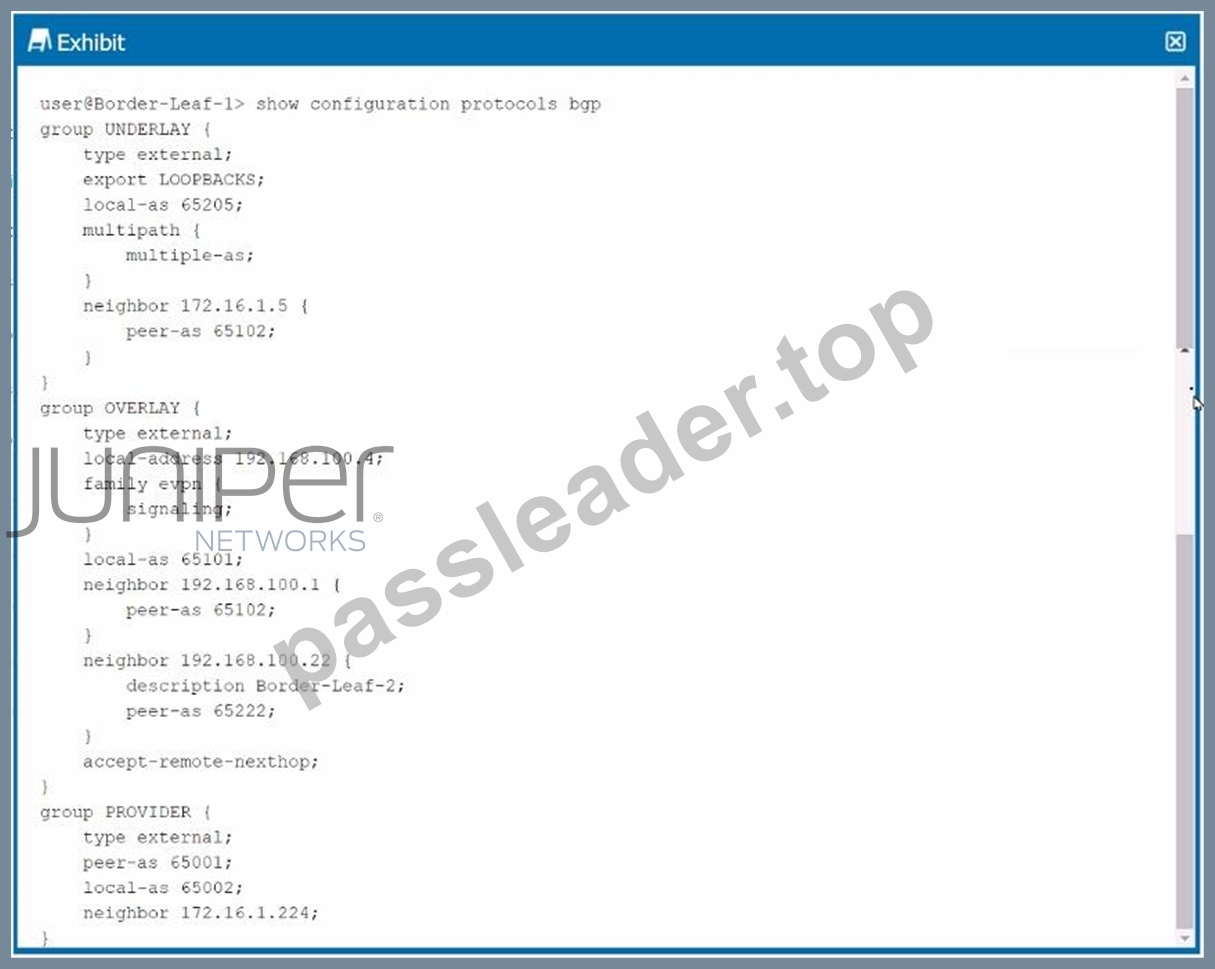
You are troubleshooting a DCI connection to another data center The BGP session to the provider is established, but the session to Border-Leaf-2 is not established. Referring to the exhibit, which configuration change should be made to solve the problem?
- A. set protocols bgp group PROVIDER export LOOPBACKS
- B. set protocols bgp group overlay export loopbacks
- C. delete protocols bgp group UNDERLAY advertise-external
- D. delete protocols bgp group OVERLAY accept-remote-nexthop
Answer: D
Explanation:
* Understanding the Configuration:
* The exhibit shows a BGP configuration on a Border-Leaf device. The BGP group UNDERLAY is used for the underlay network, OVERLAY for EVPN signaling, and PROVIDER for connecting to the provider network.
* The OVERLAY group has the accept-remote-nexthop statement, which is designed to accept the next-hop address learned from the remote peer as is, without modifying it.
* Problem Identification:
* The BGP session to Border-Leaf-2 is not established. A common issue in EVPN-VXLAN environments is related to next-hop reachability, especially when accept-remote-nexthop is configured.
* In typical EVPN-VXLAN setups, the next-hop address should be reachable within the overlay network. However, the accept-remote-nexthop can cause issues if the next-hop IP address is not directly reachable or conflicts with the expected behavior in the overlay.
* Corrective Action:
* D. delete protocols bgp group OVERLAY accept-remote-nexthop:Removing this command will ensure that the device uses its own IP address as the next-hop in BGP advertisements, which is standard practice in many EVPN-VXLAN setups. This change should help establish the BGP session with Border-Leaf-2.
Data Center References:
* Proper handling of BGP next-hop attributes is critical in establishing and maintaining stable BGP sessions, especially in complex multi-fabric environments like EVPN-VXLAN. Removing accept- remote-nexthop aligns with best practices in many scenarios.
NEW QUESTION # 41
Which two statements are true about EVPN routes for Data Center Interconnect? (Choose two.)
- A. Type 2 EVPN routes do not require a VXLAN tunnel to the protocol next hop.
- B. Type 2 EVPN routes require a VXLAN tunnel to the protocol next hop.
- C. Type 5 EVPN routes require a VXLAN tunnel to the protocol next hop.
- D. Type 5 EVPN routes do not require a VXLAN tunnel to the protocol next hop.
Answer: B,D
Explanation:
Type 5 EVPN routes (IP Prefix Routes) are used for Layer 3 (IP) interconnects between data centers. These routes do not require a VXLAN tunnel because they are IP-routed instead of being MAC-based like Type 2 routes. The next-hop resolution happens at the IP layer, not at the VXLAN tunnel level.
Type 2 EVPN routes (MAC/IP Advertisement Routes) are used to transport MAC addresses and associated IP addresses of endpoints. Since Type 2 routes are Layer 2-based, they require a VXLAN tunnel between the VTEPs (Virtual Tunnel Endpoints) to forward Ethernet frames correctly.
NEW QUESTION # 42
Exhibit.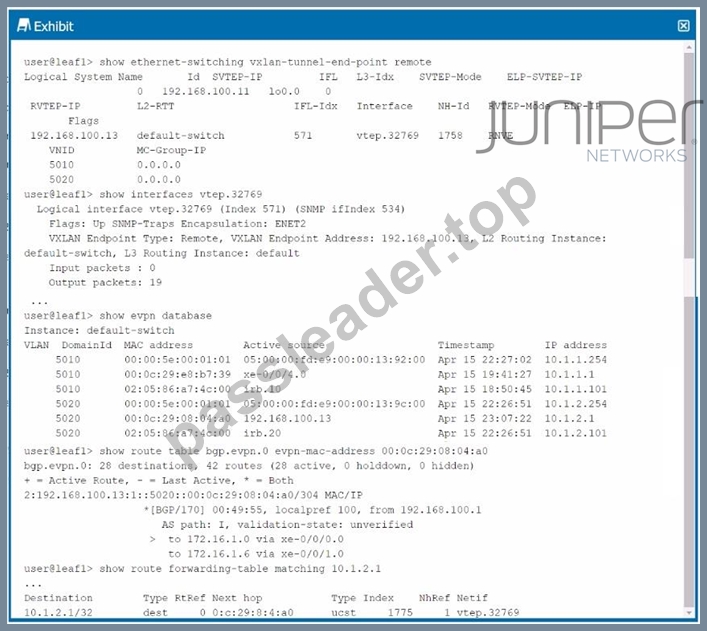
Referring to the exhibit, Host1 (10.1.1.1) is failing to communicate with Host2 (10.1.2.1) in a data center that uses an ERB architecture. What do you determine from the output?
- A. The irb.20 interface is not configured on leaf1.
- B. The traffic is failing because load balancing is not configured correctly.
- C. Host1 and Host2 are directly connected to leaf1.
- D. The traffic is entering the VXLAN tunnel.
Answer: D
Explanation:
Understanding the Problem:
* Host1 (10.1.1.1) is failing to communicate with Host2 (10.1.2.1) within an EVPN-VXLAN environment using ERB architecture.
Analysis of the Exhibit:
* The provided output includes information from the show route forwarding-table matching command for IP 10.1.2.1. The next hop is shown as vtep.32769, which indicates that the traffic destined for 10.1.2.1 is being forwarded into the VXLAN tunnel with the correct VTEP (VXLAN Tunnel Endpoint).
Conclusion:
* Option B:Correct-The traffic from Host1 is entering the VXLAN tunnel, as evidenced by the next hop pointing to a VTEP. However, the issue could lie elsewhere, possibly with the remote VTEP, routing configurations, or the receiving leaf/spine devices.
NEW QUESTION # 43
You are implementing VXLAN broadcast domains in your data center environment. Which two statements are correct in this scenario? (Choose two.)
- A. The VNI is a 16-bit value and can range from 0 through 16.777.215.
- B. The VNI must match the VLAN tag to ensure that the remote VTEP can decapsulate VXLAN packets.
- C. Layer 2 frames are encapsulated by the source VTEP.
- D. A VXLAN packet does not contain a VLAN ID.
Answer: C,D
Explanation:
* VXLAN Overview:
* VXLAN (Virtual Extensible LAN) is a network virtualization technology that encapsulates Layer
2 Ethernet frames into Layer 3 UDP packets for transmission over an IP network. It allows the creation of Layer 2 overlay networks across a Layer 3 infrastructure.
* Understanding VXLAN Components:
* VTEP (VXLAN Tunnel Endpoint):A VTEP is responsible for encapsulating and decapsulating Ethernet frames into and from VXLAN packets.
* VNI (VXLAN Network Identifier):A 24-bit identifier used to distinguish different VXLAN segments, allowing for up to 16 million unique segments.
* Correct Statements:
* C. Layer 2 frames are encapsulated by the source VTEP:This is correct. In a VXLAN deployment, the source VTEP encapsulates the original Layer 2 Ethernet frame into a VXLAN packet before transmitting it over the IP network to the destination VTEP, which then decapsulates it.
* A. A VXLAN packet does not contain a VLAN ID:This is correct. The VXLAN header does not carry the original VLAN ID; instead, it uses the VNI to identify the network segment. The VLAN ID is local to the switch and does not traverse the VXLAN tunnel.
* Incorrect Statements:
* B. The VNI must match the VLAN tag to ensure that the remote VTEP can decapsulate VXLAN packets:This is incorrect. The VNI is independent of the VLAN tag, and the VLAN ID does not need to match the VNI. The VNI is what the remote VTEP uses to identify the correct VXLAN segment.
* D. The VNI is a 16-bit value and can range from 0 through 16,777,215:This is incorrect because the VNI is a 24-bit value, allowing for a range of 0 to 16,777,215.
Data Center References:
* VXLAN technology is critical for modern data centers as it enables scalability and efficient segmentation without the constraints of traditional VLAN limits.
NEW QUESTION # 44
You are asked to set up an IP fabric that supports AI or ML workloads. You have chosen to use lossless Ethernet.
In this scenario, which statement is correct about congestion management?
- A. The switch experiencing the congestion notifies the source device.
- B. Only the source and destination devices need ECN enabled.
- C. ECN marks packets based on WRED settings.
- D. ECN is negotiated only among the switches that make up the IP fabric for each queue.
Answer: A
Explanation:
In a lossless Ethernet environment, such as one designed to support AI or ML workloads, ECN (Explicit Congestion Notification) is used to signal congestion to the source device. When congestion occurs in the network, the switch experiencing the congestion marks packets with ECN to notify the source device. This allows the source to adjust its sending rate, helping to avoid further congestion and ensuring that traffic continues to flow efficiently.
NEW QUESTION # 45
You are asked to deploy 100 QFX Series devices using ZTP Each OFX5120 requires a different configuration. In this scenario, what are two components that you would configure on the DHCP server?
(Choose two.)
- A. the MAC address for each OFX5120
- B. the MAC address of the FTP server
- C. the management IP address for each OFX5120
- D. the IP address of the FTP server
Answer: A,C
Explanation:
* Zero Touch Provisioning (ZTP):
* ZTP allows for the automated configuration of network devices, like QFX Series switches, without manual intervention. During ZTP, a switch will obtain its configuration from a DHCP server and then download the required software and configuration files from a specified server (e.
g., FTP, HTTP).
* DHCP Server Configuration:
* Option B:The DHCP server needs to know theMAC address for each QFX5120to provide a specific configuration based on the device identity. By mapping the MAC address to a particular configuration, the DHCP server can ensure that each switch gets the correct configuration.
* Option D:Themanagement IP address for each QFX5120must also be assigned by the DHCP server. This IP address allows the device to communicate on the network and access the configuration files and other required resources during the ZTP process.
Conclusion:
* Option B:Correct-MAC addresses allow the DHCP server to identify each QFX5120 and assign the appropriate configuration.
* Option D:Correct-Management IP addresses are essential for network communication during ZTP.
NEW QUESTION # 46
Exhibit.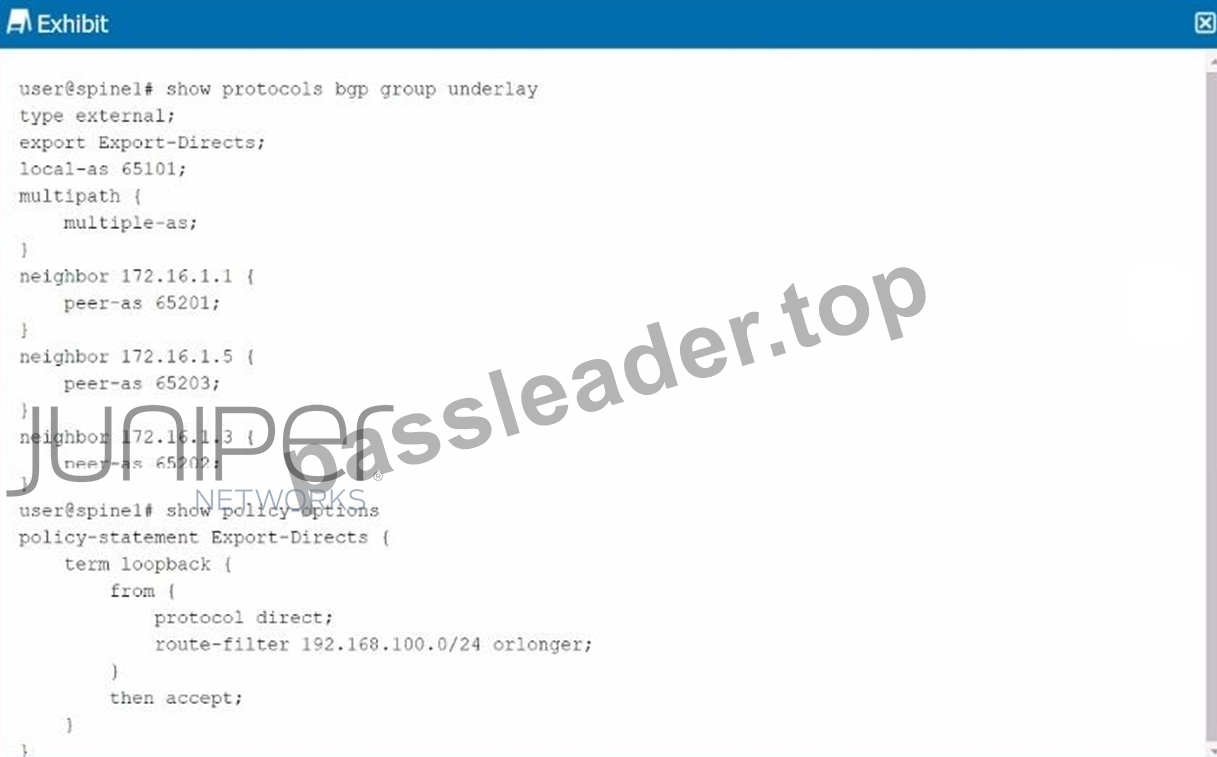
Referring to the exhibit, the spinel device has an underlay BGP group that is configured to peer with its neighbors' directly connected interfaces. Which two statements are true in this scenario? (Choose two.)
- A. The multihop statement is not required to establish the underlay BGP sessions.
- B. Load balancing for the underlay is not configured correctly.
- C. The multihop statement is required to establish the underlay BGP sessions.
- D. Load balancing for the underlay is configured correctly.
Answer: C,D
NEW QUESTION # 47
Exhibit.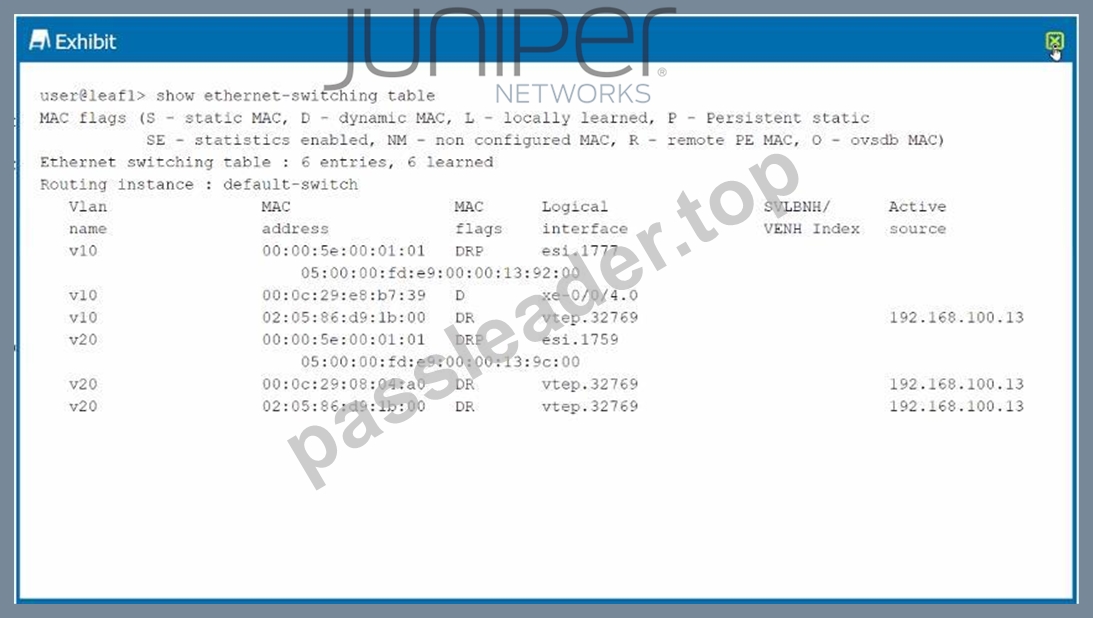
Referring to the exhibit, why is the active source field blank for the entry that uses the 00:0c:29:e8:b7:39 MAC address?
- A. The host for this entry is locally connected to leaf1.
- B. The ARP lookup for this host has failed.
- C. The EVPN route for this host does not have a valid next hop.
- D. This entry is associated with a multicast EVPN route.
Answer: A
NEW QUESTION # 48
You are asked to build redundant gateways in your EVPN-VXLAN environment, but you must conserve address space because these gateways must span across seven PES. What should you implement on the PEs lo satisfy these requirements?
- A. Use IRB interfaces with the same IP and MAC address.
- B. Use IRB interfaces with different IP addresses and the same VGA.
- C. Use IRB interfaces with the same IP address and different MAC addresses.
- D. Use IRB interfaces with the same IP and VGA.
Answer: A
Explanation:
* Redundant Gateways in EVPN-VXLAN:
* In an EVPN-VXLAN environment, providing redundant gateway functionality typically involves the use of Anycast Gateway. This allows multiple PEs (Provider Edge devices) to use the same IP address and MAC address for the gateway, enabling seamless failover and redundancy without IP conflicts.
* Conserving Address Space:
* Using the same IP address across multiple PEs conserves address space because only one IP address is needed for the gateway function, regardless of the number of PEs. The shared MAC address ensures that ARP resolution and forwarding behavior are consistent across all the PEs.
Conclusion:
* Option C:Correct-Using IRB interfaces with the same IP and MAC address across all PEs satisfies the need for redundancy while conserving address space.
OptionsA, B,andDintroduce unnecessary complexity or do not fully utilize the efficient Anycast Gateway approach, which is best practice for conserving IP space and providing redundancy.
NEW QUESTION # 49
You are designing an IP fabric tor a large data center, and you are concerned about growth and scalability.
Which two actions would you take to address these concerns? (Choose two.)
- A. Design a five-stage Clos IP fabric.
- B. Design a three-stage Clos IP fabric.
- C. Use OFX5700 Series devices as the super spines.
- D. Use EX4300 Series devices as the spine devices.
Answer: B,C
Explanation:
* Clos IP Fabric Design:
* A Clos fabric is a network topology designed for scalable, high-performance data centers. It is typically arranged in multiple stages, providing redundancy, high bandwidth, and low latency.
* Three-Stage Clos Fabric:
* Option B:A three-stage Clos fabric, consisting of leaf, spine, and super spine layers, is widely used in data centers. This design scales well and allows for easy expansion by adding more leaf and spine devices as needed.
* Super Spines for Scalability:
* Option D:Using high-capacity devices like the QFX5700 Series as super spines can handle the increased traffic demands in large data centers and support future growth. These devices provide the necessary bandwidth and scalability for large-scale deployments.
Conclusion:
* Option B:Correct-A three-stage Clos fabric is a proven design that addresses growth and scalability concerns in large data centers.
* Option D:Correct-QFX5700 Series devices are suitable for use as super spines in large-scale environments due to their high performance.
NEW QUESTION # 50
......
Juniper JN0-683 Exam Syllabus Topics:
| Topic | Details |
|---|---|
| Topic 1 |
|
| Topic 2 |
|
| Topic 3 |
|
| Topic 4 |
|
| Topic 5 |
|
JN0-683 Study Guide Brilliant JN0-683 Exam Dumps PDF: https://www.passleader.top/Juniper/JN0-683-exam-braindumps.html
Passing Juniper JN0-683 Exam Using 2026 Practice Tests: https://drive.google.com/open?id=1Q2ecMbQD4J1siBRGaa12nb8djnFrpd8h