

Get Latest [Mar-2026] Conduct effective penetration tests using PassLeader MSP-Practitioner
Penetration testers simulate MSP-Practitioner exam PDF
Peoplecert MSP-Practitioner Exam Syllabus Topics:
| Topic | Details |
|---|---|
| Topic 1 |
|
| Topic 2 |
|
| Topic 3 |
|
| Topic 4 |
|
NEW QUESTION # 26
Which of following is part of critical benefits validation test?
- A. Accurate
- B. Currency
- C. Attribution
- D. Availability
Answer: C
Explanation:
The four critical tests for benefits validation are Description, Observable outcomes, Attribution, and Measurement. "Attribution" assesses whether the programme is genuinely responsible for the benefit. The MSP Practitioner confirms, "Four tests of business validation are: Description, Observable outcomes, Attribution and Measurement," emphasizing the importance of validating benefits to ensure they result directly from programme activities.
NEW QUESTION # 27
Which of the following is not an Input to delivering the capability?
- A. Project dossier
- B. Blueprint
- C. Business Case
- D. Project outputs
Answer: D
NEW QUESTION # 28
The CFO has been appointed as the SRO for the Smart Meter Programme.
Is this appointment an appropriate application of the 'organization' theme, and why?
- A. No, because the CEO, who has industry knowledge, is better qualified to develop the programme vision
- B. Yes, because the CFO is able to monitor whether the increase in customers and reduction in costs is achieved
- C. No, because the CFO has no previous experience or working knowledge of the utility industry operations
- D. Yes, because the CFO can direct the programme, providing new insights as they are new to UU
Answer: B
Explanation:
Comprehensive and Detailed 200 to 250 words of Explanation From Exact Extract of project- programme-and-portfolio-management of 5th Edition MSP:
In MSP 5th Edition, the Organization Theme defines the roles and responsibilities required to direct, manage, and deliver the programme. The most critical role is the Senior Responsible Owner (SRO). The SRO is ultimately accountable for the programme's success and must be a senior individual with the authority to ensure the programme meets its objectives and delivers the projected benefits.
The appointment of a Chief Finance Officer (CFO) as the SRO is highly appropriate because the SRO must
"own" the Business Case. Since the primary drivers of the Smart Meter Programme are financial (increasing customer numbers and reducing operational costs), the CFO is best positioned to monitor these outcomes.
According to MSP, the SRO must provide strategic direction and ensure that the programme remains viable and focused on its benefits. Option A is correct because it highlights the SRO's responsibility for benefit realization and financial accountability. While technical or industry knowledge (as mentioned in Options C and D) is helpful, the primary requirement for an SRO is the ability to lead the change and be accountable for the investment. The CEO (Option D) is usually part of the Sponsoring Group to whom the SRO reports, rather than being the SRO themselves, to maintain a layer of objective oversight.
NEW QUESTION # 29
Which document is created from Programme mandate and works as input for Business Case?
- A. Blueprint
- B. Programme Brief
- C. Programme preparation plan
- D. Programme management plan
Answer: B
NEW QUESTION # 30
It has been agreed with the sponsoring group that a risk review should be held before any of the new customer processes and web-based portal services are used by call centre staff to consider any risks before transition.
This risk review needs to be documented appropriately.
Which role should approve the inclusion of this risk review in the relevant programme control document?
- A. Senior responsible owner
- B. Programme manager
- C. Business change manager
- D. Programme office lead
Answer: A
Explanation:
Comprehensive and Detailed 200 to 250 words of Explanation From Exact Extract of project- programme-and-portfolio-management of 5th Edition MSP:
The Senior Responsible Owner (SRO) is the individual ultimately accountable for the programme. One of the SRO's primary responsibilities is to ensure that the programme is governed effectively and that all necessary controls are in place to protect the organization and ensure benefit realization. Governance includes the approval of the Programme Strategy and its subsidiary plans, such as the Risk Management Approach and the Transition Plan.
In this scenario, holding a risk review before transition is a critical governance control. Because this decision was agreed with the Sponsoring Group, it becomes a formal part of the programme's oversight framework.
Option A is correct because the SRO is the person authorized to approve the "rules of the game" for the programme. While the Programme Manager (Option B) might draft the document and the Programme Office (Option D) might maintain it, the authority to approve how the programme will be controlled-especially regarding high-stakes activities like transitioning to new customer processes-rests with the SRO. The SRO must be satisfied that the risks are being managed before the business assumes the impact of the change. This ensures that the programme remains aligned with corporate risk appetite and strategic objectives.
NEW QUESTION # 31
Which of the following statements best defines 'transformational Flow'?
- A. Allow organizations to put in place right leadership, delivery team, robust organization structures and controls
- B. Temporary flexible organization created to coordinate, direct and oversee implementation of set of related projects
- C. Common factors of success derived from lessons learned in programmes that had both positive and negative results
- D. Provides a route through lifecycle of a programme, from its conception through to delivering new capability
Answer: D
NEW QUESTION # 32
Which of the following is not correct about 'Leading change'?
- A. Get approval from sponsoring group
- B. Actively engage stakeholder
- C. Appoint right people at right time
- D. Create novel solutions to problems
Answer: A
NEW QUESTION # 33
The programme is now in the 'close the programme' process. All the planned training from the Training Project has been completed. However, it is too early to tell how much impact the training will have on service to customers. This will need to be monitored during normal business operation.
Which theme is MOST relevant to this situation?
- A. Structure
- B. Knowledge
- C. Design
- D. Organization
Answer: B
Explanation:
Comprehensive and Detailed 200 to 250 words of Explanation From Exact Extract of project- programme-and-portfolio-management of 5th Edition MSP:
The Knowledge Theme in MSP 5th Edition is not only about the information used during the programme but also about the knowledge and data that must persist after the programme has closed. A key element of this theme is Benefit Realization, which often continues long after the programme's formal closure.
Option B is the correct answer. The situation described involves the long-term monitoring of a benefit (improved service to customers) that resulted from a programme output (the training). According to MSP 5th Edition, when a programme closes, the responsibility for ongoing benefit monitoring and the capture of
"lessons learned" must be handed over to the permanent organization. The Knowledge theme ensures that the frameworks for measuring these impacts (the Benefit Realization Plan) are in place and that the
"knowledge" of how to measure success is transferred to the Business Change Managers or operational leads. This ensures that the organization continues to track the value of the investment even after the programme team has disbanded. This focus on post-closure data and the persistence of information for future learning is a core pillar of the Knowledge theme within the MSP framework.
NEW QUESTION # 34
The programme is in the 'design the outcomes' process. The programme team is reviewing the programme brief and a revised version of the vision statement that has been prepared and validated in a workshop with key stakeholders.
What action should the programme manager and BCM take FIRST?
- A. Capture uncertain events that would affect one or more outcomes of benefit in the risk register
- B. Schedule the activities and resources to track the observable outcomes and realization of benefits
- C. Hold a workshop to confirm and document the increased customer numbers with call centre managers
- D. Analyse past programme benefit profiles in order to agree a new, standard template to be used by the programme team
Answer: C
Explanation:
Comprehensive and Detailed 200 to 250 words of Explanation From Exact Extract of project- programme-and-portfolio-management of 5th Edition MSP:
The 'Design the outcomes' process is where the high-level vision is translated into a detailed Target Operating Model (TOM) and a Benefit Framework. Once the vision is validated, the next logical step in the MSP transformational flow is to begin detailing the benefits that the new state will provide.
Option B is the correct answer because it focuses on quantifying the benefits-specifically the "increased customer numbers." Before scheduling resources (Option C) or refining risk registers (Option A), the Business Change Manager (BCM) and the Programme Manager must work with the business (the call centre managers) to define what success looks like in measurable terms. This involves creating Benefit Profiles. By holding a workshop to confirm these numbers, the BCM ensures that the benefits are realistic, owned by the business, and directly linked to the validated vision. This step is crucial for the Justification Theme, as it provides the evidence needed to build the detailed Business Case. In MSP 5th Edition, the
"benefits-led" nature of programmes means that defining the measurable improvements is a top priority once the desired future state (the vision) is understood. Only after these benefits are clearly identified and documented can the programme effectively plan the delivery of the capabilities required to achieve them.
NEW QUESTION # 35
Three pieces of information should be documented in the information approach section of the programme strategy. In which section should this information be documented?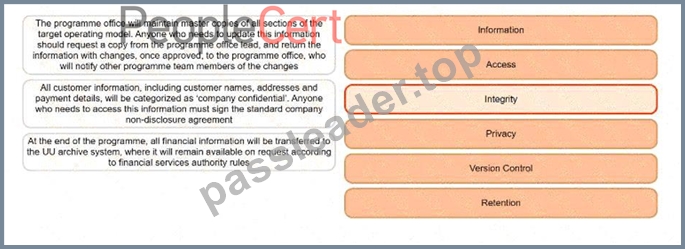
Answer:
Explanation: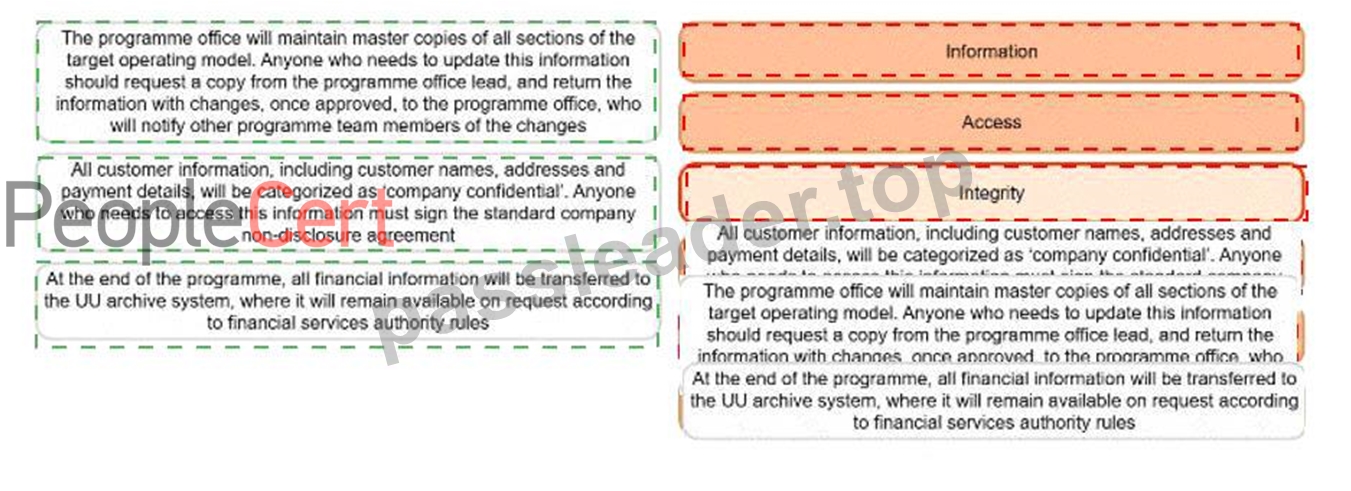
Explanation:
Information
Section
The programme office will maintain master copies of all sections of the TOM. Requests for updates must be approved before being notified to the team Version Control All customer information... will be categorized as 'company confidential'. Anyone needing access must sign the standard company NDA Privacy At the end of the programme, all financial information will be transferred to the UU archive system...
available on request
Retention
Controlling master copies and approving updates is the definition of Version Control. Handling sensitive personal data and NDAs falls under Privacy. Archiving and long-term availability post-programme is the focus of Retention
NEW QUESTION # 36
Which of the following is Management document?
- A. Issue Register
- B. Project Dossier
- C. Programme Mandate
- D. Programme brief
Answer: A
Explanation:
The Issue Register is a Management document, which captures, categorizes, and tracks issues arising during programme delivery. Management documents guide day-to-day operational activities, providing information and control mechanisms necessary for managing programme progress and risks.
According to the MSP Practitioner, "All plans, issue register and Risk register are management documents." The Programme Brief and Programme Mandate are boundary documents that set scope and governance parameters, while the Project Dossier is used to manage individual projects.
The Issue Register supports decision-making and issue resolution, helping maintain programme momentum and ensuring emerging problems are effectively addressed and escalated as required.
NEW QUESTION # 37
Which of below statements are false?
- A. Benefits management identify risks
- B. Benefits management identifies dependency in plans
- C. End of tranche review drives benefits management
- D. Benefits management qualifies Blueprint
Answer: C
NEW QUESTION # 38
Which is not a valid response for a threat?
- A. Reduce
- B. Enhance
- C. Accept
- D. Avoid
Answer: B
Explanation:
In MSP, threats are negative risks that could impact the programme adversely. Valid responses to threats include Avoiding, Accepting, or Reducing the risk to mitigate potential harm. However, "Enhance" is not a valid response for a threat because it implies increasing the likelihood or impact, which is contrary to risk management objectives.
The MSP Practitioner states: "Threats should be minimized not enhanced," reinforcing the principle that risk responses should focus on reducing negative effects or avoiding risks altogether. Accepting a risk might be chosen when mitigation is impractical or cost-prohibitive but still requires monitoring.
Understanding and applying appropriate risk responses is vital to effective programme risk management and maintaining control over uncertainties that could derail delivery.
NEW QUESTION # 39
Which of following documents are parts of governance themes?
- A. Business Case, Programme mandate
- B. System and product specification
- C. Blueprint, Vision, Quality management strategy
- D. Blueprint, Requirement Specification
Answer: C
Explanation:
Blueprint, Vision, and Quality Management Strategy are core parts of MSP's Governance Themes. These documents set the strategic direction, define the future state, and establish quality control frameworks, respectively.
The MSP Practitioner notes: "Blueprint, Business Case, Vision, Quality management are governance themes," though the Business Case and Programme Mandate also play governance roles, the listed group in option A is most directly related to governance themes that provide control and assurance.
These documents form the backbone of programme governance by setting expectations, standards, and guiding principles that ensure the programme remains aligned with corporate strategy and delivers value effectively.
NEW QUESTION # 40
Which of the following is Not one of MSP defined levels of stakeholder engagement?
- A. Formally Approve
- B. Active Consultation
- C. Keep informed
- D. Maintain Interest
Answer: A
Explanation:
"Formally Approve" is not one of the MSP-defined levels of stakeholder engagement. MSP outlines levels such as Maintain Interest, Active Consultation, and Keep Informed to categorize the nature and intensity of stakeholder engagement.
The MSP Practitioner indicates: "Fourth option is face to face," which means formal approval is a governance or decision-making activity rather than an engagement level.
Understanding and applying appropriate engagement levels ensures stakeholders receive relevant information and involvement suited to their influence and interest, facilitating support and minimizing resistance.
This categorization aids programme teams in managing communication and expectations effectively.
NEW QUESTION # 41
Which of following documents are parts of governance themes?
- A. Business Case, Programme mandate
- B. System and product specification
- C. Blueprint, Vision, Quality management strategy
- D. Blueprint, Requirement Specification
Answer: C
NEW QUESTION # 42
Which of the following is a critical organizational element?
- A. Delivery mechanisms for change
- B. Stakeholder engagement
- C. Quality management and assurance
- D. Leading change
Answer: A
NEW QUESTION # 43
Which type of cost is associated in training, moving and supporting an operational unit?
- A. Programme management cost
- B. Business change and transition cost
- C. Capital cost
- D. Benefits realization cost
Answer: B
Explanation:
Training, moving, and supporting operational units fall under business change and transition costs. These costs are related to the activities required to move from the current state to the future state, including training staff and supporting new operations. The MSP Practitioner clarifies: "Training and moving an operational unit is related to transition," distinguishing these from capital costs (assets) and programme management costs.
NEW QUESTION # 44
The programme has successfully completed all projects and work according to the delivery plan and is in the
'close the programme' process. All internal staff, who had worked on the programme, must now be transferred back into business as usual roles.
Which role should be responsible for managing these activities?
- A. Business change manager
- B. Sponsoring group members
- C. Senior responsible owner
- D. Programme manager
Answer: D
Explanation:
Comprehensive and Detailed 200 to 250 words of Explanation From Exact Extract of project- programme-and-portfolio-management of 5th Edition MSP:
The 'Close the programme' process involves the orderly decommissioning of the programme's infrastructure, including its people, assets, and technology. While the SRO is accountable for the closure, the Programme Manager is the role responsible for the practical execution of these activities.
Option C is correct because the Programme Manager's remit includes the "management of the programme team" and the "decommissioning of the programme's organization." Managing the transfer of internal staff back into Business As Usual (BAU) roles is a management task that requires coordination with HR and functional line managers. The Programme Manager must ensure that staff are released in a way that doesn't leave the programme with "resource gaps" during the final administrative wrap-up, while also ensuring the organization reabsorbs its talent effectively. This falls under the Programme Manager's responsibility for the Organization Theme, specifically the aspect of managing the programme's human resources throughout the lifecycle, from the initial "Plan progressive delivery" through to final closure. The BCM (Option D) focuses on the embedding of benefits in the business, not the management of the programme's internal delivery team.
NEW QUESTION # 45
......
Tested Material Used To MSP-Practitioner Test Engine: https://www.passleader.top/Peoplecert/MSP-Practitioner-exam-braindumps.html
Steps Necessary To Pass The MSP-Practitioner Exam: https://drive.google.com/open?id=1lgsiq-PhcMR55AQQ5us-eHas0-RS2HUf