

Free 365 Days Exam Updates NCP-US-6.5 dumps with test Engine Practice
Updated Verified NCP-US-6.5 dumps Q&As - 100% Pass Guaranteed
Nutanix NCP-US-6.5 Exam Syllabus Topics:
| Topic | Details |
|---|---|
| Topic 1 |
|
| Topic 2 |
|
| Topic 3 |
|
| Topic 4 |
|
| Topic 5 |
|
| Topic 6 |
|
NEW QUESTION # 58
An administrator needs to protect a Files cluster unique policies for different shares.
How should the administrator meet this requirement?
- A. Create a protection domain in the Data Protection view in Prism Central.
- B. Configure data protection polices in the Files view in Prism Central.
- C. Create a protection domain in the Data Protection view in Prism Element.
- D. Configure data protection polices in File Server view in Prism Element
Answer: B
Explanation:
The administrator can meet this requirement by configuring data protection policies in the Files view in Prism Central. Data protection policies are policies that define how file data is protected by taking snapshots, replicating them to another site, or tiering them to cloud storage. Data protection policies can be configured for each share or export in a file server in the Files view in Prism Central. The administrator can create different data protection policies for different shares or exports based on their protection needs and requirements. Reference: Nutanix Files Administration Guide, page 79; Nutanix Files Solution Guide, page 9
NEW QUESTION # 59
Nutanix Objects can use no more than how many vCPUs for each AHV or ESXi node?
- A. 0
- B. 1
- C. 2
- D. 3
Answer: C
Explanation:
Nutanix Objects, a component of Nutanix Unified Storage (NUS), provides an S3-compatible object storage solution. It is deployed as a set of virtual machines (Object Store Service VMs) running on the Nutanix cluster's hypervisor (AHV or ESXi). The resource allocation for these VMs, including the maximum number of vCPUs per node, is specified in the Nutanix Objects documentation to ensure optimal performance and resource utilization.
According to the official Nutanix documentation, each Object Store Service VM is limited to a maximum of 8 vCPUs per node (AHV or ESXi). This constraint ensures that the object storage service does not overburden the cluster's compute resources, maintaining balance with other workloads.
* Option C: Correct. The maximum number of vCPUs for Nutanix Objects per node is 8.
* Option A (12), Option B (16), and Option D (10): Incorrect, as they exceed or do not match the documented maximum of 8 vCPUs per node.
Exact Extract from Nutanix Documentation:
From the Nutanix Objects Administration Guide (available on the Nutanix Portal):
"Each Object Store Service VM deployed on an AHV or ESXi node is configured with a maximum of 8 vCPUs to ensure efficient resource utilization and performance. This limit applies per node hosting the Object Store Service." Additional Notes:
* The vCPU limit is per Object Store Service VM on a given node, not for the entire Objects deployment.
Multiple VMs may run across different nodes, but each is capped at 8 vCPUs.
* The documentation does not specify different limits for AHV versus ESXi, so the 8 vCPU maximum applies universally.
:
Nutanix Objects Administration Guide, Version 4.0, Section: "Object Store Resource Requirements" (Nutanix Portal).
Nutanix Certified Professional - Unified Storage (NCP-US) Study Guide, Section: "Nutanix Objects Deployment".
NEW QUESTION # 60
A team of developers are working on a new processing application and requires a solution where they can upload the ... code for testing API calls. Older iterations should be retained as newer code is developer and tested.
- A. Provision a Volume Group and connect via iSCSI with MPIO.
- B. Create a bucket in Objects with Versioning enabled.
- C. Create an NFS Share, mounted on a Linux Server with Files.
- D. Create an SMB Share with Files and enable Previous Version
Answer: B
Explanation:
Nutanix Objects supports versioning, which is a feature that allows multiple versions of an object to be preserved in the same bucket. Versioning can be useful for developers who need to upload their code for testing API calls and retain older iterations as newer code is developed and tested. Versioning can also provide protection against accidental deletion or overwrite of objects. Reference: Nutanix Objects Administration Guide
NEW QUESTION # 61
An administrator has received an alert AI60068 - ADSDuplicationIPDetected details of alert as follows: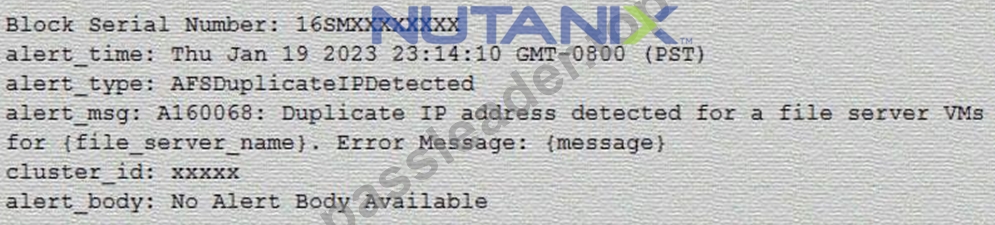
Which error log should the administrator review to determine the related Duplicate IP address involved?
- A. Solver.log
- B. Tcpkill.log
- C. Minerva_cvm.log
- D. Minerva.nvm.log
Answer: D
Explanation:
https://portal.nutanix.com/page/documents/kbs/details?targetId=kA00e000000CvHICA0
NEW QUESTION # 62
An administrator has created a distributed share on the Files cluster. The administrator connects to the share using Windows Explorer and starts creating folders in the share. The administrator observes that none of the created folders can be renamed as the company naming convention requires. How should the administrator resolve this issue?
- A. Modify the Files shares to use the NFS protocol.
- B. Modify the read/write permissions on the created folders.
- C. Use the Files MMC Snap-in and rename the folders.
- D. Use the Microsoft Shared Folder MMC Snap-in.
Answer: B
Explanation:
Nutanix Files, part of Nutanix Unified Storage (NUS), supports distributed shares that span multiple File Server Virtual Machines (FSVMs) for scalability (as discussed in Questions 16 and 30). The administrator has created a distributed share, accessed it via Windows Explorer (implying SMB protocol), and created folders.
However, the folders cannot be renamed to meet the company's naming convention, indicating a permissions issue.
Understanding the Issue:
* Distributed Share: A distributed share in Nutanix Files is accessible via SMB or NFS and spans multiple FSVMs.
* Windows Explorer (SMB): The administrator is using Windows Explorer, indicating the share is accessed via SMB.
* Cannot Rename Folders: The inability to rename folders suggests a permissions restriction, likely because the user account used to create the folders does not have sufficient permissions to modify them (e.g., rename).
* Company Naming Convention: The requirement to rename folders to meet a naming convention implies the administrator needs full control over the folders, which may not be granted by the current permissions.
Analysis of Options:
* Option A (Use the Microsoft Shared Folder MMC Snap-in): Incorrect. The Microsoft Shared Folder MMC Snap-in (e.g., via Computer Management) allows management of SMB shares on a Windows server, but Nutanix Files shares are managed through the Files Console or FSVMs, not a Windows server. While this tool can view shares, it does not provide a mechanism to resolve renaming issues caused by permissions on a Nutanix Files share.
* Option B (Use the Files MMC Snap-in and rename the folders): Incorrect. There is no "Files MMC Snap-in" for Nutanix Files. Nutanix Files is managed via the Files Console in Prism Central or through CLI/FSVM access. This option appears to be a misnomer and does not provide a valid solution for renaming folders.
* Option C (Modify the read/write permissions on the created folders): Correct. The inability to rename folders in an SMB share is typically due to insufficient permissions. When the administrator created the folders via Windows Explorer, the default permissions (inherited from the share or parent folder) may not grant the necessary rights (e.g., "Modify" or "Full Control") to rename them. The administrator should modify the permissions on the created folders to grant the required rights (e.g., Full Control) to the user account or group, allowing renaming to meet the company naming convention.
This can be done via Windows Explorer (Properties > Security tab) or through the Files Console by adjusting share/folder permissions.
* Option D (Modify the Files shares to use the NFS protocol): Incorrect. Switching the share to use NFS instead of SMB would require reconfiguring the share and client access, which is unnecessary and disruptive. The issue is with permissions, not the protocol, and SMB supports folder renaming if the correct permissions are set. Additionally, NFS may introduce other complexities (e.g., Unix permissions) that do not address the core issue.
Why Option C?
The inability to rename folders in an SMB share is a permissions issue. Modifying the read/write permissions on the created folders to grant the administrator (or relevant user/group) the necessary rights (e.g., Modify or Full Control) allows renaming, resolving the issue and enabling compliance with the company naming convention. This can be done directly in Windows Explorer or via the Files Console.
Exact Extract from Nutanix Documentation:
From the Nutanix Files Administration Guide (available on the Nutanix Portal):
"If users cannot rename folders in an SMB share on Nutanix Files, this is typically due to insufficient permissions. Modify the read/write permissions on the affected folders to grant the necessary rights (e.g., Modify or Full Control) to the user or group. Permissions can be adjusted via Windows Explorer (Properties > Security) or through the Files Console by editing share or folder permissions."
:
Nutanix Files Administration Guide, Version 4.0, Section: "Managing Permissions for SMB Shares" (Nutanix Portal).
Nutanix Certified Professional - Unified Storage (NCP-US) Study Guide, Section: "Nutanix Files Share Permissions".
NEW QUESTION # 63
An administrator has deployed a new Files cluster within a Windows environment. After some days, the Files environment is not able to synchronize users with the Active Directory server anymore. The administrator observes a large time difference between the Files environment and the Active Directory server that is responsible for the behavior. How should the administrator prevent the Files environment and the AD Server from having such a time difference in the future?
- A. Use the same NTP Servers for the Files environment and the AD Server.
- B. Use 0.pool.ntp.org as the NTP Server for the Files environment.
- C. Use 0.pool.ntp.org as the NTP Server for the AD Server.
- D. Connect to every FSVM and edit the time manually.
Answer: A
Explanation:
Nutanix Files, part of Nutanix Unified Storage (NUS), integrates with Active Directory (AD) for user authentication and synchronization in a Windows environment. A key requirement for AD integration is that the time between the Files environment (specifically, the File Server Virtual Machines or FSVMs) and the AD server must be synchronized, as a time difference greater than 5 minutes can cause Kerberos authentication failures, leading to synchronization issues.
Analysis of Options:
* Option A (Connect to every FSVM and edit the time manually): Incorrect. Manually editing the time on each FSVM is a temporary fix and not a sustainable solution. It does not prevent future time drift, as the FSVMs' clocks will continue to drift without proper synchronization.
* Option B (Use the same NTP Servers for the Files environment and the AD Server): Correct. The best way to prevent time differences is to ensure that both the Files environment (FSVMs) and the AD server use the same Network Time Protocol (NTP) servers for time synchronization. This ensures consistent timekeeping across both systems, avoiding authentication issues due to time skew.
* Option C (Use 0.pool.ntp.org as the NTP Server for the AD Server): Incorrect. While using 0.pool.
ntp.org as the NTP server for the AD server is a valid approach, it does not ensure synchronization unless the Files environment also uses the same NTP server. If the Files environment uses a different NTP server, time drift can still occur.
* Option D (Use 0.pool.ntp.org as the NTP Server for the Files environment): Incorrect. Similar to option C, using 0.pool.ntp.org for the Files environment alone does not guarantee synchronization with the AD server unless the AD server also uses the same NTP server.
Why Option B?
Time synchronization between Nutanix Files and AD is critical for Kerberos authentication, which has a default tolerance of 5 minutes. Using the same NTP servers for both the Files environment (configured at the cluster level via Prism Element) and the AD server ensures that both systems maintain the same time, preventing future synchronization issues.
Exact Extract from Nutanix Documentation:
From the Nutanix Files Administration Guide (available on the Nutanix Portal):
"For successful Active Directory integration, the time between the Nutanix Files environment and the AD server must be synchronized within a 5-minute window. To prevent time drift, configure both the Nutanix cluster (which manages FSVM time) and the AD server to use the same NTP servers. This ensures consistent timekeeping and avoids Kerberos authentication failures."
:
Nutanix Files Administration Guide, Version 4.0, Section: "Active Directory Integration" (Nutanix Portal).
Nutanix Certified Professional - Unified Storage (NCP-US) Study Guide, Section: "Nutanix Files AD Synchronization".
NEW QUESTION # 64
An administrator has been requested to set up a Files instance in a Nutanix environment. After testing data in the environment, it was determined an estimated 4,000 connections on average will be needed per node. What is the proper memory sizing that the administrator should use to configure this environment?
- A. 96 GiB RAM per node
- B. 40 GiB RAM per node
- C. 128 GiB RAM per node
- D. 32 GiB RAM per node
Answer: A
Explanation:
Nutanix Files, part of Nutanix Unified Storage (NUS), uses File Server Virtual Machines (FSVMs) to manage file services (e.g., SMB, NFS). Each FSVM runs on a node in the Nutanix cluster, and the number of connections per node impacts the resource requirements, particularly memory (RAM), for the FSVMs. The administrator needs to size the memory for a Files instance where each node will handle an average of 4,000 connections.
Sizing Guidelines:
Nutanix provides sizing guidelines for Files deployments based on the number of connections per FSVM (and thus per node, assuming one FSVM per node, which is the default configuration). The memory requirements scale with the number of connections to ensure performance and stability:
* The minimum memory per FSVM is 12 GiB (as noted in Question 2), which supports up to 1,000 connections.
* For higher connection counts, Nutanix recommends increasing the memory proportionally.
According to Nutanix documentation:
* Up to 1,000 connections: 12 GiB RAM per FSVM.
* 1,000 to 2,000 connections: 24 GiB RAM per FSVM.
* 2,000 to 4,000 connections: 48 GiB RAM per FSVM.
* 4,000 to 8,000 connections: 96 GiB RAM per FSVM.
Since the question specifies 4,000 connections per node, and assuming one FSVM per node (standard deployment), the FSVM on each node needs to handle 4,000 connections. Based on the sizing guidelines:
* 4,000 connections fall into the 4,000 to 8,000 range, requiring 96 GiB RAM per FSVM.
* Since each node hosts one FSVM, this translates to 96 GiB RAM per node dedicated to the FSVM.
Analysis of Options:
* Option A (32 GiB RAM per node): Incorrect. 32 GiB RAM per node is sufficient for up to 2,000 connections (24 GiB for the FSVM, plus some overhead), but it is insufficient for 4,000 connections, which require 96 GiB.
* Option B (40 GiB RAM per node): Incorrect. 40 GiB RAM per node is still too low for 4,000 connections, as it falls short of the 96 GiB recommended for this connection range.
* Option C (96 GiB RAM per node): Correct. 96 GiB RAM per node aligns with Nutanix's sizing guidelines for an FSVM handling 4,000 to 8,000 connections, ensuring the Files instance can manage the expected load efficiently.
* Option D (128 GiB RAM per node): Incorrect. While 128 GiB RAM per node would work, it exceeds the recommended sizing for 4,000 connections. Nutanix recommends 96 GiB for up to 8,000 connections, and 128 GiB is typically reserved for even higher connection counts (e.g., >8,000) or additional workloads on the node. The question asks for the "proper" sizing, which is the minimum recommended for the given load, making 96 GiB the correct choice.
Why Option C?
For 4,000 connections per node, Nutanix recommends 96 GiB RAM per FSVM (one FSVM per node), which translates to 96 GiB RAM per node dedicated to the FSVM. This ensures the Files instance can handle the connection load without performance degradation, aligning with Nutanix's sizing guidelines.
Exact Extract from Nutanix Documentation:
From the Nutanix Files Sizing Guide (available on the Nutanix Portal):
"For Nutanix Files deployments, memory sizing depends on the number of connections per FSVM. For 4,000 to 8,000 connections, allocate 96 GiB of RAM per FSVM. Assuming one FSVM per node, this translates to
96 GiB RAM per node dedicated to the FSVM to ensure optimal performance." Additional Notes:
* The question assumes one FSVM per node, which is the default configuration for Nutanix Files unless otherwise specified. If multiple FSVMs were on a single node, the total RAM would need to be adjusted, but the question's phrasing ("per node") aligns with the standard one-FSVM-per-node deployment.
* The 96 GiB RAM is for the FSVM itself; the node may require additional RAM for other workloads (e.
g., CVM, VMs), but the question focuses on the Files instance's memory sizing, making 96 GiB the correct answer.
:
Nutanix Files Sizing Guide, Version 4.0, Section: "Memory Sizing for Nutanix Files" (Nutanix Portal).
Nutanix Certified Professional - Unified Storage (NCP-US) Study Guide, Section: "Nutanix Files Sizing and Performance".
NEW QUESTION # 65
An administrator has been requested to increase the maximum capacity of a share on a Files instance. How should the administrator perform this action in Files Console?
- A. Select the Shares tab, Click Update.
- B. Select the Shares tab, Click Modify.
- C. Select the Settings tab, Click Change.
- D. Select the Settings tab, Click Rename.
Answer: B
Explanation:
Nutanix Files, part of Nutanix Unified Storage (NUS), allows administrators to manage file shares through the Files Console, which is accessible via Prism Central. A share in Nutanix Files can have a maximum capacity (quota) defined to limit its storage usage. To increase this capacity, the administrator must modify the share's settings.
Analysis of Options:
* Option A (Select the Settings tab, Click Change): Incorrect. The Settings tab in the Files Console is used for general file server settings (e.g., AD integration, global configurations), not for modifying individual share properties like capacity.
* Option B (Select the Shares tab, Click Modify): Correct. To increase the maximum capacity of a share, the administrator should navigate to the Shares tab in the Files Console, select the share, and click Modify (or Edit, depending on the version). This opens a dialog where the share's quota (maximum capacity) can be adjusted.
* Option C (Select the Settings tab, Click Rename): Incorrect. Renaming a share under the Settings tab does not affect its capacity. The Settings tab is not the correct location for share-specific changes like capacity adjustments.
* Option D (Select the Shares tab, Click Update): Incorrect. While the Shares tab is the correct location, "Update" is not a standard action in the Files Console for modifying share properties. The correct action is "Modify" or "Edit," as in option B.
Why Option B?
The Shares tab in the Files Console is where administrators manage individual shares, including their properties like maximum capacity (quota). The Modify (or Edit) action allows the administrator to adjust the share's quota, increasing its maximum capacity as requested.
Exact Extract from Nutanix Documentation:
From the Nutanix Files Administration Guide (available on the Nutanix Portal):
"To modify the maximum capacity (quota) of a share, navigate to the Shares tab in the Files Console. Select the share you want to modify, and click Modify. In the dialog, adjust the quota settings to increase the maximum capacity as needed, then save the changes."
:
Nutanix Files Administration Guide, Version 4.0, Section: "Managing Shares in Files Console" (Nutanix Portal).
Nutanix Certified Professional - Unified Storage (NCP-US) Study Guide, Section: "Nutanix Files Share Management".
NEW QUESTION # 66
A healthcare administrator configure a Nutanix cluster with the following requirements:
* Enable for long-term data retention of large files
* Data should be kept for two years
* Deletion or overwrite of the data must not be allowed
Which Nutanix-enabled technology should the administrator employ to satisfy these requirements?
- A. Files - Read-only share
- B. Objects - Life Cycle Policy
- C. Files - Connected share
- D. Objects - WORM with versioning
Answer: D
Explanation:
The Nutanix-enabled technology that meets these requirements is Objects - WORM with versioning. WORM (Write-Once Read-Many) is a feature that prevents anyone from modifying or deleting data in a bucket while the policy is active. WORM policies help comply with strict data retention regulations that mandate how long specific data must be stored. Versioning is a feature that keeps multiple versions of an object in a bucket whenever it is overwritten or deleted. Versioning policies help preserve previous versions of an object for backup or recovery purposes. By enabling WORM and versioning for an Objects bucket, the administrator can ensure that data is kept for two years without being deleted or overwritten. Reference: Nutanix Objects User Guide, page 17; Nutanix Objects Solution Guide, page 9
NEW QUESTION # 67
How many configure snapshots are supported for SSR in a file server?
- A. 0
- B. 1
- C. 2
- D. 3
Answer: A
Explanation:
The number of configurable snapshots that are supported for SSR in a file server is 200. SSR (Snapshot-based Replication) is a feature that allows administrators to replicate snapshots of shares or exports from one file server to another file server on a different cluster or site for disaster recovery purposes. SSR can be configured with various parameters, such as replication frequency, replication status, replication mode, etc. SSR supports up to 200 configurable snapshots per share or export in a file server. Reference: Nutanix Files Administration Guide, page 81; Nutanix Files Solution Guide, page 9
NEW QUESTION # 68
Life Cycle Manager must have compatible versions of which two components before installing or upgrading Files? (Choose two.)
- A. Acropolis Operating System
- B. Active Directory Services
- C. Nutanix Cluster Check
- D. File Server Module
Answer: A,C
Explanation:
Nutanix Files, part of Nutanix Unified Storage (NUS), can be installed or upgraded using Life Cycle Manager (LCM), a tool in Prism Central or Prism Element for managing software updates. Before installing or upgrading Files, LCM must ensure that the underlying components are compatible to avoid issues during the process.
Analysis of Options:
* Option A (Nutanix Cluster Check): Correct. Nutanix Cluster Check (NCC) is a health and compatibility checking tool integrated with LCM. LCM requires a compatible version of NCC to perform pre-upgrade checks and validate the cluster's readiness for a Files installation or upgrade. NCC ensures that the cluster environment (e.g., hardware, firmware, software) is compatible with the Files version being installed or upgraded.
* Option B (Active Directory Services): Incorrect. Active Directory (AD) Services are used by Nutanix Files for user authentication (e.g., for SMB shares or multiprotocol access, as in Question 60), but AD is not a component managed by LCM, nor is it a prerequisite for LCM compatibility. AD configuration is a separate requirement for Files functionality, not LCM operations.
* Option C (File Server Module): Incorrect. There is no "File Server Module" component in Nutanix terminology. Nutanix Files itself consists of File Server Virtual Machines (FSVMs), but this is the component being upgraded, not a prerequisite for LCM. LCM manages the Files upgrade directly and does not require a separate "module" compatibility.
* Option D (Acropolis Operating System): Correct. The Acropolis Operating System (AOS) is the core operating system of the Nutanix cluster, managing storage, compute, and virtualization. LCM requires a compatible AOS version to install or upgrade Files, as Files relies on AOS features (e.g., storage, networking) and APIs. LCM checks the AOS version to ensure it meets the minimum requirements for the target Files version.
Selected Components:
* A: NCC ensures cluster compatibility and readiness, which LCM relies on for Files installation or upgrades.
* D: AOS provides the underlying platform for Files, and LCM must ensure its version is compatible with the Files version being deployed.
Exact Extract from Nutanix Documentation:
From the Nutanix Files Administration Guide (available on the Nutanix Portal):
"Before installing or upgrading Nutanix Files using Life Cycle Manager (LCM), ensure that LCM has compatible versions of Nutanix Cluster Check (NCC) and Acropolis Operating System (AOS). NCC performs pre-upgrade checks to validate cluster readiness, while AOS must meet the minimum version requirements for the target Files version."
:
Nutanix Files Administration Guide, Version 4.0, Section: "Prerequisites for Files Installation/Upgrade with LCM" (Nutanix Portal).
Nutanix Certified Professional - Unified Storage (NCP-US) Study Guide, Section: "Nutanix Files LCM Requirements".
NEW QUESTION # 69
Which two platform are currently supported for Smart Tiering? (Choose two.)
- A. Wasabi
- B. AWS Standard
- C. Google Cloud Storage
- D. Azure Blob
Answer: B
Explanation:
The two platforms that are currently supported for Smart Tiering are AWS Standard and Azure Blob. Smart Tiering is a feature that allows administrators to tier data from Files to cloud storage based on file age, file size, and file type. Smart Tiering can help reduce the storage cost and optimize the performance of Files.
Smart Tiering currently supports AWS Standard and Azure Blob as the cloud storage platforms, and more platforms will be added in the future. References: Nutanix Files Administration Guide, page 99; Nutanix Files Solution Guide, page 11
NEW QUESTION # 70
An administrator needs to ensure maximum performance, throughput, and redundancy for the company's Oracle RAC on Linux implementation, while using the native method for securing workloads.
Which configuration meets these requirements?
- A. Volumes with MPIO and a single vDisk
- B. Flies with a distributed share and ABE
- C. Files with a general purpose share and File Blocking
- D. Volumes with CHAP and multiple vDisks
Answer: A
Explanation:
Volumes is a feature that allows users to create and manage block storage devices (volume groups) on a Nutanix cluster. Volume groups can be accessed by external hosts using the iSCSI protocol. To ensure maximum performance, throughput, and redundancy for Oracle RAC on Linux implementation, while using the native method for securing workloads, the recommended configuration is to use Volumes with MPIO (Multipath I/O) and a single vDisk (virtual disk). MPIO is a technique that allows multiple paths between an iSCSI initiator and an iSCSI target, which improves performance and availability. A single vDisk is a logical unit number (LUN) that can be assigned to multiple hosts in a volume group, which simplifies management and reduces overhead. Reference: Nutanix Volumes Administration Guide, page 13; Nutanix Volumes Best Practices Guide
NEW QUESTION # 71
An organization is implementing their first Nutanix cluster. In addition to hosting VMs, the cluster will be providing block storage services to existing physical servers, as well as CIFS shares and NFS exports to the end users. Security policies dictate that separate networks are used for different functions, which are already configured as:
* Management - VLAN 500 - 10.10.50.0/24
* iSCSI access - VLAN 510 - 10.10.51.0/24
* Files access - VLAN 520 - 10.10.52.0/24How should the administrator configure the cluster to ensure the CIFS and NFS traffic is on the correct network and accessible by the end users?
- A. Create a new subnet in Network Configuration, assign it VLAN 520, and configure the Files client network on it.
- B. Configure the Data Services IP in Prism Central with an IP on VLAN 520.
- C. Create a new virtual switch in Network Configuration, assign it VLAN 520, and configure the Files client network on it.
- D. Configure the Data Services IP in Prism Element with an IP on VLAN 520.
Answer: A
Explanation:
The organization is deploying a Nutanix cluster to provide block storage (via iSCSI), CIFS shares, and NFS exports (via Nutanix Files). Nutanix Files, part of Nutanix Unified Storage (NUS), uses File Server Virtual Machines (FSVMs) to serve CIFS (SMB) and NFS shares to end users. The security policy requires separate networks:
* Management traffic on VLAN 500 (10.10.50.0/24).
* iSCSI traffic on VLAN 510 (10.10.51.0/24).
* Files traffic on VLAN 520 (10.10.52.0/24).
To ensure CIFS and NFS traffic uses VLAN 520 and is accessible by end users, the cluster must be configured to route Files traffic over the correct network.
Analysis of Options:
* Option A (Create a new subnet in Network Configuration, assign it VLAN 520, and configure the Files client network on it): Correct. Nutanix Files requires two networks: a Client network (for CIFS
/NFS traffic to end users) and a Storage network (for internal communication with the cluster's storage pool). To isolate Files traffic on VLAN 520, the administrator should create a new subnet in the cluster' s Network Configuration (via Prism Element), assign it to VLAN 520, and then configure the Files instance to use this subnet as its Client network. This ensures that CIFS and NFS traffic is routed over VLAN 520, making the shares accessible to end users on that network.
* Option B (Configure the Data Services IP in Prism Element with an IP on VLAN 520): Incorrect.
The Data Services IP is used for iSCSI traffic (as seen in Question 25, where it was configured for VLAN 510). It is not used for CIFS or NFS traffic, which is handled by Nutanix Files. Configuring the Data Services IP on VLAN 520 would incorrectly route iSCSI traffic, not Files traffic.
* Option C (Create a new virtual switch in Network Configuration, assign it VLAN 520, and configure the Files client network on it): Incorrect. A virtual switch is used for VM networking (e.g., for AHV VMs), but Nutanix Files traffic is handled by FSVMs, which use the cluster's network configuration for external communication. While FSVMs are VMs, their network configuration is managed at the Files instance level by specifying the Client network, not by creating a new virtual switch. The correct approach is to configure the subnet for the Files Client network, as in option A.
* Option D (Configure the Data Services IP in Prism Central with an IP on VLAN 520): Incorrect.
As with option B, the Data Services IP is for iSCSI traffic, not CIFS/NFS traffic. Additionally, the Data Services IP is configured in Prism Element, not Prism Central, making this option doubly incorrect.
Why Option A?
Nutanix Files requires a Client network for CIFS and NFS traffic. By creating a new subnet in the cluster's Network Configuration, assigning it to VLAN 520, and configuring the Files instance to use this subnet as its Client network, the administrator ensures that all CIFS and NFS traffic is routed over VLAN 520, meeting the security policy and ensuring accessibility for end users.
Exact Extract from Nutanix Documentation:
From the Nutanix Files Administration Guide (available on the Nutanix Portal):
"Nutanix Files requires a Client network for CIFS and NFS traffic to end users. To isolate Files traffic on a specific network, create a subnet in the cluster's Network Configuration in Prism Element, assign it the appropriate VLAN (e.g., VLAN 520), and configure the Files instance to use this subnet as its Client network.
This ensures that all client traffic (SMB/NFS) is routed over the specified network."
:
Nutanix Files Administration Guide, Version 4.0, Section: "Configuring Network for Nutanix Files" (Nutanix Portal).
Nutanix Certified Professional - Unified Storage (NCP-US) Study Guide, Section: "Nutanix Files Network Configuration".
NEW QUESTION # 72
An administrator wants to monitor their Files environment for suspicious activities, such mass deletion or access denials.
How can the administrator be alerted to such activities?
How can the administrator be alerted to such activities?
- A. Create a data protection policy in the Files view in Prism Central.
- B. Configure Alerts & Events in the Files Console, filtering for Warning severity.
- C. Configure Files to use ICAP servers, with monitors for desired activities.
- D. Deploy the Files Analytics VM. and configure anomaly rules.
Answer: D
Explanation:
The administrator can monitor their Files environment for suspicious activities, such as mass deletion or access denials, by deploying the File Analytics VM and configuring anomaly rules. File Analytics is a feature that provides insights into the usage and activity of file data stored on Files. File Analytics consists of a File Analytics VM (FAVM) that runs on a Nutanix cluster and communicates with the File Server VMs (FSVMs) that host the file shares. File Analytics can alert the administrator when there is an unusual or suspicious activity on file data, such as mass deletion, encryption, permission change, or access denial. The administrator can configure anomaly rules to define the threshold, time window, and notification settings for each type of anomaly. References: Nutanix Files Administration Guide, page 93; Nutanix File Analytics User Guide
NEW QUESTION # 73
An existing Object bucket was created for backups with these requirements:
* WORM policy of one year
* Versioning policy of one year
* Lifecycle policy of three years
A recent audit has reported a compliance failure. Data that should be retained for three years has been deleted prematurely.
How should the administrator resolve the compliance failure within Objects?
- A. Modify the existing bucket versioning policy from one year to three years.
- B. Create a tiering policy to store deleted data on cold storage for three years.
- C. Recreate a new bucket with the retention policy of three years.
- D. Modify the existing bucket WORM policy from one year to three years.
Answer: D
Explanation:
The administrator should resolve the compliance failure within Objects by modifying the existing bucket WORM (Write-Once Read-Many) policy from one year to three years. WORM is a feature that prevents anyone from modifying or deleting data in a bucket while the policy is active. WORM policies help comply with strict data retention regulations that mandate how long specific data must be stored. The administrator can extend the WORM retention period for a bucket at any time, but cannot reduce it or delete it. By extending the WORM policy from one year to three years, the administrator can ensure that data in the bucket is retained for the required duration and not deleted prematurely. References: Nutanix Objects User Guide, page 17; Nutanix Objects Solution Guide, page 9 Nutanix Objects, part of Nutanix Unified Storage (NUS), supports several policies for data retention and management:
* WORM (Write Once, Read Many): Prevents objects from being modified or deleted for a specified period.
* Versioning: Retains multiple versions of an object, with a policy to expire non-current versions after a specified time.
* Lifecycle Policy: Deletes objects (or versions) after a specified time (e.g., "Expire current objects after X years").
The bucket in question has:
* A WORM policy of one year (objects cannot be modified/deleted for one year).
* A versioning policy of one year (non-current versions are deleted after one year).
* A lifecycle policy of three years (current objects are deleted after three years).
The compliance failure indicates that data expected to be retained for three years was deleted prematurely, meaning some data was deleted before the three-year mark.
Analysis of Policies and Issue:
* The lifecycle policy of three years means the current version of an object is deleted after three years, which aligns with the retention requirement.
* The WORM policy of one year ensures that objects cannot be deleted or modified for one year, after which they can be deleted (unless protected by another policy).
* The versioning policy of one year means that non-current versions of an object are deleted after one year. Since versioning is enabled, every time an object is updated, a new version is created, and the previous version becomes a non-current version. With a versioning policy of one year, these non- current versions are deleted after one year, which is likely causing the compliance failure-data (past versions) that should be retained for three years is being deleted after only one year.
Analysis of Options:
* Option A (Modify the existing bucket versioning policy from one year to three years): Correct. The versioning policy determines how long non-current versions are retained. Since the compliance requirement is to retain data for three years, and the lifecycle policy already ensures the current version is kept for three years, the versioning policy should be updated to retain non-current versions for three years as well. This prevents premature deletion of past versions, resolving the compliance failure.
* Option B (Modify the existing bucket WORM policy from one year to three years): Incorrect. The WORM policy prevents deletion or modification of objects for the specified period (one year).
Extending it to three years would prevent manual deletion for a longer period, but it does not address the issue of non-current versions being deleted by the versioning policy after one year. The lifecycle and versioning policies are the primary mechanisms for automatic deletion, and WORM does not override them once the WORM period expires.
* Option C (Create a tiering policy to store deleted data on cold storage for three years): Incorrect.
Tiering policies in Nutanix Objects move data to cold storage (e.g., AWS S3, Azure Blob) for cost optimization, but they do not apply to deleted data. Once data is deleted (e.g., by the versioning policy), it cannot be tiered. This option does not address the root cause of premature deletion.
Why Option A?
The compliance failure is due to non-current versions being deleted after one year (per the versioning policy), while the requirement is to retain all data for three years. By extending the versioning policy to three years, non-current versions will be retained for the full three-year period, aligning with the lifecycle policy for the current version and resolving the compliance issue.
Exact Extract from Nutanix Documentation:
From the Nutanix Objects Administration Guide (available on the Nutanix Portal):
"When versioning is enabled, the versioning policy determines how long non-current versions of an object are retained before deletion. For example, a versioning policy of one year will delete non-current versions after one year. To meet compliance requirements, ensure that the versioning policy aligns with the desired retention period for all versions of an object, in conjunction with the lifecycle policy for current objects."
:
Nutanix Objects Administration Guide, Version 4.0, Section: "Versioning and Lifecycle Policies" (Nutanix Portal).
Nutanix Certified Professional - Unified Storage (NCP-US) Study Guide, Section: "Nutanix Objects Data Retention".
NEW QUESTION # 74
After configuring Smart DR, an administrator is unable see the policy in the Policies tab. The administrator has confirmed that all FSVMs are able to connect to Prism Central via port 9440 bidirectional.
What is the possible reason for this issue?
- A. The primary and recovery file servers do not have the same version.
- B. Port 7575 should be open for all Internal/Storage IPs of FSVMs on the Source and Target.
- C. Port 7575 should be open for all External/Client IPS of FSVMs on the Source and Target cluster.
- D. The primary and recovery file servers do not have the same protocols.
Answer: C
Explanation:
Smart DR is a feature that allows share-level replication between active file server instances for disaster recovery. To configure Smart DR, one of the prerequisites is to open TCP port 7575 for all External/Client IPs of FSVMs on the Source and Target cluster. This port is used for communication between the FSVMs and Prism Central. If this port is not open, Smart DR policies will not be visible in the Policies tab in Prism Central. Reference: Nutanix Files Administration Guide, page 79; Nutanix Files Solution Guide, page 9
NEW QUESTION # 75
What best describes the data protection illustrated in the exhibit?
- A. Metro Availability
- B. NearSync
- C. Smart DR
- D. Availability Zones
Answer: C
Explanation:
The data protection illustrated in the exhibit is Smart DR. Smart DR is a feature that allows share-level replication between active file server instances for disaster recovery. Smart DR can replicate shares from a primary FSI to one or more recovery FSIs on different clusters or sites. Smart DR can also perform failover and failback operations in case of a disaster or planned maintenance. The exhibit shows a Smart DR configuration with one primary FSI and two recovery FSIs. Reference: Nutanix Files Administration Guide, page 79; Nutanix Files Solution Guide, page 9
NEW QUESTION # 76
An administrator wants to monitor their Files environment for suspicious activities, such mass deletion or access denials.
How can the administrator be alerted to such activities?
How can the administrator be alerted to such activities?
- A. Create a data protection policy in the Files view in Prism Central.
- B. Configure Alerts & Events in the Files Console, filtering for Warning severity.
- C. Configure Files to use ICAP servers, with monitors for desired activities.
- D. Deploy the Files Analytics VM. and configure anomaly rules.
Answer: D
Explanation:
The administrator can monitor their Files environment for suspicious activities, such as mass deletion or access denials, by deploying the File Analytics VM and configuring anomaly rules. File Analytics is a feature that provides insights into the usage and activity of file data stored on Files. File Analytics consists of a File Analytics VM (FAVM) that runs on a Nutanix cluster and communicates with the File Server VMs (FSVMs) that host the file shares. File Analytics can alert the administrator when there is an unusual or suspicious activity on file data, such as mass deletion, encryption, permission change, or access denial. The administrator can configure anomaly rules to define the threshold, time window, and notification settings for each type of anomaly. Reference: Nutanix Files Administration Guide, page 93; Nutanix File Analytics User Guide
NEW QUESTION # 77
An administrator is leveraging Smart DR to protect a Files share. There is a requirement that in the event of a failure, client redirection should be seamless. How should the administrator satisfy this requirement?
- A. Create a reverse replication policy.
- B. Enable redirection in the protection policy.
- C. Update the AD and DNS entries.
- D. Activate protected shares on the recovery site.
Answer: C
Explanation:
Smart DR in Nutanix Files, part of Nutanix Unified Storage (NUS), automates disaster recovery (DR) by replicating shares between primary and recovery file servers (e.g., using NearSync, as in Question 24). The administrator is using Smart DR to protect a Files share and needs seamless client redirection in the event of a failure, meaning clients should automatically connect to the recovery site without manual intervention.
Understanding the Requirement:
* Smart DR Protection: Smart DR replicates the Files share from the primary site to the recovery site, typically with the primary site in read-write (RW) mode and the recovery site in read-only (RO) mode (as seen in the exhibit for Question 24).
* Seamless Client Redirection: In a failure scenario (e.g., primary site down), clients should automatically redirect to the recovery site without needing to reconfigure their connections (e.g., changing the share path or IP address).
* Files Share Context: Clients typically access Files shares via SMB or NFS, using a hostname or IP address (e.g., \fileserver\share for SMB or fileserver:/share for NFS).
Analysis of Options:
* Option A (Create a reverse replication policy): Incorrect. A reverse replication policy would replicate data from the recovery site back to the primary site, typically used after failover to prepare for failback. This does not address seamless client redirection during a failure-it focuses on data replication direction, not client connectivity.
* Option B (Enable redirection in the protection policy): Incorrect. Smart DR protection policies define replication settings (e.g., RPO, schedule), but there is no "redirection" setting in the policy itself.
Client redirection in Nutanix Files DR scenarios is managed through external mechanisms like DNS, not within the protection policy.
* Option C (Update the AD and DNS entries): Correct. Seamless client redirection in Nutanix Files DR scenarios requires that clients can automatically connect to the recovery site without changing their share paths. This is achieved by updating Active Directory (AD) and DNS entries:
* DNS Update: The hostname of the file server (e.g., fileserver.company.com) should resolve to the IP address of the primary site's File Server under normal conditions. During a failure, DNS is updated to point to the recovery site's File Server IP address (e.g., the Client network IP of the recovery FSVMs). This ensures clients automatically connect to the recovery site without changing the share path (e.g., \fileserver.company.com\share continues to work).
* AD Update: For SMB shares, the Service Principal Name (SPN) in AD must be updated to reflect the recovery site's File Server, ensuring Kerberos authentication works seamlessly after failover.This approach ensures clients are redirected without manual intervention, meeting the
"seamless" requirement.
* Option D (Activate protected shares on the recovery site): Incorrect. Activating protected shares on the recovery site (e.g., making them RW during failover) is a necessary step for failover, but it does not ensure seamless client redirection. Without updating DNS/AD, clients will not know to connect to the recovery site-they will continue trying to access the primary site's IP address, requiring manual reconfiguration (e.g., changing the share path), which is not seamless.
Why Option C?
Seamless client redirection in a Nutanix Files DR scenario requires that clients can connect to the recovery site without changing their share paths. Updating AD and DNS entries ensures that the file server's hostname resolves to the recovery site's IP address after failover, and AD authentication (e.g., Kerberos for SMB) continues to work. This allows clients to automatically redirect to the recovery site without manual intervention, fulfilling the requirement for seamlessness.
Exact Extract from Nutanix Documentation:
From the Nutanix Files Administration Guide (available on the Nutanix Portal):
"To ensure seamless client redirection during a Smart DR failover, update Active Directory (AD) and DNS entries. Configure DNS to resolve the file server's hostname to the recovery site's File Server IP address after failover, and update the Service Principal Name (SPN) in AD to ensure Kerberos authentication works for SMB clients. This allows clients to automatically connect to the recovery site without manual reconfiguration."
:
Nutanix Files Administration Guide, Version 4.0, Section: "Smart DR Failover and Client Redirection" (Nutanix Portal).
Nutanix Certified Professional - Unified Storage (NCP-US) Study Guide, Section: "Nutanix Files Disaster Recovery".
NEW QUESTION # 78
An administrator is able to review and modify objects in a registered ESXI cluster from a PE instance, but when the administrator attempts to deploy an Objects cluster to the same ESXi cluster, the error that is shown in the exhibit is shown.
What is the appropriate configuration to verify to allow successful Objects cluster deployment to this ESXi cluster?
- A. Replace the expired self-signed SSL certificate for the Object Store with a non-expired ' signed by a valid Certificate Authority.
- B. Ensure that vCenter in PE cluster is registered using FQDN and that vCenter details in Objects UI are using IP address.
- C. Replace the expired self-signed SSL certificate for the Object Store with a non-expired self signed SSL certificate.
- D. Ensure that vCenter in PE cluster is registered using FQDN and that vCenter details in Objects UI are using FQDN.
Answer: D
Explanation:
The appropriate configuration to verify to allow successful Objects cluster deployment to this ESXi cluster is to ensure that vCenter in PE cluster is registered using FQDN (Fully Qualified Domain Name) and that vCenter details in Objects UI are using FQDN. FQDN is a domain name that specifies the exact location of a host in the domain hierarchy. For example, esxi01.nutanix.com is an FQDN for an ESXi host. Using FQDN instead of IP addresses can avoid certificate validation errors when deploying Objects clusters to ESXi clusters. References: Nutanix Objects User Guide, page 9; Nutanix Objects Troubleshooting Guide, page 5
NEW QUESTION # 79
What is a prerequisite for deploying Smart DR?
- A. The primary and recovery file servers must have the same domain name.
- B. The Files Manager must have at least three file servers.
- C. Requires one-to-many shares.
- D. Open TCP port 7515 on all client network IPs (uni-directionally on the source and recovery file servers).
Answer: D
Explanation:
Smart DR is a feature that allows share-level replication between active file server instances for disaster recovery. To configure Smart DR, one of the prerequisites is to open TCP port 7515 on all client network IPs (uni-directionally on the source and recovery file servers). This port is used for communication between the FSVMs and the replication engine. Reference: Nutanix Files Administration Guide, page 79; Nutanix Files Solution Guide, page 9
NEW QUESTION # 80
Which port is required between a CVM or Prism Central to insights,nutanix.com for Data Lens configuration?
- A. 0
- B. 1
- C. 2
- D. 3
Answer: D
Explanation:
Data Lens is a SaaS that provides file analytics and reporting, anomaly detection, audit trails, ransomware protection features, and tiering management for Nutanix Files. To configure Data Lens, one of the network requirements is to allow HTTPS (port 443) traffic between a CVM or Prism Central to insights.nutanix.com.
This allows Data Lens to collect metadata and statistics from the FSVMs and display them in a graphical user interface. References: Nutanix Files Administration Guide, page 93; Nutanix Data Lens User Guide Data Lens is a cloud-based service hosted at insights.nutanix.com, and Nutanix requires secure communication over HTTPS (port 443) for configuration and operation. The CVMs or Prism Central must have outbound access to insights.nutanix.com on port 443 to enable Data Lens, authenticate with the service, and send/receive analytics data.
Exact Extract from Nutanix Documentation:
From the Nutanix Data Lens Administration Guide (available on the Nutanix Portal):
"Data Lens requires outbound connectivity from the Nutanix cluster (CVMs or Prism Central) to insights.
nutanix.com over port 443 (HTTPS). Ensure that this port is open for secure communication to enable Data Lens configuration and operation."
:
Nutanix Data Lens Administration Guide, Version 4.0, Section: "Network Requirements for Data Lens" (Nutanix Portal).
Nutanix Certified Professional - Unified Storage (NCP-US) Study Guide, Section: "Nutanix Data Lens Network Configuration".
NEW QUESTION # 81
......
Provide Valid Dumps To Help You Prepare For Nutanix Certified Professional - Unified Storage (NCP-US) v6.5 Exam: https://www.passleader.top/Nutanix/NCP-US-6.5-exam-braindumps.html
NCP-US-6.5 Dumps Questions [2025] Pass for Exam: https://drive.google.com/open?id=1gGPNtEEpk1Ook_wDbDmKLU00GBnwNNmq