

CPRE-FL_Syll_3.0 Dumps with Free 365 Days Update Fast Exam Updates
Verified CPRE-FL_Syll_3.0 dumps Q&As - 2026 Latest CPRE-FL_Syll_3.0 Download
ISQI CPRE-FL_Syll_3.0 (IREB Certified Professional for Requirements Engineering. Foundation Level) Exam is a certification program designed for professionals who want to enhance their skills and knowledge in requirements engineering. CPRE-FL_Syll_3.0 exam is based on the latest syllabus and is recognized internationally as a standard for assessing the knowledge and competency of individuals in this field. IREB Certified Professional for Requirements Engineering. Foundation Level certification provides candidates with a comprehensive understanding of the requirements engineering process and equips them with the necessary skills to manage and optimize requirements for successful project outcomes.
NEW QUESTION # 44
A requirement is complete if...
- A. it is self-contained, providing all the necessary information for its understanding, implementation, and verification.
- B. it reflects the genuine and agreed-upon needs of the stakeholders.
- C. all stakeholders interpret it in the same way, leaving no room for multiple interpretations.
- D. it falls within the relevant system scope, ensuring it contributes to fulfilling at least one stakeholder goal or need.
Answer: A
NEW QUESTION # 45
Choose the WRONG sentence regarding the users of a system.
- A. Personas are fictional characters representing typical user groups of a system.
- B. Internal users are inside the system while using it.
- C. Individuals who deliberately attempt to interact with the system in a harmful or malicious manner are referred to as misusers.
- D. It is not uncommon that external users are unaware of the system being developed.
Answer: B
NEW QUESTION # 46
The following factors favour the adoption of a linear RE process, EXCEPT:
- A. A comprehensive requirements specification is required as a contractual basis for outsourcing or tendering the design and implementation of the system.
- B. The ability to change requirements easily is important for the project.
- C. The stakeholders are available, know their requirements, and can specify them up front.
- D. The development process for the system is plan-driven.
Answer: B
NEW QUESTION # 47
Which of the following are NOT categories of validation techniques?
- A. Review techniques
- B. Evaluation techniques
- C. Sample development techniques
- D. Assertive techniques
Answer: B,D
NEW QUESTION # 48
Which type of prototype is employed to establish a common understanding, refine requirements, or verify their validity?
- A. Evolutionary prototype
- B. Shared-understanding prototype
- C. Exploratory prototype
- D. Experimental prototype
Answer: C
NEW QUESTION # 49
To get maximum value from validation activities, which practices should be followed? (Select 2 answers.)
- A. Ensure independence between those eliciting and those validating requirements.
- B. Identify the most important view and perform validation only from it.
- C. Ensure identification and correction of defects are done by different workers.
- D. Choose a single ideal milestone to perform all validation activities.
Answer: A,C
Explanation:
Comprehensive and Detailed Explanation From Exact Extract:
Good validation practice includes separating responsibilities: reviewers focus on detecting defects, while others propose and implement corrections, reducing bias and conflicts of interest-supporting A.
Independence between elicitation and validation roles increases objectivity and helps expose assumptions missed during elicitation, so C is also recommended. Validation should incorporate multiple views (business, technical, test, operations), not just one, making B incorrect. Validation is not a one-off event; it should be repeated at successive milestones as requirements evolve, so D conflicts with guidance. Therefore A and C are the correct practices.
NEW QUESTION # 50
You are project manager for a system that your company is creating for the military in the field of logistics. A requirements engineer has been assigned to your project but does not have all the desirable skills for this role.
In respect to the attributes of the requirements engineer, which of the following statements implies the greatest risk for the requirements engineering? (1 Point)
- A. The requirements engineer is introverted and has no knowledge of requirements elicitation and documentation.
- B. The requirements engineer does not have detailed knowledge of the military norms and standards that should be applied to the system.
- C. The requirements engineer has no solid project management training.
- D. The requirements engineer is not familiar with the military ranks and so cannot deal adequately with the hierarchical sensitivities.
Answer: A
NEW QUESTION # 51
Which of the following is NOT a main influencing factor for configuring an RE process?
- A. Volatility of requirements
- B. Shared understanding
- C. Quantity of requirements
- D. Available time and budget
Answer: C
Explanation:
Comprehensive and Detailed Explanation From Exact Extract:
The handbook lists several key factors for tailoring RE processes: degree of shared understanding between stakeholders and team, available time and budget, trust, system complexity, criticality and volatility of requirements. High volatility and low shared understanding typically call for more iterative and rigorous RE.
Limited time and budget favour lightweight approaches. The sheer number of requirements may affect workload but is not considered a primary factor in deciding process facets such as linear vs. iterative or customer-specific vs. market-oriented. Thus, "quantity of requirements" is not one of the main influencing factors.
NEW QUESTION # 52
All the following are general documentation guidelines, EXCEPT:
- A. Select a work product type aligned with the intended purpose.
- B. Structure work products accordingly (e.g., using standard structures).
- C. Avoid inconsistencies by repeating the same content throughout the document.
- D. Use terms as defined in the glossary.
Answer: C
Explanation:
Comprehensive and Detailed Explanation From Exact Extract:
The handbook recommends choosing documentation forms that match purpose-formal specs for contracts, user stories for agile backlogs, etc.-and encourages consistent structure using standard templates or reference models. It also insists on using glossary terms to prevent ambiguity. However, repeating the same content in multiple places is discouraged because redundancy quickly leads to inconsistencies when updates are made. Instead, authors should reference existing sections rather than duplicate them. Therefore B is not a recommended guideline and is the correct "EXCEPT" option.
NEW QUESTION # 53
Which of the following prototype types are not used in Requirements Engineering? (Select 2 answers.)
- A. Technical feasibility prototype
- B. Evolutionary prototype
- C. Exploratory prototype
- D. Experimental prototype
- E. Mock-ups
Answer: A,D
Explanation:
Comprehensive and Detailed Explanation From Exact Extract:
The handbook identifies three major prototype types in RE: exploratory prototypes (to establish shared understanding and validate requirements), evolutionary prototypes (early versions that grow into the final system) and mock-ups (medium-fidelity UI or interaction prototypes). These support elicitation and validation. Experimental prototypes, by contrast, are built mainly to evaluate technical solution concepts and feasibility; they belong more to design/architecture than RE. "Technical feasibility prototype" is not an official category and overlaps with experimental prototypes. Hence B and D are the ones not considered RE prototype types.
NEW QUESTION # 54
As input for the system development, the Board of Directors of an automotive manufacturer has specified the following goals:
1. The infotainment system should be easy to operate.
2. The user must be able to operate the system without becoming distracted from the road traffic.
3. The system should function without an additional power source.
4. The system should be configurable for various models of car.
With which two approaches can these goals be detailed and refined best? (2 Points)
- A. Decomposition of the goals with the help of goaltrees, in order to obtain more concrete goals.
- B. Formulation of other goals, since the given goals are not feasible.
- C. Documentation of the goals in a sequence diagram.
- D. Clear specification of the goals with the help of use casesand the associated activity diagrams.
Answer: C,D
NEW QUESTION # 55
Which of the following perspectives is the most important when selecting a tool to support the RE process?
- A. User perspective
- B. Project perspective
- C. Process perspective
- D. All the other options are wrong
Answer: D
NEW QUESTION # 56
A new system for monitoring vital functions of patients is to be developed. The system is to be used in intensive care. The usability of the system is especially critical, primarily because the nursing staff must correctly interpret the information indicated by the system and do sounder great time pressure.
Which two techniques are best suited to identifying the user requirements? (2 Points)
- A. Apprenticing
- B. Questionnaires / interviews
- C. Field surveys
- D. Role playing
- E. Brainstorming
Answer: B,D
NEW QUESTION # 57
One activity in managing requirements includes prioritization of the requirements. Which of the following criteria is not a sensible criterion for prioritization? (1 Point)
- A. The impact on the existing operational system (operating environment)
- B. The effort for the validation of the requirements
- C. The influence on the overall success of the business
- D. The costs resulting from the implementation of the requirements
- E. Which requirements must be implemented in which release
Answer: B
NEW QUESTION # 58
Choose the correct sentence regarding phrase templates for requirements:
- A. "Will" is used for the strongest form of mandatory requirements.
- B. Even requirements using "should" are mandatory.
- C. "Shall" is used for mandatory requirements.
- D. "May" is used for requirements that are strongly desired, but not mandatory.
Answer: C
NEW QUESTION # 59
In regard to configurations and baselines in RE, it is INCORRECT to say that:
- A. A baseline is a stable, validated, and change-controlled configuration that marks a milestone or another kind of resting point in the project.
- B. A configuration always has 2 dimensions: product and version.
- C. The sprint backlog in an agile project should not be used as a baseline at the beginning of the next iteration.
- D. A configuration should be unchangeable.
Answer: C
NEW QUESTION # 60
Which two statements are correct with regard to the introduction of a requirements engineering tool? (2 Points)
- A. The introduction of a tool defines the future requirements engineering approach
- B. The requirements engineering processes must be clearly defined before introduction
- C. Risks associated with the introduction can be identified through a pilot operation
- D. The license costs are generally the greatest cost block relating to the introduction of a requirements engineering tool
Answer: B,D
NEW QUESTION # 61
Requirements conflict resolution is considered to be part of which major RE task?
- A. Management
- B. Documentation
- C. Elicitation
- D. Validation
Answer: C
Explanation:
Comprehensive and Detailed Explanation From Exact Extract:
According to the CPRE syllabus, Requirements Engineering comprises four major tasks: elicitation, documentation, validation and management. Elicitation is not just "collecting" requirements; it also includes dealing with conflicts that emerge when different stakeholders express incompatible needs, expectations or priorities. Conflict analysis, negotiation and resolution are therefore components of elicitation activities.
Validation focuses on checking correctness and quality of documented requirements, while management handles versioning, traceability and change control. Documentation is about representing requirements in suitable forms. Thus, conflict resolution is explicitly placed under elicitation.
NEW QUESTION # 62
Consider the table that lists several "Source" entries in rows and Req1-Req4 in columns, with crosses marking which requirements originate from which sources. This table is an example of a: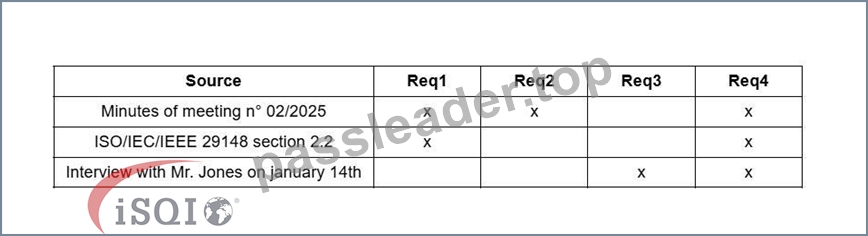
- A. Configuration Control Board
- B. Decision Matrix
- C. Traceability Matrix
- D. Kano Analysis Matrix
Answer: C
Explanation:
Comprehensive and Detailed Explanation From Exact Extract:
A traceability matrix is a tabular representation that links two sets of items-for example, requirements to their sources, requirements to design elements, or requirements to test cases. Each axis lists one set, and marks (such as "x") show relationships. The illustrated table links sources (meeting minutes, standards, interviews) to requirements Req1-Req4, so it is a source-to-requirement traceability matrix. A configuration control board is an organizational body, not a table; a decision matrix is used for evaluating options, and a Kano matrix classifies customer satisfaction. Thus option A is correct.
NEW QUESTION # 63
As a requirements engineer, you deal with a diverse range of requirements. A template for natural language functional requirements can help you to formulate different forms of system activities in a more precise way.
Which two kinds of system activities are among those supported? (1 Point)
- A. Independent system activity
- B. User interaction
- C. System requirement
- D. Technical requirement
- E. Quality requirements
Answer: A,B
NEW QUESTION # 64
Which of the following are categories of validation techniques?
- A. Exploratory techniques
- B. Evaluation techniques
- C. Sample development
- D. Experimental techniques
- E. Incremental techniques
Answer: A,C
NEW QUESTION # 65
......
Updated ISQI Study Guide CPRE-FL_Syll_3.0 Dumps Questions: https://www.passleader.top/ISQI/CPRE-FL_Syll_3.0-exam-braindumps.html
Dumps Questions [2026] Pass for CPRE-FL_Syll_3.0 Exam: https://drive.google.com/open?id=1lUJ7H69_yBc43Akvp_j_QbcVSVvZn9wY