

300-620 Study Guide: Latest [Sep 05, 2025] Realistic Verified 300-620 Dumps
300-620 Questions & Practice Test are Available On-Demand
Cisco's ACI infrastructure is a new generation of networking technology that focuses on the applications themselves, rather than the network that supports them. This infrastructure provides IT professionals with greater scalability, resiliency, and agility through automation, policy-based management, and centralized control of networking and data center resources. The DCACI exam covers all of these aspects of ACI and tests the knowledge and skills necessary to deploy and manage this infrastructure effectively.
NEW QUESTION # 28
An engineer must add new servers to a Cisco ACI cluster and configure ports to accept the new servers. The existing servers are dual-homed to Leaf101 and Leaf102 using ports 1-3 and an interface policy group called cluster1_ifpg. The new servers must use ports 1 and 2 on Leaf103 and Leaf104. Which two actions must be taken to enable the ports with the same configuration as the existing servers in the cluster? (Choose two.)
- A. Configure interface selector using a new interface policy group.
- B. Use interface selector for cluster1_infpg.
- C. Select ports 1 and 2 using interface selectors.
- D. Attach interface selectors to leaf profiles Leaf103 and Leaf104.
- E. Connect with interface selector using a new AEP.
Answer: C,D
NEW QUESTION # 29
Refer to the exhibit.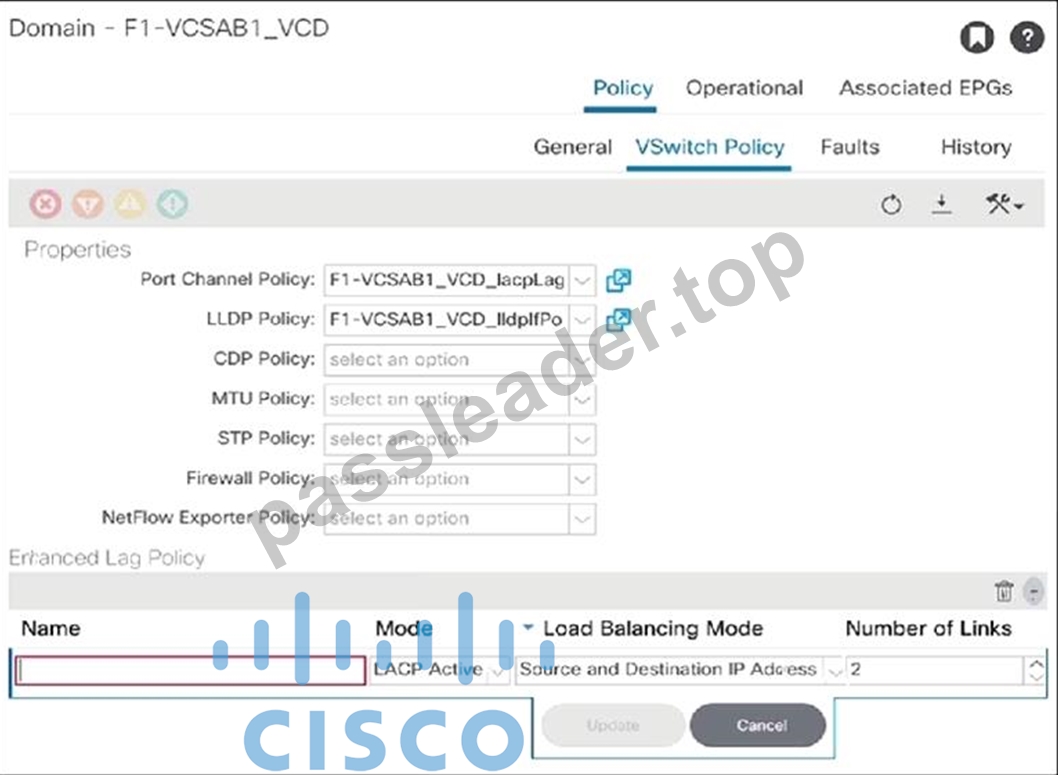
An engineer configures the Cisco ACI fabric for VMM integration with ESXi servers that are to be connected to the ACI leaves. The server team requires the network switches to initiate the LACP negotiation as opposed to the servers. The LAG group consists of two 10 Gigabit Ethernet links. The server learn also wants to evenly distribute traffic across all available links. Which two enhanced LAG policies meet these requirements? (Choose two.)
- A. LACP Mode: LACP Active
- B. LB Mode: Source IP Address and TCP/UDP Port
- C. LACP Mode: LACP Standby
- D. LB Mode: Source and Destination MAC Address
- E. LB Mode: Destination IP Address and TCP/UDP Port
Answer: A,D
Explanation:
Reference:
https://www.cisco.com/c/en/us/td/docs/switches/datacenter/aci/aci_virtual_edge/configuration/2-x/Cisco-ACIVirtual- Edge-Configuration-Guide-202/Cisco-ACI-Virtual-Edge-Configuration-Guide-202_chapter_0100.html
NEW QUESTION # 30
Which feature allows firewall ACLs to be configured automatically when new endpoints are attached to an EPG?
- A. ARP gleaning
- B. network-stitching
- C. dynamic endpoint attach
- D. hardware proxy
Answer: C
Explanation:
Dynamic Endpoint Attach is a feature that allows Firewall ACLs or ADC load balanced servers to be dynamically configured when new endpoints are attached to an EPG.
https://www.cisco.com/c/en/us/solutions/collateral/data-center-virtualization/application-centric- infrastructure/white-paper-c11-734298.html
NEW QUESTION # 31
An engineer configures port-12 on Leaf-101 and Leaf-102 to connect to a new server, SVR-12. The new server will belong to EPG-12 and use encap VLAN-1212. The engineer configured SVR-12 as a VPC member port and statically bound the VPC member port to EPG-12. Which additional step must the engineer take to configure connectivity?
- A. Create a VPC Explicit Protection Group for EPG-12 and VLAN-1212.
- B. Associate a domain with EPG-12 that is associated with VLAN-1212.
- C. Select VLAN-1212 on the EPG-12 Interface Policy Group.
- D. Configure an LACP Interface Policy and apply it to EPG-12.
Answer: B
Explanation:
The engineer configures port 1/2 on Leaf-101 and Leaf-102 to connect to a new server (SVR-12), which belongs to EPG-12 using VLAN-1212 encapsulation. The server is configured as a vPC member port and statically bound to EPG-12. The task is to ensure connectivity, indicating a missing configuration step.
Requirement Analysis
Static binding of a vPC member port to an EPG requires proper VLAN association and domain mapping.
vPC ensures redundancy, and the VLAN (1212) must be allocated and associated with the EPG via a domain (e.g., VMM or physical domain).
Option Evaluation
A . Create a VPC Explicit Protection Group for EPG-12 and VLAN-1212:
vPC Explicit Protection Groups are used for specific vPC configurations, but this is not a standard requirement for EPG binding and VLAN association.
Reference:
B . Associate a domain with EPG-12 that is associated with VLAN-1212:
Associating a domain (e.g., VMM or physical domain) with EPG-12 and mapping VLAN-1212 ensures the VLAN is allocated and recognized by the fabric for the vPC ports. This is a critical step for static binding to work.
C . Select VLAN-1212 on the EPG-12 Interface Policy Group:
The Interface Policy Group defines port settings, but VLAN selection is managed via the domain association, not the policy group alone. This is insufficient.
D . Configure an LACP Interface Policy and apply it to EPG-12:
LACP is optional for vPC and not required for static EPG binding. The issue is VLAN/domain association, not link aggregation.
Final Answer Justification
B is correct because associating a domain with EPG-12 and VLAN-1212 ensures the fabric recognizes the VLAN encapsulation and applies the EPG configuration to the vPC ports.
Primary Cisco Reference:
Cisco APIC vPC Deployment Guide.
Cisco ACI EPG and Domain Configuration Guide.
NEW QUESTION # 32
Which two dynamic routing protocols are supported when using Cisco ACI to connect to an external Layer 3 network? (Choose two.)
- A. iBGP
- B. VXLAN
- C. eBGP
- D. RIPv2
- E. IS-IS
Answer: A,C
Explanation:
The two dynamic routing protocols supported when using Cisco ACI to connect to an external Layer 3 network are iBGP (Option A) and eBGP (Option E)78. These protocols are included in the routing protocol options for a Layer 3 external outside network configuration in ACI
NEW QUESTION # 33
Which class of ACI object is presented in this output?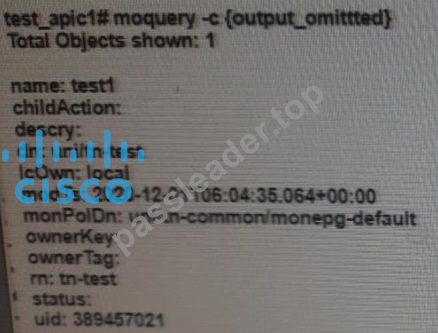
- A. Tenant
- B. Contract
- C. Endpoint
- D. Bridge Domain
Answer: A
Explanation:
In Cisco ACI, the object classes are used to categorize different types of managed objects within the ACI model. The output presented is indicative of a Tenant class object. Tenants in ACI are a top-level container for application policies, essentially providing a unit of isolation from other tenants. Each tenant can contain its own application policies, services, and network policies, and they are separate from other tenants to ensure multi-tenancy1.
Reference:
Cisco ACI Policy Model Guide1
Object Renaming in Cisco ACI - Cisco2
Application Centric Infrastructure (ACI) REST API Guide - Cisco DevNet
https://www.cisco.com/c/en/us/td/docs/switches/datacenter/aci/apic/sw/4-x/openstack/ACI-Installation-Guide-for-Red-Hat-Using-OSP13-Director/m-configuring-ironic-for-openstack.html
NEW QUESTION # 34
What represents the unique identifier of an ACI object?
- A. management information tree
- B. universal resource identifier (URI)
- C. application programming interface
- D. distinguished name
Answer: D
Explanation:
https://www.slideshare.net/CiscoDevNet/introduction-to-aci-apis
NEW QUESTION # 35
An engineer is configuring a VRF for a tenant named Cisco. Drag and drop the child objects on the left onto the correct containers on the right for this configuration.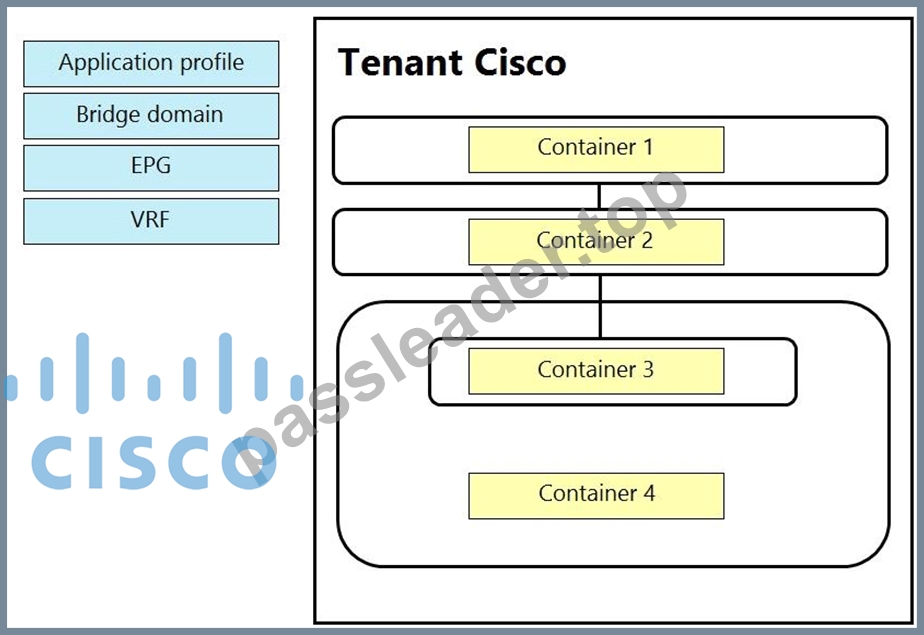
Answer:
Explanation: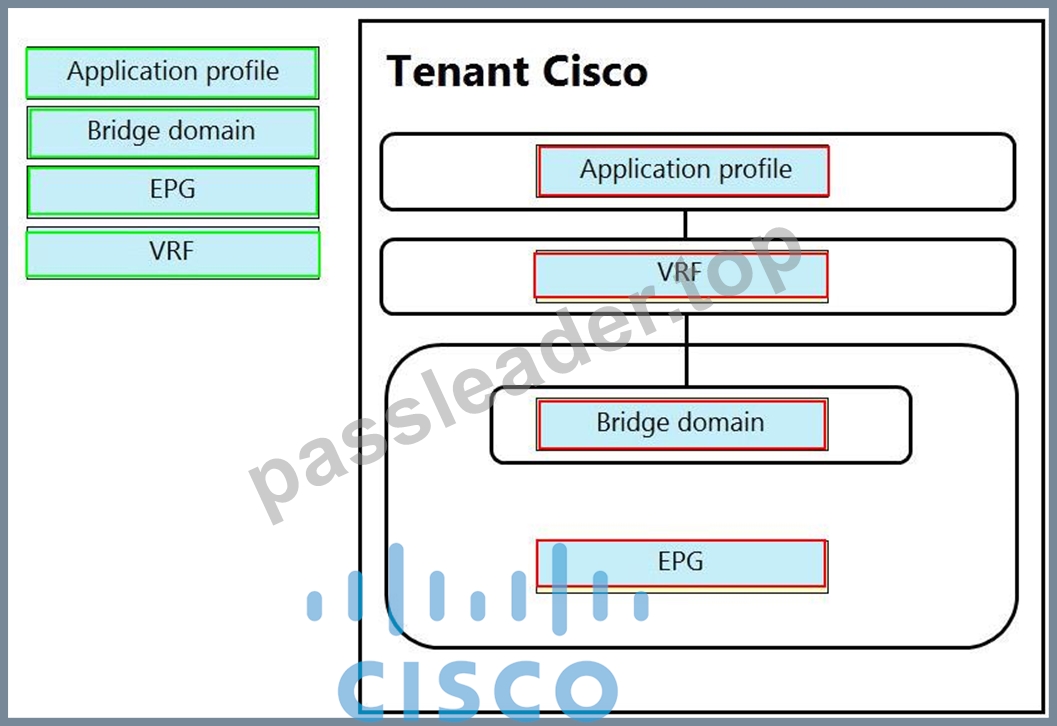
NEW QUESTION # 36
When configuring Cisco ACI VMM domain integration with VMware vCenter, which object is created in vCenter?
- A. VMware vSphere Distributed Switch
- B. datacenter
- C. VMware vSphere Standard vSwitch
- D. cluster
Answer: A
NEW QUESTION # 37
Drag and drop the Cisco ACI Layer 4 to Layer 7 service insertion terms on the left to the correct descriptions on the right.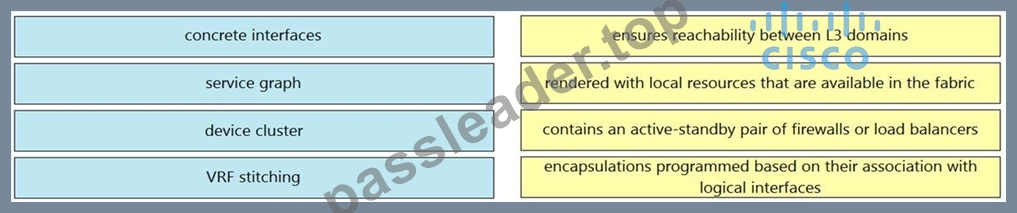
Answer:
Explanation: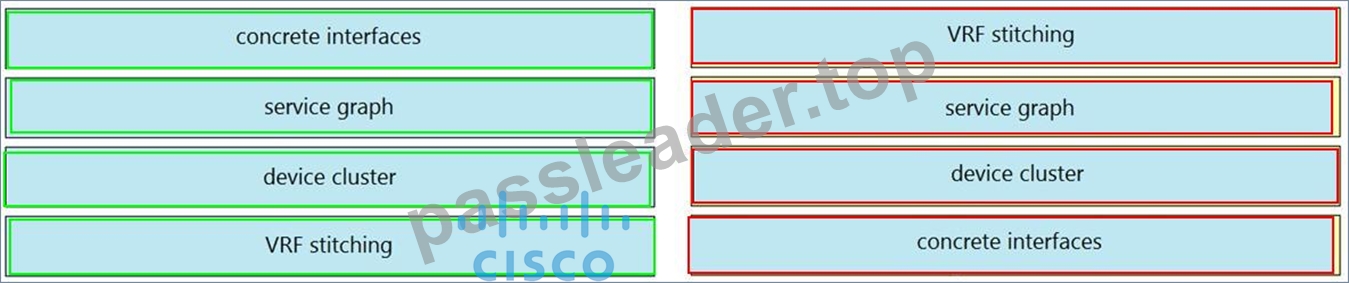
NEW QUESTION # 38
What controls communication between EPGs?
- A. Inter-EPG communication is controlled by VXLAN.
- B. Inter-EPG communication is controlled by BGP.
- C. Inter-EPG communication is controlled by contracts.
- D. Inter-EPG communication is controlled by IS-IS.
Answer: D
NEW QUESTION # 39
Refer to the exhibit.
An engineer configures the Cisco ACI fabric for VMM integration with ESXi servers that are to be connected to the ACI leaves. The server team requires the network switches to initiate the LACP negotiation as opposed to the servers. The LAG group consists of two 10 Gigabit Ethernet links. The server learn also wants to evenly distribute traffic across all available links. Which two enhanced LAG policies meet these requirements? (Choose two.)
- A. LACP Mode: LACP Active
- B. LB Mode: Source IP Address and TCP/UDP Port
- C. LB Mode: Source and Destination MAC Address
- D. LACP Mode: LACP Standby
- E. LB Mode: Destination IP Address and TCP/UDP Port
Answer: A,E
Explanation:
To meet the server team's requirements for VMM integration with ESXi servers, the two enhanced LAG policies that should be configured are:
LB Mode: Destination IP Address and TCP/UDP Port (Option B): This load balancing mode ensures that traffic is evenly distributed across all available links based on the destination IP address and the TCP/UDP port numbers, which can provide a balanced traffic flow for different sessions.
LACP Mode: LACP Active (Option E): Setting the LACP mode to active allows the network switches to initiate the LACP negotiation, which is necessary when the servers are not configured to initiate the LACP process.
These settings ensure that the LAG group consisting of two 10 Gigabit Ethernet links will have traffic evenly distributed across them and that the network switches will initiate the LACP negotiation as required by the server team.
Reference:
https://www.cisco.com/c/en/us/td/docs/switches/datacenter/aci/aci_virtual_edge/configuration/2-x/Cisco-ACIVirtual- Edge-Configuration-Guide-202/Cisco-ACI-Virtual-Edge-Configuration-Guide-202_chapter_0100.html
NEW QUESTION # 40
When creating a subnet within a bridge domain, which configuration option is used to specify the network visibility of the subnet?
- A. gateway IP
- B. scope
- C. limit IP learning to subnet
- D. subnet control
Answer: A
Explanation:
Reference:
https://www.cisco.com/c/en/us/td/docs/switches/datacenter/aci/apic/sw/1-x/Operating_ACI/guide/ b_Cisco_Operating_ACI/b_Cisco_Operating_ACI_chapter_0111.html
NEW QUESTION # 41
An engineer is configuring a VRF for a tenant named Cisco. Drag and drop the child objects on the left onto the correct containers on the right for this configuration.
Answer:
Explanation: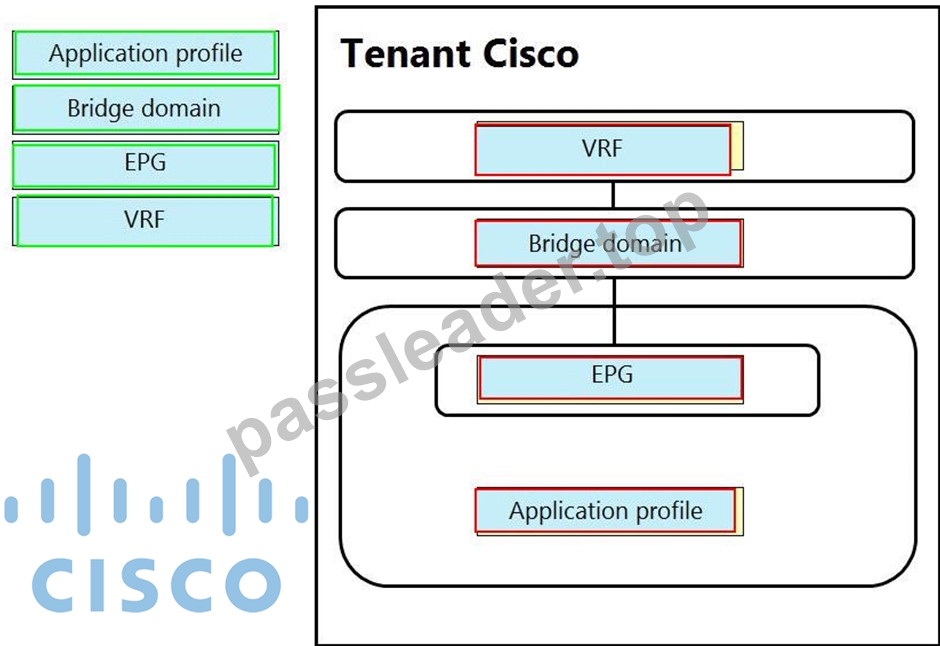
NEW QUESTION # 42
An engineer configured a bridge domain with the hardware-proxy option for Layer 2 unknown unicast traffic.
Which statement is true about this configuration?
- A. The leaf switch forwards the Layers 2 unknown unicast packets to all other leaf switches if it is unable to find the MAC address in its local forwarding tables.
- B. The leaf switch drops the Layer 2 unknown unicast packet if it is unable to find the MAC address in the local forwarding tables.
- C. The spine switch drops the Layer 2 unknown unicast packet if it is unable to find the MAC address in the proxy database.
- D. The Layer 2 unknown hardware proxy lacks support of the topology change notification.
Answer: B
Explanation:
Section: ACI Packet Forwarding
NEW QUESTION # 43
Refer to the exhibit.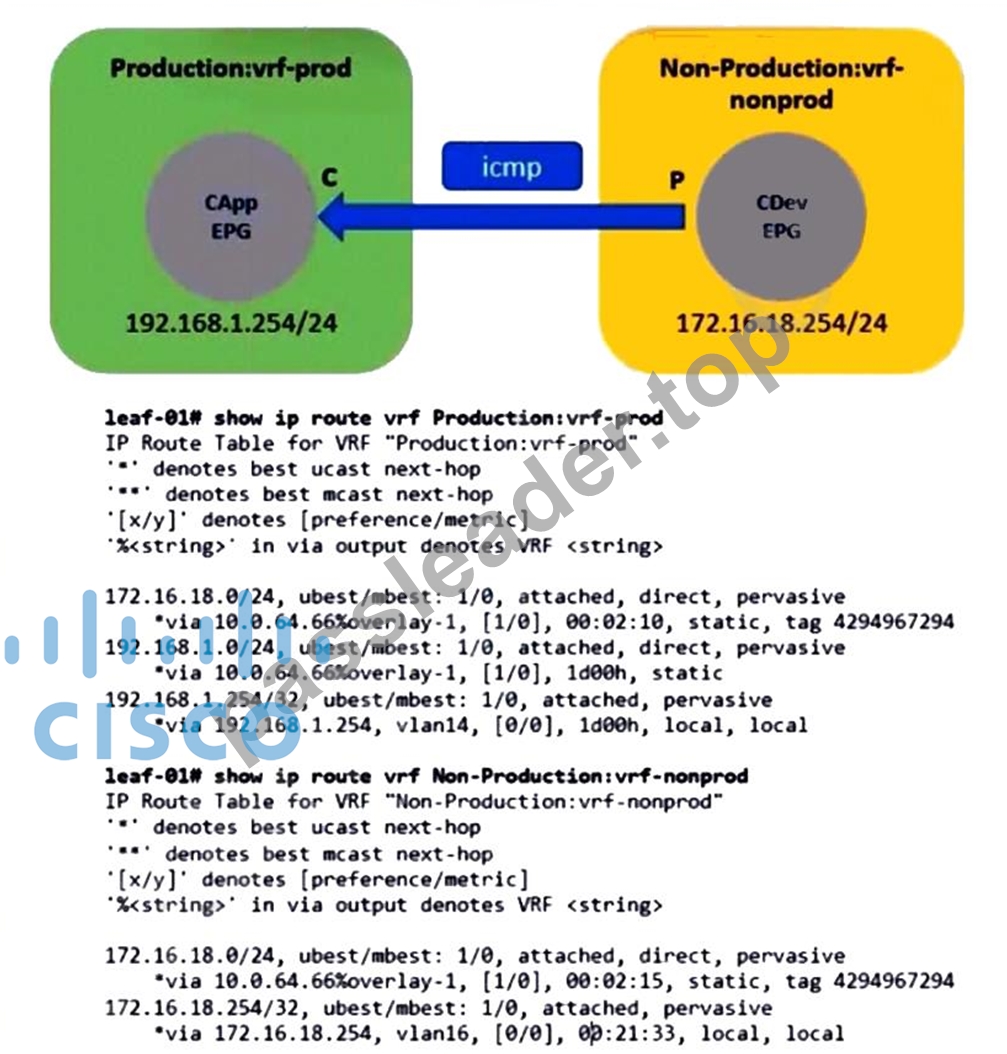
Refer to the exhibit. An administrator configures inter-VRF route leaking between Production:vrf-prod and Non-Production:vrf-nonprod. However, the route in the Non-Production:vrf-nonprod VRF to the production tenant is missing. Which action resolves the VRF route leaking issue?
- A. Enable the Shared between VRFs option for the EPG subnet in the non-production VRF.
- B. Enable the Shared between VRFs option for the BD subnet in the production VRF.
- C. Change the contract scope to Global.
- D. Export the contract from provider to consumer tenant.
Answer: B
Explanation:
To resolve the VRF route leaking issue and ensure that the route in the Non-Production:vrf-nonprod VRF to the production tenant is present, the action that should be taken is to enable the "Shared between VRFs" option for the bridge domain (BD) subnet in the production VRF. This setting allows the subnet to be shared across different VRFs within the same tenant or across tenants, enabling communication between EPGs that are in different VRFs1.
Reference:
ACI Inter VRF/Tenant Route Leaking Configuration Example
NEW QUESTION # 44
......
Valid 300-620 Exam Dumps Ensure you a HIGH SCORE: https://www.passleader.top/Cisco/300-620-exam-braindumps.html
Pass 300-620 Exam with Latest Questions: https://drive.google.com/open?id=1ouuM_nEWJreZ8mTSVelQ0kxhVRoBfxHl