

2026 Latest 800-150 Exam Dumps Recently Updated 102 Questions
Cisco 800-150 Real 2026 Braindumps Mock Exam Dumps
Cisco 800-150 Exam Syllabus Topics:
| Topic | Details |
|---|---|
| Topic 1 |
|
| Topic 2 |
|
| Topic 3 |
|
| Topic 4 |
|
NEW QUESTION # 20
Which Cisco UCS management platform is specifically designed for managing standalone Cisco UCS C- Series rack servers and E-Series servers?
- A. Cisco UCS Manager
- B. Cisco Integrated Management Controller
- C. Cisco UCS Central
- D. Cisco Intersight
Answer: B
Explanation:
TheCisco Integrated Management Controller (CIMC)is the embedded management solution designed specifically forstandalone Cisco UCS C-Series rack servers and E-Series servers. It allows administrators to perform out-of-band management functions such as BIOS configuration, firmware updates, remote console access, and power control.
* Cisco UCS Manageris used for managing UCS blade chassis environments.
* Cisco UCS Centralis intended for centralized management across multiple UCS domains.
* Cisco Intersightis a cloud-based management platform that can extend CIMC functionality but is not the embedded, standalone option.
Reference:Supporting Cisco Devices for Field Technicians (FLDTEC) - Cisco Equipment and Related Hardware
NEW QUESTION # 21
Refer to the exhibit. Drag and drop the names of the field-replaceable units from the left onto the corresponding letters on the image of the Cisco Catalyst 9400 modular switch.
Answer:
Explanation:
Explanation:
A # Power supply modules
B # Fan tray assembly
C # Line card slots 1 and 2
D # Supervisor modules
E # Line card slots 5, 6, and 7
The power supply units (A) are at the top, the fan tray (B) is a vertical module on the left, line cards (C and E) span multiple slots horizontally, and supervisor modules (D) are typically placed centrally for control functions.
In theFLDTEC courseunderCisco Modular Hardware Overview, the Cisco Catalyst 9400 series is broken down into clearly defined FRU zones:
* Power Supply Modules (A):Located at thetop of the chassis, these provide redundant, hot-swappable power to the switch.
* Fan Tray Assembly (B):Mounted vertically on the left, this ensures proper cooling and airflow throughout the chassis.
* Line Card Slots 1 and 2 (C):Located in the upper section for network expansion.
* Supervisor Modules (D):Positioned centrally, they handle control plane operations, management, and switching logic.
* Line Card Slots 5, 6, and 7 (E):Lower slots for high-density port expansion.
Correct FRU identification ensures successful maintenance, upgrades, and hardware replacement during field operations.
NEW QUESTION # 22
Which management option is best suited for standalone Cisco Secure Firewall deployments?
- A. Cisco Secure Firewall Device Manager
- B. Cisco Secure Firewall Management Center
- C. Cisco Defense Orchestrator
- D. Cisco Security Manager
Answer: A
Explanation:
For standalone Cisco Secure Firewall deployments, theCisco Secure Firewall Device Manager (FDM)is the most appropriate management option. FDM is a browser-based, on-box management tool that allows administrators to configure and manage a single firewall device without the need for external management infrastructure. It provides an intuitive interface for basic configurations, policy management, and monitoring.
In contrast:
* Cisco Secure Firewall Management Center (FMC)is designed for centralized management of multiple firewall devices.
* Cisco Defense Orchestrator (CDO)is a cloud-based solution for managing security policies across various devices.
* Cisco Security Manageris an older platform primarily used for managing ASA devices.
Reference:Supporting Cisco Devices for Field Technicians (FLDTEC) - Cisco Equipment and Related Hardware
NEW QUESTION # 23
Which two configuration parameters are most critical to ensure optimal performance when configuring a network port for a newly installed IP phone in an enterprise environment? (Choose two.)
- A. Power over Ethernet
- B. QoS classification
- C. Link aggregation
- D. Spanning Tree Protocol
- E. VLAN assignment
Answer: A,E
Explanation:
When configuring a network port for a newly installed IP phone, two critical parameters to ensure optimal performance are:
VLAN Assignment: Assigning the correct VLANs is essential for segregating voice and data traffic. Typically, a separate voice VLAN is configured to prioritize voice traffic and enhance security.
Power over Ethernet (PoE): PoE allows the switch to supply power to the IP phone over the same Ethernet cable used for data transmission. This eliminates the need for separate power supplies and simplifies installation.
While QoS classification (Option E) is important for prioritizing voice traffic, it is typically configured at a broader network level. Link aggregation (Option B) and Spanning Tree Protocol (Option C) are more relevant to network redundancy and loop prevention, respectively, and are not directly critical for the initial configuration of an IP phone port.
Reference:
===
NEW QUESTION # 24
Which command is used to determine if there is sufficient space in the memory of a device before installing a new Cisco IOS image?
- A. show file-system
- B. show storage
- C. show memory
- D. show flash:
Answer: D
Explanation:
The show flash: command is used to display the contents of the device's flash memory, which is where the Cisco IOS image is typically stored. By issuing this command, a technician can verify available space and determine whether there is enough capacity to accommodate a new IOS image before initiating an upgrade or image replacement process.
This command provides a detailed listing of files, their sizes, and the total and available memory space within the flash file system.
show file-system lists all available file systems but doesn't detail their content.
show memory shows runtime memory usage (RAM), not flash memory.
show storage is not a standard IOS command.
NEW QUESTION # 25
Which two actions ensure a smooth transition to the new hardware when replacing a Cisco UCS C-Series Rack-Mount Server? (Choose two.)
- A. Back up the server configuration using Cisco Integrated Management Controller.
- B. Reconfigure the DHCP server to assign a new IP address to the replacement server.
- C. Decommission the server if it is integrated in a Cisco UCS domain.
- D. Update the firmware on the fabric interconnects.
- E. Temporarily disable all firewalls during the replacement process.
Answer: A,C
Explanation:
To ensure asmooth replacementof a Cisco UCS C-Series Rack-Mount Server, two critical actions are:
* Back up the server configuration using the Cisco Integrated Management Controller (CIMC):
This preserves all configuration data such as BIOS settings, RAID setup, and network configuration.
After replacing the hardware, this configuration can be restored to minimize setup time.
* Decommission the server if it is integrated in a Cisco UCS domain: Before physically replacing the server, decommissioning it ensures the UCS Manager properly releases it from the inventory, preventing configuration conflicts or orphaned profiles.
Other options, like reconfiguring DHCP or disabling firewalls, are not required procedures for a UCS C- Series hardware swap.
Reference:Supporting Cisco Devices for Field Technicians (FLDTEC) - Maintenance and RMA Procedures
NEW QUESTION # 26
Which two cloud computing services are vendor-managed in an Infrastructure as a Service (IaaS) delivery model? (Choose two.)
- A. Applications
- B. Storage
- C. Operating System
- D. Networking
- E. Data
Answer: B,D
Explanation:
In the Infrastructure as a Service (IaaS) model, the cloud provider is responsible for managing and maintaining the underlying infrastructure components, including:
Networking: The cloud provider handles all aspects of network configuration, hardware, and virtual networking.
Storage: The cloud provider supplies and manages the physical and virtual storage infrastructure required to support the consumer's data needs.
The customer is responsible for managing:
Operating Systems
Applications
Data
This model offers flexibility while shifting infrastructure maintenance responsibilities to the service provider.
NEW QUESTION # 27
Which command is used to copy the startup configuration of a device to a USB file system when transferring files to a Cisco device?
- A. Router# copy startup-config usbflash0:[filename]
- B. Router# copy running-config usbflash0:[filename]
- C. Router# copy startup-config tftp://[server_ip]/[destination_file]
- D. Router# copy usbflash0:[filename] startup-config
Answer: A
Explanation:
To back up the startup configuration of a Cisco device to a USB drive, the command copy startup-config usbflash0:[filename] is used. This command copies the contents of the startup configuration file stored in NVRAM to a specified file on the USB flash drive. This is particularly useful for creating backups before performing upgrades or replacements. Option A: Copies the startup configuration to a TFTP server, not a USB drive.
Option B: Attempts to copy from the USB drive to the startup configuration, which is the reverse of the desired operation.
Option D: Copies the running configuration, not the startup configuration, to the USB drive.
NEW QUESTION # 28
Which command is used to determine if there is sufficient space in the memory of a device before installing a new Cisco IOS image?
- A. show file-system
- B. show storage
- C. show memory
- D. show flash:
Answer: D
Explanation:
Theshow flash:command is used todisplay the contents of the device's flash memory, which is where the Cisco IOS image is typically stored. By issuing this command, a technician can verify available space and determine whether there is enough capacity to accommodate a new IOS image before initiating an upgrade or image replacement process.
This command provides a detailed listing of files, their sizes, and the total and available memory space within the flash file system.
* show file-systemlists all available file systems but doesn't detail their content.
* show memoryshows runtime memory usage (RAM), not flash memory.
* show storageis not a standard IOS command.
Reference:Supporting Cisco Devices for Field Technicians (FLDTEC) - Cisco IOS Software Basics
NEW QUESTION # 29
Which layer of the OSI model provides error detection and defines how access to the media is controlled?
- A. Presentation layer
- B. Network layer
- C. Physical layer
- D. Data link layer
Answer: D
Explanation:
The Data Link Layer (Layer 2) of the OSI model is responsible for node-to-node data transfer and plays a crucial role in error detection and media access control. It ensures that data frames are transmitted to the correct device on a local network segment.
This layer is divided into two sublayers:
* Logical Link Control (LLC):Manages frame synchronization, flow control, and error checking.
* Media Access Control (MAC):Controls how devices on the network gain access to the medium and permission to transmit data.
Together, these sublayers ensure reliable data transmission by detecting and possibly correcting errors that may occur in the Physical Layer. They also manage how devices share the transmission medium, preventing collisions and ensuring orderly communication.
Reference:Supporting Cisco Devices for Field Technicians (FLDTEC) - Cisco IOS Software Basics
NEW QUESTION # 30
Which component serves as the central management and communication core and provides a single point of management via Cisco UCS Manager in a Cisco UCS environment?
- A. Nexus 9000 Series Switch
- B. UCS Fabric Interconnect
- C. UCS E-Series server in ISR platforms
- D. MDS 9000 Series SAN Switch
Answer: B
Explanation:
TheUCS Fabric Interconnectis the central management and communication hub of theCisco UCS (Unified Computing System)environment. It integrates compute, network, and storage access into a unified system.
Fabric Interconnects:
* Manage all servers and I/O modules connected to the UCS domain
* Provide connectivity and are the point of integration with the Cisco UCSManager
* Offer high-availability and centralized policy management
Other options like the Nexus or MDS switches do not serve this unified management function in a UCS deployment.
Reference:Supporting Cisco Devices for Field Technicians (FLDTEC) -Cisco Equipment and Related Hardware Explanation:
The UCS Fabric interconnect serves as the central management and communication core in a Cisco UCS environment, providing a single point of management via Cisco UCS Manager for the entire UCS system, including servers, networking, and storage components.
NEW QUESTION # 31
What is the primary advantage of the Cisco Intersight cloud-based approach compared to traditional on-premises management tools?
- A. It provides faster hardware upgrades
- B. It allows management from anywhere without on-premises software
- C. It requires less local storage
- D. It offers better integration with non-Cisco products
Answer: B
Explanation:
The main advantage of Cisco Intersight is its cloud-based architecture, which allows IT administrators to manage infrastructure from any location without needing to install or maintain traditional on-premises management tools.
This provides:
Centralized visibility and control over UCS servers and HyperFlex infrastructure Remote firmware upgrades and configuration Policy-driven automation Unlike on-premises tools, Intersight eliminates the overhead of maintaining dedicated infrastructure for management.
NEW QUESTION # 32
What is the primary function of a wireless LAN controller in a Cisco Unified Wireless Network solution?
- A. To translate data into a frame format for transmission
- B. To operate at Layer 3 of the OSI model
- C. To manage and configure associated access points centrally
- D. To provide wireless connectivity to LAN devices
Answer: C
Explanation:
TheWireless LAN Controller (WLC)plays a central role in Cisco's Unified Wireless Network solution by providing centralized management, configuration, and monitoring for multiple access points (APs). It allows for streamlined policy enforcement, seamless mobility, load balancing, and security management across wireless networks.
While WLCs facilitate wireless connectivity indirectly, their main role is tocentrally manage and control access points - not to function as Layer 3 routers or format data frames.
Reference:Supporting Cisco Devices for Field Technicians (FLDTEC) - Wireless Device Support Explanation:
The primary function of a wireless LAN controller (WLC) in a Cisco Unified Wireless Network is to centrally manage, configure, and monitor multiple access points, simplifying administration and enhancing scalability.
NEW QUESTION # 33
Which two results are achieved by briefly pressing the restore/reset button on a Cisco Meraki switch? (Choose two.)
- A. The device reboots.
- B. Cloud management is disabled.
- C. A full factory restore is performed.
- D. The management interface is cleared.
- E. The downloaded configuration is deleted.
Answer: A,D
Explanation:
On a Cisco Meraki switch, briefly pressing the restore/reset button (typically less than 5 seconds) triggers:
A reboot of the device (Option A)
Clearing of the local management interface settings (Option D), which may include temporary network information such as DHCP leases or local overrides.
To perform a full factory reset (Option B), the button must be held down for a longer duration, usually more than 10 seconds. Options C and E do not reflect standard reset behavior.
NEW QUESTION # 34
What is the purpose of the pre-service checklist in the endpoint replacement process?
- A. To test the functionality of the existing endpoint
- B. To verify the current configuration settings of the endpoint
- C. To ensure all necessary tools and personnel are available
- D. To gather information about the replacement unit
Answer: C
Explanation:
A pre-service checklist is a procedural step followed before replacing an endpoint. Its primary purpose is to confirm that all resources, tools, documentation, and personnel are in place to execute the replacement efficiently and without delays.
It helps avoid service interruptions and ensures a smooth replacement by ensuring that every necessary component and action is accounted for ahead of time.
NEW QUESTION # 35
Drag and drop the functions from the left onto the corresponding Cisco data center technologies on the right.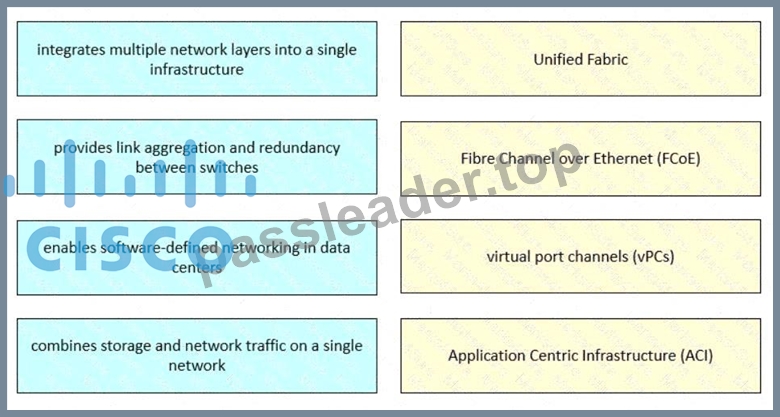
Answer:
Explanation: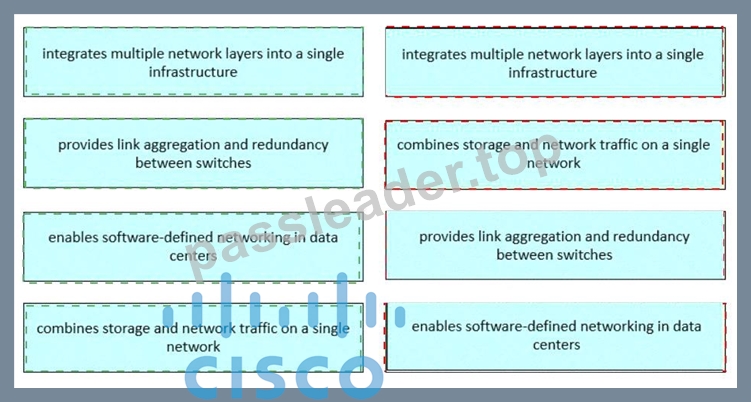
Explanation:
Integrates multiple network layers into a single infrastructure # Unified Fabric Provides link aggregation and redundancy between switches # Virtual port channels (vPCs) Enables software-defined networking in data centers # Application Centric Infrastructure (ACI) Combines storage and network traffic on a single network # Fibre Channel over Ethernet (FCoE) These data center solutions are covered in theFLDTEC courseunder Cisco's unified data center architecture and switching portfolio:
Unified Fabric:Streamlines Layer 2 and Layer 3 into a single operational model, reducing complexity and enhancing scalability.
vPC (Virtual Port Channel): Allows two Nexus switches to appear as one logical switch, enablingloop-free topologyandactive-active uplinks.
ACI (Application Centric Infrastructure): Cisco's SDN solution, delivering centralized automation, policy enforcement, and fabric management.
FCoE: Enableslossless Ethernetforstorage (Fibre Channel)traffic to coexist withdatatraffic on the same Ethernet infrastructure.
These technologies are fundamental in modern Cisco-powered data centers tooptimize performance,reduce hardware, andsimplify management.
NEW QUESTION # 36
Which deployment model minimizes dependence on internet connectivity for core collaboration functions?
- A. Hosted Collaboration Solution
- B. On-premises deployment
- C. Cloud-based deployment
- D. Software-as-a-Service model
Answer: B
Explanation:
An on-premises deployment model minimizes dependence on internet connectivity for core collaboration functions. In this model, all critical services, including call control, messaging, and conferencing, are hosted within the organization's local infrastructure. This ensures that internal communication services remain operational even if internet connectivity is lost.
In contrast, cloud-based deployments (Options A and C) and Hosted Collaboration Solutions (Option D) rely on internet connectivity to access services hosted externally, making them more susceptible to internet outages.
NEW QUESTION # 37
What is the purpose of the pre-service checklist in the endpoint replacement process?
- A. To test the functionality of the existing endpoint
- B. To verify the current configuration settings of the endpoint
- C. To ensure all necessary tools and personnel are available
- D. To gather information about the replacement unit
Answer: C
Explanation:
Apre-service checklistis a procedural step followed before replacing an endpoint. Its primary purpose is to confirm that all resources, tools,documentation, and personnel are in placeto execute the replacement efficiently and without delays.
It helps avoid service interruptions and ensures a smooth replacement by ensuring that every necessary component and action is accounted for ahead of time.
Reference:Supporting Cisco Devices for Field Technicians (FLDTEC) - Maintenance and RMA Procedures
NEW QUESTION # 38
Which two settings are standard Cisco console connections when configuring a terminal emulator to connect to the console port of a Cisco switch? (Choose two.)
- A. Data bits: 8
- B. Flow control: Hardware
- C. Parity: Even
- D. Stop bits: 2
- E. Speed (baud rate): 9600
Answer: A,E
Explanation:
When configuring a terminal emulator (such as PuTTY, Tera Term, or HyperTerminal) to connect to the console port of a Cisco switch, the standard settings are as follows:
* Speed (baud rate): 9600This is the default transmission speed for Cisco console ports, ensuring compatibility across various devices.
* Data bits: 8This setting specifies that each character transmitted consists of 8 data bits, which is standard for most serial communications.
* Parity: NoneNo parity bit is used, meaning there is no additional error-checking bit appended to each character.
* Stop bits: 1One stop bit indicates the end of a character transmission.
* Flow control: NoneNo flow control is employed, allowing continuous data transmission without hardware or software-based pausing.
Therefore, optionsC (Speed: 9600)andD (Data bits: 8)are correct. Options A (Stop bits: 2), B (Flow control:
Hardware), and E (Parity: Even) deviate from the standard settings and may result in communication issues if configured.
Reference:Supporting Cisco Devices for Field Technicians (FLDTEC) - Device Configuration and Verification
NEW QUESTION # 39
Drag and drop the Cisco UCS components from the left onto the corresponding functionalities on the right.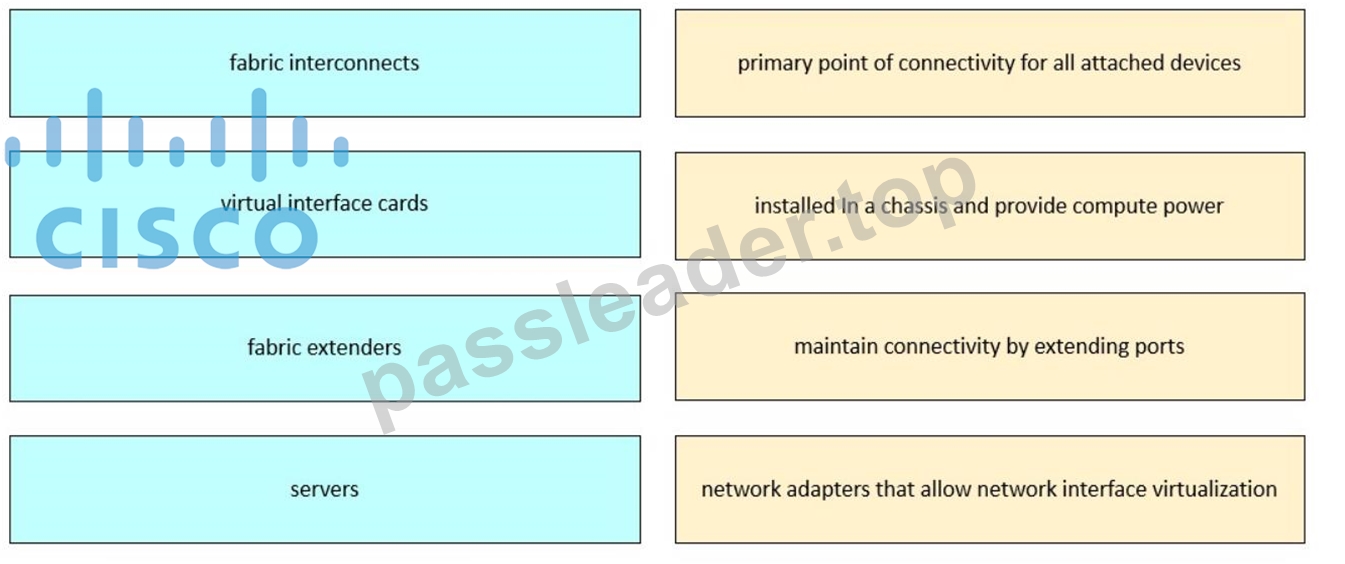
Answer:
Explanation: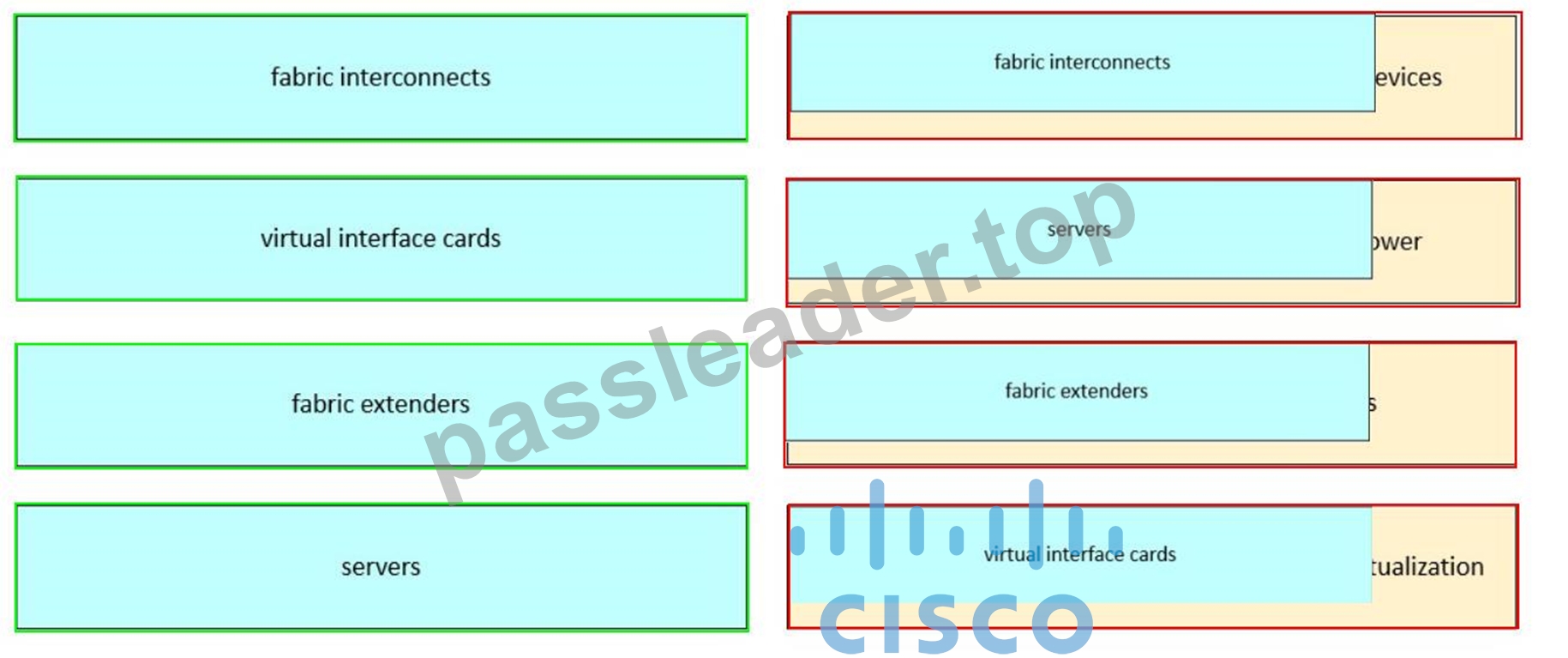
NEW QUESTION # 40
Which command is used to download a copied configuration file from a TFTP server to merge it with the running configuration of a replacement Cisco device?
- A. load tftp: running-config
- B. copy tftp: running-config
- C. merge tftp: running-config
- D. copy tftp: startup-config
Answer: B
Explanation:
The command copy tftp: running-config is used to retrieve a configuration file from a TFTP server and merge it with the current running configuration of a Cisco device. This operation is additive, meaning it integrates the new configuration commands into the existing running configuration without removing any pre-existing commands unless explicitly overridden.
This method is particularly useful when restoring configurations to a replacement device, as it allows for the seamless integration of necessary settings without disrupting the current operational state.
In contrast, using copy tftp: startup-config would overwrite the startup configuration file, which could lead to unintended consequences upon the next device reload. The options load tftp: running-config and merge tftp: running-config are not valid Cisco IOS commands.
NEW QUESTION # 41 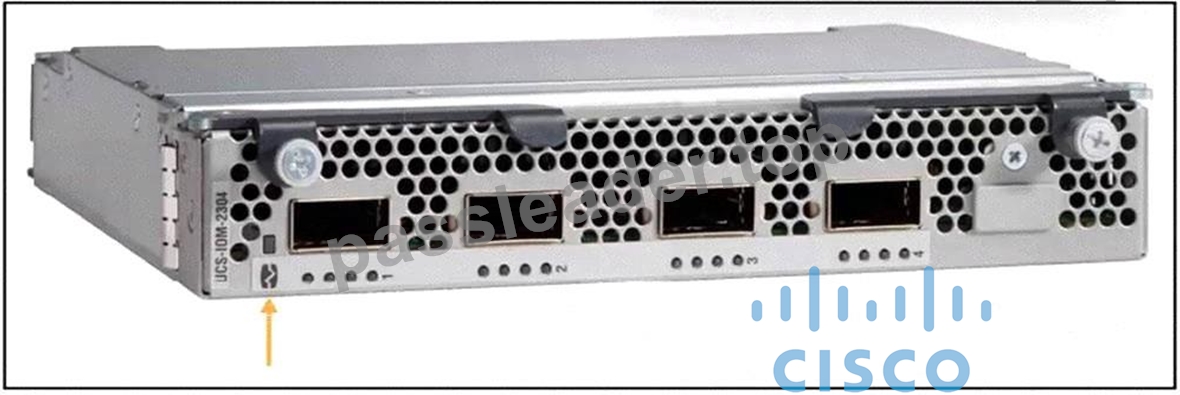
Refer to the exhibit. Which component is highlighted on the Cisco I/O module image?
- A. fan module LED
- B. fixed port
- C. chassis connections LED
- D. captive screw
Answer: C
Explanation:
The highlighted component on the Cisco I/O module is the chassisconnections LED, which indicates the status of connectivity between the I/O module and the chassis.
In the exhibit, the orange arrow points to asmall rectangular LED indicatorlocated to the left side of the I/O module (Cisco UCS-IOM-2304). This specific LED isnot aligned with the ports, fans, or screws, which helps identify it correctly.
Chassis connections LED (B)is responsible for indicating thestatus of uplink/downlink communication between the I/O module and the chassis.
* Greenusually indicates a healthy link.
* Amberoroffmay indicate a problem or no connection.
Why the other answers are incorrect:
* A. Captive screw# These are at the far corners, not where the arrow points.
* C. Fan module LED# This IOM doesn't have user-visible fan LEDs atthe front face.
* D. Fixed port# These are the large rectangular SFP ports clearly visible in the middle, not near the arrow.
This identification is important whentroubleshooting chassis-to-IOM connectivityor verifyingmodule status LEDsduring field maintenance.
NEW QUESTION # 42
......
Verified 800-150 Exam Dumps Q&As - Provide 800-150 with Correct Answers: https://www.passleader.top/Cisco/800-150-exam-braindumps.html
800-150 Exam Questions | Real 800-150 Practice Dumps: https://drive.google.com/open?id=1ziGQMT8T9akVkIqzLt4dF6uJXuKpGRwI