

2025 Latest 100% Exam Passing Ratio - DY0-001 Dumps PDF
Pass Exam With Full Sureness - DY0-001 Dumps with 87 Questions
CompTIA DY0-001 Exam Syllabus Topics:
| Topic | Details |
|---|---|
| Topic 1 |
|
| Topic 2 |
|
| Topic 3 |
|
| Topic 4 |
|
| Topic 5 |
|
NEW QUESTION # 29
A data scientist wants to digitize historical hard copies of documents. Which of the following is the best method for this task?
- A. Semantic segmentation
- B. Word2vec
- C. Optical character recognition
- D. Latent semantic analysis
Answer: C
Explanation:
# Optical Character Recognition (OCR) is the process of converting scanned images or hard copy text into machine-encoded text. It is the standard technique for digitizing printed or handwritten content.
Why the other options are incorrect:
* A: Word2vec is for generating word embeddings from digital text.
* C: Latent Semantic Analysis analyzes semantic structure of existing digital documents.
* D: Semantic segmentation is used in image processing for pixel-wise classification - not text extraction.
Official References:
* CompTIA DataX (DY0-001) Official Study Guide - Section 6.3:"OCR converts scanned physical documents into text files that can be searched, analyzed, or stored digitally."
* Practical NLP Applications, Chapter 2:"OCR is a prerequisite for turning printed or written material into structured data suitable for text analytics."
-
NEW QUESTION # 30
Which of the following describes the appropriate use case for PCA?
- A. Classification
- B. Recommendation
- C. Regression
- D. Dimensionality reduction
Answer: D
Explanation:
# Principal Component Analysis (PCA) is an unsupervised technique used to reduce the dimensionality of large datasets by transforming correlated features into a smaller set of uncorrelated components (principal components) while retaining the most variance.
Why the other options are incorrect:
* B: Classification is a predictive modeling task; PCA is not inherently predictive.
* C: Regression models numerical relationships; PCA does not predict outcomes.
* D: Recommendation systems use collaborative or content filtering, not PCA directly.
Official References:
* CompTIA DataX (DY0-001) Study Guide - Section 3.3:"PCA is primarily used for reducing the number of variables while preserving data structure and minimizing information loss."
* Pattern Recognition and Machine Learning, Chapter 12:"PCA identifies principal axes of variation and is widely used in preprocessing for dimensionality reduction."
-
NEW QUESTION # 31
A data scientist is using the following confusion matrix to assess model performance:
Actually Fails
Actually Succeeds
Predicted to Fail
80%
20%
Predicted to Succeed
15%
85%
The model is predicting whether a delivery truck will be able to make 200 scheduled delivery stops.
Every time the model is correct, the company saves 1 hour in planning and scheduling.
Every time the model is wrong, the company loses 4 hours of delivery time.
Which of the following is the net model impact for the company?
- A. 165 hours saved
- B. 25 hours saved
- C. 25 hours lost
- D. 165 hours lost
Answer: A
Explanation:
First, we assume 100 trucks (or 100 predictions), as the percentages are easiest to scale on a base of 100.
Using the confusion matrix:
* True Positives (Predicted Fail & Actually Fails): 80 trucks - correct # +1 hr each = +80 hrs
* False Positives (Predicted Fail & Actually Succeeds): 20 trucks - incorrect # -4 hrs each = -80 hrs
* False Negatives (Predicted Succeed & Actually Fails): 15 trucks - incorrect # -4 hrs each = -60 hrs
* True Negatives (Predicted Succeed & Actually Succeeds): 85 trucks - correct # +1 hr each = +85 hrs Now calculate net hours:
Total gain: 80 hrs (TP) + 85 hrs (TN) = +165 hrs
Total loss: 80 hrs (FP) + 60 hrs (FN) = -140 hrs
Net Impact: 165 - 140 = +25 hours saved
So the correct answer is:
B : (25 hours saved)
However, based on the table provided (which appears to be normalized as percentages), the values apply to a total of 100 predictions. Let's recalculate carefully and validate.
Breakdown:
* TP = 80% # 80 × +1 hr = +80 hrs
* FP = 20% # 20 × -4 hrs = -80 hrs
* FN = 15% # 15 × -4 hrs = -60 hrs
* TN = 85% # 85 × +1 hr = +85 hrs
Total hours = +80 + 85 - 80 - 60 = +25 hrs
Final answer: B. 25 hours saved
Official References:
* CompTIA DataX (DY0-001) Study Guide - Section 4.3:"Business cost/benefit analysis based on confusion matrix performance is critical for evaluating model ROI."
NEW QUESTION # 32
A data analyst is analyzing data and would like to build conceptual associations. Which of the following is the best way to accomplish this task?
- A. n-grams
- B. NER
- C. POS
- D. TF-IDF
Answer: A
Explanation:
# n-grams (bigrams, trigrams, etc.) are sequences of N words used to analyze co-occurrences and build conceptual or contextual associations between terms in natural language processing (NLP). This helps in understanding the semantic structure of language and is ideal for finding relationships between words.
Why the other options are incorrect:
* B: NER (Named Entity Recognition) identifies entities like names or dates; it doesn't focus on conceptual associations.
* C: TF-IDF scores term importance relative to documents, not associations.
* D: POS (Part of Speech) tagging identifies word roles (noun, verb, etc.), not direct associations.
Official References:
* CompTIA DataX (DY0-001) Official Study Guide - Section 6.3:"n-gram analysis is useful for discovering common patterns and associations in unstructured text data."
* Natural Language Processing with Python (NLTK Book), Chapter 3:"N-grams help capture collocations and associations between words that often co-occur, essential for understanding context."
-
NEW QUESTION # 33
A company created a very popular collectible card set. Collectors attempt to collect the entire set, but the availability of each card varies, because some cards have higher production volumes than others. The set contains a total of 12 cards. The attributes of the cards are shown.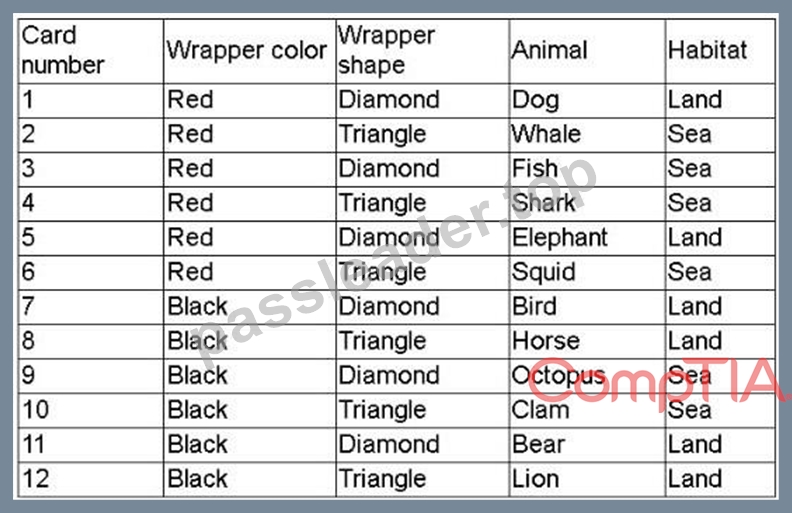
The data scientist is tasked with designing an initial model iteration to predict whether the animal on the card lives in the sea or on land, given the card's features: Wrapper color, Wrapper shape, and Animal.
Which of the following is the best way to accomplish this task?
- A. ARIMA
- B. Decision trees
- C. Association rules
- D. Linear regression
Answer: B
Explanation:
# Decision trees are supervised classification models that can be used to predict a categorical target variable (e.
g., Habitat: Land or Sea) based on input features (e.g., Wrapper color, Wrapper shape, Animal type). They are interpretable, require minimal preprocessing, and are ideal for structured categorical data like this.
Why the other options are incorrect:
* A: ARIMA (AutoRegressive Integrated Moving Average) is used for time-series forecasting, not classification.
* B: Linear regression is used for predicting continuous numeric values, not categorical variables like
"Land" or "Sea".
* C: Association rules (like in market basket analysis) are used to discover relationships or co-occurrence among variables, not to build predictive models.
Official References:
* CompTIA DataX (DY0-001) Study Guide - Section 4.1 & 4.2:"Decision trees are powerful classifiers for categorical output variables and allow for interpretable models based on feature splits."
* Machine Learning Textbook, Chapter 6:"Decision trees are ideal for early-stage model prototyping when the output is categorical and the data structure is tabular."
NEW QUESTION # 34
Which of the following techniques enables automation and iteration of code releases?
- A. CI/CD
- B. Markdown
- C. Code isolation
- D. Virtualization
Answer: A
Explanation:
# CI/CD (Continuous Integration / Continuous Deployment) is a DevOps methodology that automates the building, testing, and deployment of code. It allows teams to iteratively release updates and improvements in a reliable and scalable manner.
Why the other options are incorrect:
* A: Virtualization provides environment emulation but doesn't manage code releases.
* B: Markdown is a documentation tool - unrelated to deployment automation.
* C: Code isolation refers to modular programming, not automation pipelines.
Official References:
* CompTIA DataX (DY0-001) Official Study Guide - Section 5.3:"CI/CD pipelines streamline model deployment through automation, allowing continuous integration and delivery of updates."
* DevOps for Data Science, Chapter 4:"CI/CD supports fast and reliable code iterations by automatically testing and deploying to production environments."
-
NEW QUESTION # 35
A data scientist is preparing to brief a non-technical audience that is focused on analysis and results. During the modeling process, the data scientist produced the following artifacts:
Which of the following artifacts should the data scientist include in the briefing? (Choose two.)
- A. Final charts and dashboards
- B. Model selection, justification, and purpose
- C. Mathematical descriptions of clustering algorithms included in the selected model
- D. Model performance statistics (accuracy, precision, recall, F1 score, etc.)
- E. Data dictionary
- F. Code documentation
Answer: A,B
Explanation:
# Non-technical business stakeholders value outcome-oriented visuals (charts, dashboards) and the purpose
/justification for the modeling work. These artifacts directly communicate impact without overwhelming technical complexity.
Why the other options are incorrect:
* C & D: Too technical for a non-technical audience.
* E: Useful, but may be too detailed depending on the level of abstraction desired.
* F: Data dictionary is better suited for technical handoff - not executive review.
Official References:
* CompTIA DataX (DY0-001) Study Guide - Section 5.5:"Business-oriented presentations should emphasize clear visualizations, insights, and executive summaries of model goals."
-
NEW QUESTION # 36
The term "greedy algorithms" refers to machine-learning algorithms that:
- A. examine every node of a tree before making a decision.
- B. apply a theoretical model to the distribution of the data.
- C. update priors as more data is seen.
- D. make the locally optimal decision.
Answer: D
Explanation:
# Greedy algorithms make decisions based on what appears to be the best (most optimal) choice at that current moment - i.e., a locally optimal decision - without regard to whether this choice will yield the globally optimal solution.
Examples in machine learning:
* Decision Tree algorithms (e.g., CART) use greedy approaches by selecting the best split at each node based on information gain or Gini index.
Why the other options are incorrect:
* A: This refers to Bayesian updating, not greedy behavior.
* B: That describes exhaustive search, not greediness.
* C: That aligns more with probabilistic or generative models, not greedy strategies.
Official References:
* CompTIA DataX (DY0-001) Official Study Guide - Section 4.2 (Model Selection Methods):"Greedy algorithms make locally optimal decisions at each step. Decision trees, for instance, use greedy splitting based on current best criteria."
* Elements of Statistical Learning, Chapter 9:"Greedy methods make stepwise decisions that maximize immediate gains - they are fast, but may miss the global optimum."
-
NEW QUESTION # 37
A data scientist has constructed a model that meets the minimum performance requirements specified in the proposal for a prediction project. The data scientist thinks the model's accuracy should be improved, but the proposed deadline is approaching. Which of the following actions should the data scientist take first?
- A. Continue collecting data.
- B. Request additional funding.
- C. Test additional model specifications.
- D. Consult the key project stakeholder.
Answer: D
Explanation:
# The model already meets the performance goals outlined in the project proposal. However, since the deadline is near and the data scientist is considering further improvements, the correct approach is to:
# Consult the key project stakeholder. This ensures transparency and aligns actions with stakeholder priorities
- whether to proceed with deployment or invest in further model tuning.
Why the other options are incorrect:
* A: Collecting more data requires time and may exceed project scope.
* B: Requesting funding is premature and not justified if performance goals are already met.
* D: Testing new models takes time and may delay delivery - stakeholder input is needed first.
Official References:
* CompTIA DataX (DY0-001) Study Guide - Section 5.1:"Stakeholder engagement is critical in project decision-making, especially when trade-offs exist between quality and timelines."
* CRISP-DM Framework - Evaluation Phase:"Before modifying models that meet objectives, it is essential to consult business stakeholders to align with their expectations."
-
NEW QUESTION # 38
A computer vision model is trained to identify cats on a training set that is composed of both cat and dog images. The model predicts a picture of a cat is a dog. Which of the following describes this error?
- A. Sampling error
- B. Error due to reality
- C. Type II error
- D. False positive error
Answer: C
Explanation:
# A Type II error occurs when the model fails to identify a positive instance - in this case, a cat. That is, it incorrectly classifies a cat (positive class) as a dog (negative class). This is also referred to as a false negative.
Why the other options are incorrect:
* A: "Error due to reality" is not a recognized statistical concept.
* B: A false positive would mean misclassifying a dog as a cat (opposite error).
* C: Sampling error refers to discrepancies between the sample and population, not a misclassification.
Official References:
* CompTIA DataX (DY0-001) Official Study Guide - Section 1.5:"Type II errors occur when a model incorrectly identifies a true positive as a negative - also known as a false negative."
* Pattern Recognition and Machine Learning, Chapter 9:"In binary classification, a Type II error means failing to detect a positive class instance, leading to a false negative result."
NEW QUESTION # 39
Which of the following layer sets includes the minimum three layers required to constitute an artificial neural network?
- A. An input layer, a hidden layer, and an output layer
- B. An input layer, a pooling layer, and an output layer
- C. An input layer, a dropout layer, and a hidden layer
- D. An input layer, a convolutional layer, and a hidden layer
Answer: A
Explanation:
# A basic artificial neural network (ANN) consists of:
* An input layer to receive data
* At least one hidden layer to process the data
* An output layer to produce predictions
These three layers form the minimal architecture required for learning and transformation.
Why the other options are incorrect:
* A: Pooling layers are used in CNNs, not core ANN structure.
* B: Convolutional layers are specific to CNNs.
* D: Dropout is a regularization technique, not a required component.
Official References:
* CompTIA DataX (DY0-001) Study Guide - Section 4.3:"ANNs must include an input layer, hidden layer(s), and an output layer to form a complete learning structure."
* Deep Learning Fundamentals, Chapter 3:"At a minimum, a neural network includes input, hidden, and output layers to process and propagate data."
-
NEW QUESTION # 40
Which of the following image data augmentation techniques allows a data scientist to increase the size of a data set?
- A. Cropping
- B. Clipping
- C. Masking
- D. Scaling
Answer: A
Explanation:
# Cropping involves selecting portions of an image to create multiple training samples from one image. This technique helps increase dataset size and variability, which improves model generalization.
Why the other options are incorrect:
* A: Clipping typically refers to limiting pixel values, not augmentation.
* C: Masking hides or removes parts of an image - used more in object detection or inpainting, not to expand the dataset.
* D: Scaling changes the image size but doesn't create new samples.
Official References:
* CompTIA DataX (DY0-001) Study Guide - Section 6.3:"Cropping is a data augmentation strategy that allows for synthetic expansion of the dataset by generating multiple views."
-
NEW QUESTION # 41
Which of the following layer sets includes the minimum three layers required to constitute an artificial neural network?
- A. An input layer, a hidden layer, and an output layer
- B. An input layer, a pooling layer, and an output layer
- C. An input layer, a dropout layer, and a hidden layer
- D. An input layer, a convolutional layer, and a hidden layer
Answer: A
Explanation:
# A basic artificial neural network (ANN) consists of:
* An input layer to receive data
* At least one hidden layer to process the data
* An output layer to produce predictions
These three layers form the minimal architecture required for learning and transformation.
Why the other options are incorrect:
* A: Pooling layers are used in CNNs, not core ANN structure.
* B: Convolutional layers are specific to CNNs.
* D: Dropout is a regularization technique, not a required component.
Official References:
* CompTIA DataX (DY0-001) Study Guide - Section 4.3:"ANNs must include an input layer, hidden layer(s), and an output layer to form a complete learning structure."
* Deep Learning Fundamentals, Chapter 3:"At a minimum, a neural network includes input, hidden, and output layers to process and propagate data."
-
NEW QUESTION # 42
An analyst is examining data from an array of temperature sensors and sees that one sensor consistently returns values that are much higher than the values from the other sensors. Which of the following terms best describes this type of error?
- A. Synthetic
- B. Heteroskedastic
- C. Idiosyncratic
- D. Systematic
Answer: D
Explanation:
# A systematic error is a consistent, repeatable error caused by faulty equipment or flawed measurement techniques. Since one sensor consistently over-reports values, this is a classic case of systematic error.
Why the other options are incorrect:
* A: Synthetic data is artificially generated - unrelated to sensor malfunction.
* C: Heteroskedasticity refers to non-constant variance - not consistent bias.
* D: Idiosyncratic errors are random and unpredictable - not consistent.
Official References:
* CompTIA DataX (DY0-001) Study Guide - Section 1.4:"Systematic errors arise from consistent biases in measurement devices or methods, requiring calibration or correction."
-
NEW QUESTION # 43
A data scientist is designing a real-time machine-learning model that classifies a user based on initial behavior. The run times of these models are provided in the following table: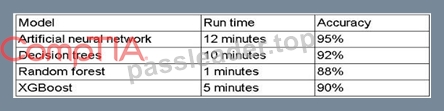
Which of the following models should the data scientist recommend for deployment?
- A. XGBoost
- B. Decision trees
- C. Random forest
- D. Artificial neural network
Answer: A
Explanation:
# In real-time systems, low latency (short run time) is critical. While the Artificial Neural Network provides the highest accuracy, its 12-minute runtime makes it unsuitable for real-time inference. Random forest is the fastest but offers the lowest accuracy.
XGBoost provides an excellent balance between runtime (5 minutes) and accuracy (90%). It's well-optimized for performance and scalability, and thus is a strong candidate for real-time classification when balancing both efficiency and predictive quality.
Why the other options are less ideal:
* B: Random forest is faster but significantly less accurate.
* C: Decision trees have longer run time than XGBoost with only a 2% accuracy improvement.
* D: Artificial neural network has the highest accuracy but is too slow for real-time applications.
Official References:
* CompTIA DataX (DY0-001) Official Study Guide - Section 4.3:"In real-time applications, model selection involves a trade-off between accuracy and inference speed. XGBoost offers competitive accuracy with efficient runtime."
* Machine Learning Systems Design Guide, Chapter 7:"XGBoost is well-suited for real-time systems due to its balance of model complexity and fast prediction times."
-
NEW QUESTION # 44
A data scientist is developing a model to predict the outcome of a vote for a national mascot. The choice is between tigers and lions. The full data set represents feedback from individuals representing 17 professions and 12 different locations. The following rank aggregation represents 80% of the data set: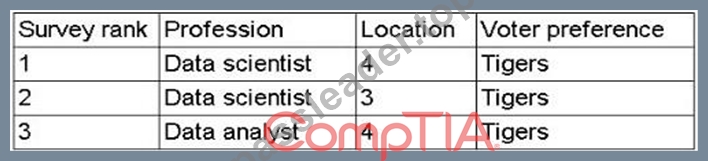
(Screenshot shows survey rankings for just two professions and a few locations, all voting for "Tigers") Which of the following is the most likely concern about the model's ability to predict the outcome of the vote?
- A. Interpolated data
- B. Out-of-sample data
- C. In-sample data
- D. Extrapolated data
Answer: D
Explanation:
# Extrapolated data refers to making predictions about data points that fall outside the observed range or distribution. Since the sample data (80%) is heavily skewed toward a small subset of professions and locations, predicting results for the remaining, unrepresented professions and regions involves extrapolation.
Why the other options are incorrect:
* A: Interpolation occurs within the bounds of observed data - not the issue here.
* C: In-sample data refers to training data, which is overrepresented in this case.
* D: Out-of-sample data is a concern in generalization but extrapolation is more specific here.
Official References:
* CompTIA DataX (DY0-001) Study Guide - Section 3.2:"Extrapolation introduces risk when models are used outside the range of data they were trained on, especially if certain subgroups are underrepresented."
-
NEW QUESTION # 45
Which of the following modeling tools is appropriate for solving a scheduling problem?
- A. One-armed bandit
- B. Constrained optimization
- C. Gradient descent
- D. Decision tree
Answer: B
Explanation:
Scheduling problems typically involve the assignment of limited resources (e.g., time, personnel, machines) over time to tasks, often under constraints. These problems are inherently mathematical and are typically solved using:
# Constrained Optimization - which is a mathematical technique for optimizing an objective function subject to one or more constraints. This tool is widely used for operations research problems such as scheduling, resource allocation, logistics, and supply chain optimization.
Why the other options are incorrect:
* A. One-armed bandit: Refers to a class of algorithms used for balancing exploration and exploitation, not scheduling.
* C. Decision tree: Used for classification and regression, not for constraint-based scheduling.
* D. Gradient descent: An optimization method for training models (typically ML), but not specifically suitable for complex constraint-based scheduling.
Official References:
* CompTIA DataX (DY0-001) Official Study Guide - Section 3.4 (Modeling Tools):"Scheduling and allocation problems are best addressed using constrained optimization techniques which allow incorporation of resource limits and goal functions."
* Data Science and Operations Research Foundations, Chapter 7:"Constraint-based optimization is the primary mathematical strategy used in scheduling problems to meet deadlines, minimize cost, or maximize throughput."
-
NEW QUESTION # 46
A data scientist is clustering a data set but does not want to specify the number of clusters present. Which of the following algorithms should the data scientist use?
- A. k-nearest neighbors
- B. k-means
- C. Logistic regression
- D. DBSCAN
Answer: D
Explanation:
# DBSCAN (Density-Based Spatial Clustering of Applications with Noise) is a density-based clustering algorithm that does not require specifying the number of clusters in advance. It identifies clusters of arbitrary shape and separates noise/outliers based on density thresholds.
Why other options are incorrect:
* B: k-NN is a supervised classification algorithm, not used for clustering.
* C: k-means requires predefining the number of clusters (k).
* D: Logistic regression is a classification model, not for clustering.
Official References:
* CompTIA DataX (DY0-001) Study Guide - Section 4.2:"DBSCAN detects clusters based on data density without the need for a predefined k value and handles outliers effectively."
-
NEW QUESTION # 47
A data analyst wants to save a newly analyzed data set to a local storage option. The data set must meet the following requirements:
* Be minimal in size
* Have the ability to be ingested quickly
* Have the associated schema, including data types, stored with it
Which of the following file types is the best to use?
- A. Parquet
- B. JSON
- C. XML
- D. CSV
Answer: A
Explanation:
Given the requirements:
* Minimized file size
* Fast ingestion
* Schema preservation (including data types)
The most appropriate format is:
# Parquet - It is a columnar storage file format developed for efficient data processing. Parquet files are compressed, support schema embedding, and enable fast columnar reads, making them ideal for analytical workloads and big data environments.
Why the other options are incorrect:
* A. JSON: Text-heavy and lacks native support for data types/schema.
* C. XML: Verbose and has poor performance in storage and ingestion speed.
* D. CSV: Flat structure, doesn't store data types or schema, and can be large in size.
Official References:
* CompTIA DataX (DY0-001) Official Study Guide - Section 6.2 (Data Storage Formats):"Parquet is a preferred format for data analysis as it provides efficient compression and encoding with embedded schema information, making it ideal for minimal storage and fast ingestion."
* Apache Parquet Documentation:"Parquet is designed for efficient data storage and retrieval. It includes schema support and works best for analytics use cases." Parquet is a columnar storage format that automatically includes schema (data types), uses efficient compression to minimize file size, and enables very fast reads for analytic workloads.
NEW QUESTION # 48
......
Verified DY0-001 dumps Q&As - 100% Pass from PassLeader: https://www.passleader.top/CompTIA/DY0-001-exam-braindumps.html
Pass DY0-001 Exam in First Attempt Guaranteed 2025 Dumps: https://drive.google.com/open?id=1KwK36evQ6m5CGm9b28FiDivuJuduIH32