

[2025] Easy To Download CTAL_TM_001 Actual Exam Dumps Resources
Uplift Your CTAL_TM_001 Exam Marks With The Help of CTAL_TM_001 Dumps
CTAL-TM Certification Path
6 months of experience in Software development/software testing. Successful completion of the ISTQB Certified Tester Foundation level and a minimum of three years testing experience is recommended. The Intermediate Certificate may also be helpful but is not required.
NEW QUESTION # 105
Which of the following is an advantage of specifying test conditions at a detailed level? [1]
- A. Saves time
- B. Can be used to identify test coverage gaps
- C. Improves maintainability and reduces ownership costs for the testware
- D. Can be used to leverage use cases for acceptance testing
Answer: B
Explanation:
The correct answer is A. Can be used to identify test coverage gaps. This is because test conditions are the items or events of a component or system that will be verified by one or more test cases. Specifying test conditions at a detailed level can help to identify test coverage gaps, which are the areas or aspects of the component or system that are not covered by the test conditions or test cases. By identifying test coverage gaps, the test team can ensure that the testing is complete and consistent with the test objectives and scope. Test Conditions - ISTQB not-for-profit association References: Certified Tester Advanced Level Test Manager (CTAL-TM) - ISTQB not-for-profit association, ISTQB Test Manager Certification - ISTQB Exams Worldwide - ISTQB Official Registration, Test Conditions - ISTQB not-for-profit association
NEW QUESTION # 106
You are working In an environment that is continually pushing process improvements down to the lest team You are skeptical that any of these have actually accomplished any improvement In fact you know that some of the changes have actually impaired progress Given this information what step of the IDEAL model is missing?
- A. Diagnosing
- B. Learning
- C. Acting
- D. Establishing
Answer: B
Explanation:
* Understanding the IDEAL Model:
* The IDEAL model (Initiating, Diagnosing, Establishing, Acting, Learning) is a framework for process improvement.
* In this case, theLearningphase is missing, which involves evaluating the outcomes of implemented changes to identify what worked and what did not.
* Evaluation of Options:
* A(Diagnosing) andB(Establishing) refer to earlier stages of the model.
* C(Acting) relates to implementing changes but does not address the lack of retrospective evaluation.
* Dis correct as the problem lies in not assessing the success of past improvements.
References and Syllabus Alignment:
* The IDEAL model is covered under "Improving the Testing Process" (TM-1.5.4) in the ISTQB syllabus
NEW QUESTION # 107
You have recently implemented a new defect management process which now includes a defect triage committee whose job is to review all new defects. The process is shown in the following diagram: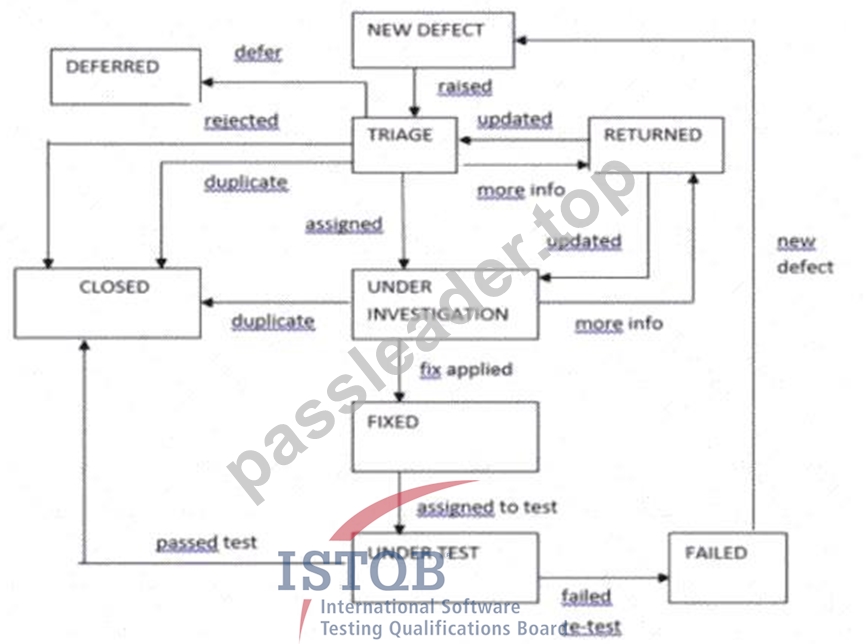
b. The total number of defects rejected as not a problem following investigation by the product author c. The number of defects returned to the defect author, expressed as a percentage of all defects raised d. The total number of defects that failed re-test more than once e. The total number of defects closed by the defect triage committee SELECT ONE OPTION
- A. b and d.
- B. c and d.
- C. a and b.
- D. a and e.
Answer: D
NEW QUESTION # 108
Considerable attention will be given in this project to defining exit criteria and on reporting back on their status. Which combination of TWO exit criteria from the list would be best to use? 1 credit
I. Total number of defects found
II. Percentage of test cases executed
III. Total test effort planned versus total actual test effort spent
IV. Defect trend (number of defects found per test run over time
- A. (ii) and (iv)
- B. (i) and (ii)
- C. (ii) and (iii)
- D. (i) and (iv)
Answer: A
Explanation:
Topic 2, Scenario 2 "Reviews"
A software development organization wants to introduce some specific improvements to its test process. Currently, most of their testing resources are focussedon system testing. They are developing embedded software, and do not have a simulation environment to enable them toexecute software modules on the development host. They have been advised that introducing inspections and reviews could be the most appropriate step forward.
NEW QUESTION # 109
Which four combinations of stages and activities correctly characterise the lifecycle of a tool?
Stages:
* Evolution
* Retirement
* Support and maintenance
* Acquisition
Activities:
a) Data must be preserved and/or archived
b) Vendor decisions can require changes to the tool
c) Decisions are made about where work products will be stored
d) Decisions on backup and restoration of artefacts are required
- A. 1a, 2d, 3b, 4c
- B. 1b, 2d, 3d, 4a
- C. 1b, 2a, 3d, 4c
- D. 1d, 2a, 3c, 4d
Answer: C
Explanation:
* Evolution: Vendor decisions can affect tool evolution # 1b
* Retirement: Involves archiving data # 2a
* Support & Maintenance: Backup/restoration plans are crucial # 3d
* Acquisition: Requires storing decisions for traceability # 4c
Reference:ISTQB-CTFL_Syllabus_2018_V3.1, section 6.1 and 6.2 on tool lifecycle and selection
NEW QUESTION # 110
Given is the following defect removal chart reported at the end of system testing - showing total defects detected and closed defects (fixed and successfully retested). A number of open defects are classified as critical. All tests have been executed.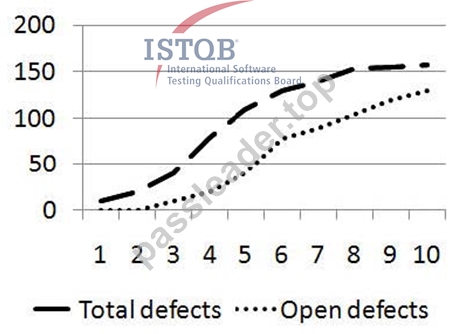
Based on the chart above, what is the most appropriate next test phase? 1 credit
- A. Another system test cycle to verify defect resolution
- B. Requirements testing as part of testing regulatory compliance
- C. Acceptance testing to verify operational requirements
- D. Acceptance testing to verify the business process
Answer: A
NEW QUESTION # 111
When Is the metric for the percentage of requirements coverage defined?
- A. Test planning
- B. Test monitoring
- C. Test execution
- D. Test completion
Answer: A
Explanation:
Context Analysis:
Requirements coverage must be defined during test planning to ensure tests align with all requirements from the start of the project.
Evaluation of Options:
A . Test planning:
Correct. Coverage goals are established during planning to define test objectives and scope.
B . Test monitoring:
Incorrect. Monitoring tracks progress but doesn't define coverage.
C . Test execution:
Incorrect. Execution measures coverage but doesn't define it.
D . Test completion:
Incorrect. Completion reviews coverage metrics but doesn't define them.
Syllabus Alignment:
Test planning (TM-1.1.1) includes defining coverage goals and ensuring alignment with requirements.
Reference:
ISTQB Advanced Level Test Management Syllabus (TM-1.1.1)
NEW QUESTION # 112
Since the system is in the medical domain and therefore in the safety critical area, testing needs to be rigorous and evidence is required that the system has been adequately tested. Identify THREE measures that would typically be part of the test approach in this domain and which are not always applicable in other domains! 1 credit
- A. Failure Mode and Effect Analysis (FMEA) sessions
- B. Reviews
- C. Traceability to requirements
- D. High level of documentation
- E. Non-functional testing
- F. Test design techniques
- G. Master test planning
Answer: A,C,D
Explanation:
Explanation/Reference:
Explanation:
NEW QUESTION # 113
At what testing level do the test management activities Include coordinating with end users7
- A. System testing
- B. Component Integration testing
- C. Acceptance testing
- D. Component testing
Answer: C
Explanation:
* End User Involvement in Testing Levels:
* Acceptance testing involves validating the product with the end users to ensure it meets their needs and requirements.
* It typically requires close coordination with end users for User Acceptance Testing (UAT).
* Evaluation of Options:
* A (Component testing)andB (Component Integration testing)do not involve end users, as these are technical-level testing activities.
* C (System testing)focuses on the integrated system but does not require end-user participation.
* Dis correct because acceptance testing involves direct collaboration with end users.
References and Syllabus Alignment:
* Covered under "Test Levels and Objectives" in the ISTQB syllabus (TM-1.2.5).
NEW QUESTION # 114
Which of the following software characteristics are possibly revealed through the application of a open source static analysis tool? [1]
- A. Memory leaks
- B. Timing dependencies
- C. Coding standard violations
- D. Concurrency thresholds
Answer: C
Explanation:
A static analysis tool is a software tool that analyzes the source code of a program without executing it. It can detect various software characteristics, such as syntax errors, potential bugs, security vulnerabilities, code quality, and coding standard violations. Coding standard violations are deviations from the agreed or recommended rules and conventions for writing source code, such as naming, indentation, formatting, commenting, and complexity. A static analysis tool can check the source code against a predefined or customized coding standard and report any violations. Coding standard violations can affect the readability, maintainability, and portability of the code, and can also introduce defects or inconsistencies. List of tools for static code analysisTop 5 Open Source Source and Free Static Code Analysis Tools in 2020 Reference:
List of tools for static code analysis - Wikipedia
Top 5 Open Source Source and Free Static Code Analysis Tools in 2020 - GeeksforGeeks
NEW QUESTION # 115
Which of the following statements is true regarding documentation standards? [2]
- A. Documentation standards are determined by the Project Manager.
- B. Documentation standards are a lower priority than testing standards.
- C. Agile projects consistently use level test plans and documentation standards.
- D. Documentation standards can vary depending on the test level.
Answer: D
Explanation:
Documentation standards are not uniform across all test levels; they can differ based on the specific requirements of each level. For instance, unit testing may have different documentation needs compared to system testing. The ISTQB documentation standards recognize this variability and allow for flexibility to suit the context of the test level. This ensures that the documentation is appropriate for the objectives and constraints of each test level, providing clarity and efficiency in the testing process.
References: The ISTQB Advanced Level Test Manager syllabus and the ISTQB Glossary provide detailed information on documentation standards and their application across different test levels. These resources are essential for understanding the principles and practices of effective test documentation in various testing scenarios.
NEW QUESTION # 116
You have been asked to make a recommendation on deployment readiness on the software your team has been testing. You have the following metrics: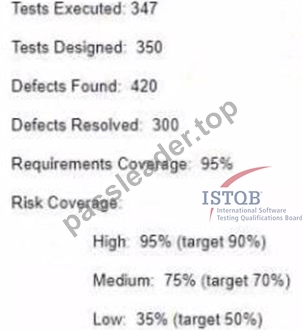
Given this information what is a critical metric you are missing?
- A. Planned vs actual cost of testing
- B. Residual risk
- C. Number of defects outstanding
- D. Number of tests passed
Answer: B
Explanation:
Context Analysis:
Deployment readiness depends on understanding the risk of releasing the software. The metrics provided include execution, design, defect counts, and coverage but do not quantify residual risk, which reflects remaining risks post-testing.
Evaluation of Options:
A . Number of tests passed:
Incorrect. While important, it doesn't directly provide insight into the remaining risk.
B . Number of defects outstanding:
Incorrect. Though critical, it's only one aspect of assessing readiness and doesn't provide the full picture of residual risk.
C . Residual risk:
Correct. Residual risk quantifies untested areas and unresolved issues, vital for decision-making.
D . Planned vs actual cost of testing:
Incorrect. While useful for process evaluation, it's not directly tied to deployment readiness.
Syllabus Alignment:
The syllabus emphasizes risk-based approaches, highlighting residual risk as a critical deployment readiness metric (TM-1.3.4).
Reference:
ISTQB Advanced Level Test Management Syllabus (TM-1.3.4)
NEW QUESTION # 117
Refer to SCENARIO 1
Week 4 of test execution has been completed and the following test report has been produced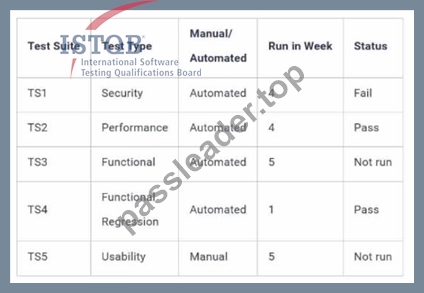
Review this report against the organisational Test Strategy, what is the status of the Test Strategy objectives? SELECT ONE OPTION
- A. Test strategy objective 1. 2 and 3 have been met
- B. Test strategy objective 1 and 2 have been met. Test strategy objective 3 has NOT been met.
- C. Test strategy objective 1 and 3 have been met. Test strategy objective 2 has NOT been met.
- D. Test strategy objective 2 and 3 have been met. Test strategy objective 1 has NOT been met.
Answer: C
NEW QUESTION # 118
Which of the following statements is true regarding documentation standards?
- A. Documentation standards are determined by the Project Manager.
- B. Documentation standards are a lower priority than testing standards.
- C. Agile projects consistently use level test plans and documentation standards.
- D. Documentation standards can vary depending on the test level.
Answer: D
Explanation:
Documentation standards are not uniform across all test levels; they can differ based on the specific requirements of each level. For instance, unit testing may have different documentation needs compared to system testing. The ISTQB documentation standards recognize this variability and allow for flexibility to suit the context of the test level. This ensures that the documentation is appropriate for the objectives and constraints of each test level, providing clarity and efficiency in the testing process.
References: The ISTQB Advanced Level Test Manager syllabus and the ISTQB Glossary provide detailed information on documentation standards and their application across different test levels. These resources are essential for understanding the principles and practices of effective test documentation in various testing scenarios.
NEW QUESTION # 119
You are working on a project where the business part of the organization works traditionally with defined requirements, but the development team follows an Agile model Neither team plans to change their approach What is the proper name for this type of project approach''
- A. Hybrid as a transition to Agile
- B. Hybrid as fit for purpose
- C. Agile
- D. Sequential
Answer: B
Explanation:
Context Analysis:
The project described has teams using different methodologies (traditional vs. Agile) tailored to their needs.
The "fit for purpose" hybrid approach is explicitly designed to combine methodologies based on team and project requirements.
Evaluation of Options:
A . Sequential:
Incorrect. A sequential approach suggests a traditional waterfall-like model, not a hybrid.
B . Hybrid as a transition to Agile:
Incorrect. This term implies the entire project is transitioning to Agile, which is not the case here.
C . Agile:
Incorrect. Only the development team is Agile; the business team uses a traditional approach.
D . Hybrid as fit for purpose:
Correct. Combines the most effective aspects of both traditional and Agile methodologies to suit the project context.
Syllabus Alignment:
ISTQB defines hybrid models as combinations of methodologies tailored to specific project needs (TM-1.2.4).
Reference:
ISTQB Advanced Level Test Management Syllabus (TM-1.2.4)
NEW QUESTION # 120
Continuing with the Scenario described in the previous question, which of the following topics would you need to address in detail in the master test plan? 3 credits
- A. A list of boundary values for "advance amount"
- B. An approach to regression testing
- C. A description of dependencies between test cases
- D. A logical collection of test cases
Answer: B
Explanation:
Explanation/Reference:
Explanation:
NEW QUESTION # 121
When scheduling performance testing, which of the following approaches would be most advisable? [1]
- A. Requiring all performance tests to pass before starting functional testing
- B. Starting the performance testing during unit and integration testing
- C. Deferring the start of performance testing until all functional defects have been resolved
- D. Leveraging end users to do unit-level performance testing and automated tools for system-level performance testing
Answer: B
Explanation:
Performance testing is the process of determining the speed, responsiveness, and stability of a system under a given workload1. Performance testing should be started as early as possible in the software development lifecycle, preferably during unit and integration testing, to identify and resolve performance issues before they become costly or risky2. Starting performance testing early can also help to validate the performance requirements, design, and architecture of the system, as well as to optimize the performance testing strategy and scope3. Therefore, option A is the correct answer. Option B is incorrect because deferring the start of performance testing until all functional defects have been resolved can delay the detection and resolution of performance issues, increase the cost and effort of performance testing, and reduce the confidence and quality of the system4. Option C is incorrect because leveraging end users to do unit-level performance testing and automated tools for system-level performance testing can introduce inconsistency, bias, and inefficiency in the performance testing process, as well as compromise the reliability and validity of the performance test results. Option D is incorrect because requiring all performance tests to pass before starting functional testing can create unrealistic or unnecessary expectations, as well as hinder the progress and feedback of the functional testing activities. References: 1: ISTQB Glossary, Performance Testing 2: ISTQB Certified Tester - Performance Testing (CT-PT)3 3: ISTQB Performance Testing - TesterYou4 4: Performance Testing - ISTQB not-for-profit association : ISTQB - PERFORMANCE TESTING : Performance Testing - ISTQB not-for-profit association
NEW QUESTION # 122
You have been given responsibility for the non-functional testing of a safety-critical monitoring & diagnostics package in the medical area. Which of the following would you least expect to see addressed in the test plan? 1 credit
- A. Portability
- B. Reliability
- C. Availability
- D. Safety
Answer: A
NEW QUESTION # 123
You have initiated a test process improvement project for your organisation using the STEP model. You have agreed the objectives, goals, scope and coverage of the process improvements with the stakeholders and defined the success criteria that will be applied to the project. Success criteria make risk reduction the most important target benefit for the process improvements, but overall return on investment is also an important consideration. You have just received the initial test assessment report.
Which ONE of the following would be the next step? SELECT ONE OPTION
- A. Build a test process improvement plan that achieves benefits identified by individual stakeholders.
- B. Prioritize the proposed improvements by predicted risk reduction and build a test process improvement plan that aligns with organisational strategy
- C. Build a test process improvement plan that aligns with organisational strategy and maximizes return on investment.
- D. Prioritize the proposed improvements by return on investment and build a test process improvement plan that does not reduce overall risk management overheads.
Answer: D
NEW QUESTION # 124
Which three of the following would be considered a good mix of technical and interpersonal skills (hard and soft), for a test team leader?
a. Ability to compliment a developer.
b. Presenting information regarding a test project progress to stakeholders c. Using a configuration management tool.
d. Ability to read a development coding language
e. Assessing a failure and documenting it correctly.
- A. a. b and e.
- B. c. d and e.
- C. a. c and d.
- D. b, d and e.
Answer: D
NEW QUESTION # 125
Which of the following software characteristics are possibly revealed through the application of a open source static analysis tool?
- A. Memory leaks
- B. Timing dependencies
- C. Coding standard violations
- D. Concurrency thresholds
Answer: C
Explanation:
A static analysis tool is a software tool that analyzes the source code of a program without executing it. It can detect various software characteristics, such as syntax errors, potential bugs, security vulnerabilities, code quality, and coding standard violations. Coding standard violations are deviations from the agreed or recommended rules and conventions for writing source code, such as naming, indentation, formatting, commenting, and complexity. A static analysis tool can check the source code against a predefined or customized coding standard and report any violations. Coding standard violations can affect the readability, maintainability, and portability of the code, and can also introduce defects or inconsistencies. List of tools for static code analysisTop 5 Open Source Source and Free Static Code Analysis Tools in 2020 References:
* List of tools for static code analysis - Wikipedia
* Top 5 Open Source Source and Free Static Code Analysis Tools in 2020 - GeeksforGeeks
NEW QUESTION # 126
What is a "depth-first" risk-based testing technique? [1]
- A. All risk items are tested at least once
- B. Non-functional test cases are executed first
- C. Highest risk test cases are executed first
- D. Lowest risk test cases are executed first
Answer: C
Explanation:
A depth-first risk-based testing technique is a method of prioritizing and executing test cases based on the risk level of the features or functions to be tested. In this technique, the test cases with the highest risk are executed first, followed by the test cases with lower risks. This ensures that the most critical and likely areas of failure are tested thoroughly and early in the testing process. Risk Based Testing: Approach, Matrix, Process & Examples - Guru99 Reference: Certified Tester Advanced Level Test Manager (CTAL-TM) - ISTQB not-for-profit association, ISTQB Test Manager Certification - ISTQB Exams Worldwide - ISTQB Official Registration, [Analytical Test Strategy: A Comprehensive Guide - LambdaTest]
NEW QUESTION # 127
What is a "depth-first" risk-based testing technique?
- A. All risk items are tested at least once
- B. Non-functional test cases are executed first
- C. Highest risk test cases are executed first
- D. Lowest risk test cases are executed first
Answer: C
Explanation:
A depth-first risk-based testing technique is a method of prioritizing and executing test cases based on the risk level of the features or functions to be tested. In this technique, the test cases with the highest risk are executed first, followed by the test cases with lower risks. This ensures that the most critical and likely areas of failure are tested thoroughly and early in the testing process. Risk Based Testing: Approach, Matrix, Process & Examples - Guru99 References: Certified Tester Advanced Level Test Manager (CTAL-TM) - ISTQB not-for-profit association, ISTQB Test Manager Certification - ISTQB Exams Worldwide - ISTQB Official Registration, [Analytical Test Strategy: A Comprehensive Guide - LambdaTest]
NEW QUESTION # 128
The test team is using a distributed model for testing.
What is the primary factor you should consider with this model? [1]
- A. Co-location of test team
- B. Alignment of methodologies
- C. Planned vs. actual hours
- D. Provision of growth opportunities for the individual testers
Answer: B
Explanation:
A distributed model for testing is a testing model that involves testers working in different locations, time zones, or organizations, such as onshore, offshore, or nearshore1. The primary factor that you should consider with this model is the alignment of methodologies, which means that the testers follow the same or compatible testing processes, standards, tools, and techniques, regardless of their location, time zone, or organization2. The alignment of methodologies can help to ensure the consistency, quality, and efficiency of the testing activities, as well as to facilitate the communication, coordination, and collaboration among the testers3. Therefore, option A is the correct answer. Option B is incorrect because co-location of test team is not a factor that you should consider with a distributed model for testing, but rather a factor that is contrary to a distributed model for testing. Co-location of test team means that the testers work in the same physical location, which can have some advantages, such as easier communication, faster feedback, and stronger team spirit, but also some disadvantages, such as higher costs, limited resources, and less diversity4. Option C is incorrect because provision of growth opportunities for the individual testers is not a factor that you should consider with a distributed model for testing, but rather a factor that is relevant to any testing model. Provision of growth opportunities for the individual testers means that the testers are given the chance to learn new skills, gain new experiences, and advance their careers, which can have some benefits, such as increased motivation, productivity, and retention of the testers. Option D is incorrect because planned vs. actual hours is not a factor that you should consider with a distributed model for testing, but rather a factor that is relevant to any testing model. Planned vs. actual hours is a testing metric that compares the estimated and the actual effort spent on the testing activities, which can help to measure the accuracy of the test estimation, the efficiency of the test execution, and the variance of the test schedule. Reference: 1: ISTQB Glossary, Distributed Testing 2: Distributed Testing - Software Testing Fundamentals 3: ISTQB Advanced Level Test Manager Syllabus, Section 3.2.1 4: Co-located vs. Distributed Teams: What's the Difference? : How to Provide Growth Opportunities for Employees : Software Testing Metrics: What is, Types & Example
NEW QUESTION # 129
......
Use ISTQB CTAL_TM_001 Dumps To Succeed Instantly in CTAL_TM_001 Exam: https://www.passleader.top/ISTQB/CTAL_TM_001-exam-braindumps.html
Ultimate Guide to CTAL_TM_001 Dumps - Enhance Your Future Career Now: https://drive.google.com/open?id=1D4VKpWdwD2u4d3IqKC-rbA1KPrkvw-nh